Oceans give a warning of the planet’s ecology in danger
 These symptoms, moreover, could be the harbinger of wider disruptions in the interlocking web of biological and chemical interactions that scientists now call the Earth system….
Oceans in distress, mass extinctions. The Age, Marlowe Hood , June 21, 2011 Pollution and global warming are pushing the world’s oceans to the brink of a mass extinction of marine life unseen for tens of millions of years, a consortium of scientists warn.
Dying coral reefs, biodiversity ravaged by invasive species, expanding open-water “dead zones,” toxic algae blooms, the massive depletion of big fish stocks — all are accellerating, they said on Monday in a report compiled during an April meeting in Oxford of 27 of the world’s top ocean experts. Continue reading
Urgency to protect Fort Calhoun Nuclear Plant from rising waters
Nebraska Nuke Plant Owners Tell Management To Buy Anything They Need To Ward Off Rising Floodwaters, Business Insider, Ricky Kreitner| Jun. 20, 2011 But just to be sure, they are allowing the plant’s management to skip the normal procurement process and buy anything it might need to protect Fort Calhoun from the still-rising waters of the flooded Missouri River.
World Nuclear News today reports that the Omaha Public Power District, which owns and operates the Fort Calhoun plant, issued that directive June 16. In a statement, the public utility said that high volumes of water released from up-river by the Army Corps of Engineers “continue to pose a threat to the electric system and generation facilities along the river.”
Yesterday, a second Nebraska nuclear plant facing rising floodwaters was put under a “notification of unusual event,” (as the Fort Calhoun plant was on June 6th). The second plant, the Cooper Nuclear Station, is located south of Omaha and owned by the Nebraska Public Power District (NPPD). A “notification of unusual event” is the least urgent of four classifications that can be declared in a nuclear emergency.
Rain is forecast for the Greater Omaha area for the next three days……http://www.businessinsider.com/nebraska-nuke-plant-owners-tell-management-to-buy-anything-they-need-to-ward-off-rising-floodwaters-2011-6
Flood crisis at Nebraska nuclear plant
12 Significant Events That the Mockingbird Media is Currently Ignoring, Benzinga, By Truth is Treason, June 20, 2011 ”…The crisis at the Fort Calhoun nuclear facility in Nebraska has received almost no attention in the national mainstream media. Back on June 7th, there was a fire at Fort Calhoun. The official story is that the fire was in an electrical switchgear room at the plant. The facility lost power to a pump that cools the spent fuel pool for approximately 90 minutes. According to the Omaha Public Power District, the fire was quickly extinguished and no radioactive material was released. …….
But the crisis at Fort Calhoun is not over. Right now, the nuclear facility at Fort Calhoun is essentially an island. It is surrounded by rising flood waters from the Missouri River. (photo from Washington Post 20 June 11)
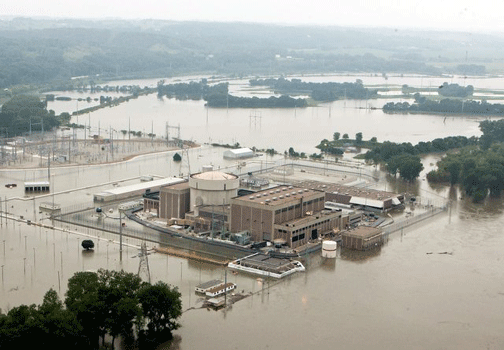
Officials claim that there is no danger and that they are prepared for the river to rise another ten feet.The Cooper Nuclear Station in Brownville, Nebraska is also being threatened by rising flood waters. A “Notification of Unusual Event” was declared at Cooper Nuclear Station this morning at 4:02. This notification was issued because the Missouri River’s water level reached 42.5 feet…….
Right now the facility is operating normally and officials don’t expect a crisis.But considering what has been going on at Fukushima, it would be nice if we could have gotten a lot more coverage of these events by the mainstream media… http://www.benzinga.com/11/06/1183421/12-significant-events-that-the-mockingbird-media-is-currently-ignoring#ixzz1PrRYnCv0
How USA’s Nuclear Regulatory Commission repeatedly weakens safety rules
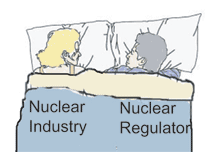 the AP investigation found that with billions of dollars and 19 percent of America’s electricity supply at stake, a cozy relationship prevails between the industry and its regulator, the NRC.
All the while the NRC keeps extending licenses of dozens of reactors….
Fukushima USA? Dangerous radioactive leaks and cracked foundations go unpunished at American nuclear power plants By DAILY MAIL REPORTER 20 June 11 Safety has taken a back seat to cost-cutting at most of the nation’s nuclear power plants, sparking fears that America could be facing its own Fukushima disaster.
An investigation by the Associated Press has revealed federal regulators are repeatedly weakening – or simply failing to impose – strict rules. The constant danger of aging reactors operating without the highest standards has resulted in rising fears the NRC is significantly undermining safety. Continue reading
IAEA Fukushima Report highlights the unsafety and diseconomics of nuclear power
To sum up, when you build a reactor you are committing to controlling the nuclear fury at its heart for half a century or more, and controlling the waste produced for many thousands of years (using methods no-one has yet developed)……
But the real lesson is that it is impossible to cover all eventualities. That means nuclear power is not safe or, given the colossal clean-up costs, cheap. Regretfully, I believe it is an illusory answer to the problem of rising greenhouse gas emissions and climate change.
 Fukushima report shows nuclear power can never be safe and cheap, by Damian Carrington 20 June 2011 guardian.co.uk The first “independent” review of the safety failures during Japan’s nuclear disaster reveals some chillingly obvious “lessons” to be learned
..The first “independent” review of the Fukushima nuclear disaster was published today and it does not make reassuring reading.
Japan is perhaps the most technologically advanced nation on Earth and yet, time after time, the report finds missing measures that I would have expected to already be in place. It highlights the fundamental inability for anyone to anticipate all future events and so deeply undermines the claims of the nuclear industry and its supporters that this time, with the new generation of reactors, things will be different.
I used quote marks on the word “independent” because the report comes from the International Atomic Energy Association (pdf) (IAEA) which, while independent of Japan, is far from independent from the nuclear industry it was founded to promote. But this conflict of interest only makes the findings of the IEAE’s experts more startling. Continue reading
USA nuclear regulators undermining public safety?
Are federal regulators undermining safety at nuclear reactors? America Blog, by Chris in Paris on 6/20/2011 Federal regulators have been working closely with the nuclear power industry to keep the nation’s aging reactors operating within safety standards by repeatedly weakening those standards, or simply failing to enforce them, an investigation by The Associated Press has found.
The result? Rising fears that these accommodations by the NRC are significantly undermining safety — and inching the reactors closer to an accident that could harm the public and jeopardize the future of nuclear power in the United States…
IAEA likely to rubber stamp Australian company’s plan for dumping radioactive waste in Malaysia
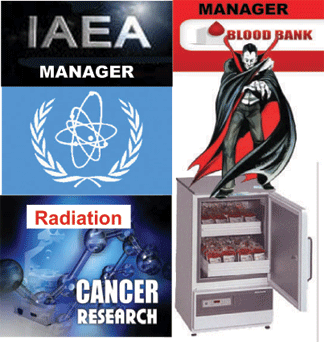 “How can we monitor daily? The risks of human error are too high,” she said, pointing out that the half-life of thorium was 14 billion years…..Fuziah promised that if the report from the panel, which includes members of the IAEA, was as she anticipated, she will continue to bring the issue to a higher level and exert pressure on authorities.
No confidence in Lynas safety review’, Free Malaysia Today Tashny Sukumaran, June 20, 2011, The IAEA report on the Lynas Corp is bound to be slanted and the human factor will not be taken into account, says Kuantan MP Fuziah Salleh. KUALA LUMPUR: Kuantan MP Fuziah Salleh is already second guessing the International Atomic Energy Agency’s (IAEA) report on the Lynas Corp’s rare earth refinery in Gebeng, Pahang.
She said she has no confidence in the independent panel’s safety review of the RM300 million Lynas Corp rare earth refinery . “I can imagine the outcome will contain acknowledgement of safety concerns, but also on how this refinery can be made safe,” said Fuziah. Continue reading
Giant cover for No 1 nuclear reactor to stop Fukushima radiation to atmosphere
 N-bldg cover to be built, unbuilt, rebuilt, The Yomiuri Shimbun, 21 June 11 IWAKI, Fukushima–-Work to assemble parts of a giant cover for the No. 1 nuclear reactor building at Tokyo Electric Power Co.’s Fukushima No. 1 nuclear power plant is proceeding at a fever pitch at Onahama Port in Iwaki, Fukushima Prefecture.
The giant cover is designed to prevent most radioactive substances from dispersing into the atmosphere from the No. 1 reactor, which was damaged by a hydrogen explosion on March 12.
It will enclose an area of 42 meters by 47 meters and will stand 54 meters high.
To limit workers’ exposure to radiation and shorten the construction period, 62 parts, including pillars, beams and polyester-sheeted panels, are being assembled at the port into a unified structure. After it is confirmed that the parts fit together properly, the cover will be disassembled and transported to the nuclear power plant by ship.
On-site assembly of the components is scheduled to start next Monday. TEPCO plans to complete the work in late September. Final construction of the cover will be carried out by two giant cranes, which will be remote-controlled.A traditional Japanese insertion-only joint method, which does not employ welding or bolts for joining materials, is being used to assemble the cover… http://www.yomiuri.co.jp/dy/national/T110620004790.htm
At last, Grand Canyon to be protected from uranium mining
The moratorium will “reverse a century-long history of damage to the Grand Canyon from uranium mining,”
OBAMA ADMINISTRATION TO BAN URANIUM MINING AT GRAND CANYON, FORBES, OSHA GRAY DAVIDSON Standing at the south rim of the Grand Canyon this morning, Secretary of the Interior Ken Salazar announced that the Obama administration will enact a 20-year ban on new uranium mining in the last remaining unprotected lands surrounding the place President Theodore Roosevelt called “the one great sight which every American should see.”
Mining companies had filed thousands of claims in recent years, but it is unlikely that any of the 3,500 mining claims in the area will receive federal permits when the 20-year ban goes into effect. In March, Arizona’s Department of Environmental Quality (ADEQ) issued permits to three uranium mines on the land – provoking an outcry by native peoples, hunters, hikers, tourism groups and environmental organizations. Continue reading
Radiation – the big safety hazard for nuclear reactors themselves
 Radiation bombards reactors, make them brittle, Google News By JEFF DONN, AP National Writer –20 June 11 No aging problem has been more vexing or dangerous in nuclear power plants than the tendency of reactors to grow brittle. This stubborn problem threatens the main radiation barrier at the plants: the garage-size steel vessels that cradle tons of radioactive fuel.
In certain emergencies, these vessels would flood with cooling water. If the vessel walls are too brittle, they could shatter and spew their radioactive contents into the environment. Continue reading
Unnecessary radiation – too many CT scans in USA hospitals
 Hospitals Nationwide Unnecessarily Perform Double CT Scans, -California Heath Line – June 20, 2011Hundreds of hospitals nationwide routinely perform two chest CT scans on a single patient, needlessly exposing them to double doses of radiation and driving up costs, according to a review of Medicare data, the New York Times reports (Bogdanich/Craven McGinty, New York Times, 6/17).
Unnecessary Testing Patients who receive a double CT scan undergo a contrast and a noncontrast CT scan in succession (Appleby/Rau, Kaiser Health News/Washington Post, 6/18). Although most radiologists say nearly all chest issues can be accurately diagnosed with only one scan, 2008 Medicare data show that some hospitals performed double scans on chest patients more than 80% of the time. According to the Times, a single CT chest scan exposes a patient to 350 times the radiation of a standard chest X-ray (New York Times, 6/17).
Specifically, Medicare data show that 76,781 chest patients, or 5.4%, received double CT scans in 2008. While most hospitals administered them sparingly—a median of 2% of Medicare patients received two scans—618 hospitals performed double scans on at least 10% of Medicare chest patients, and 94 of those hospitals performed double scans on at least 50% of Medicare chest patients (Kaiser Health News/Washington Post, 6/18).
Experts note that double scanning also is common for privately insured patients (New York Times, 6/17). Although the number of overall non-Medicare patients who receive double scans is unknown, HealthPartners, a not-for-profit Minnesota HMO, reports that 7% of its chest patients received double scans in 2010 (Kaiser Health News/Washington Post, 6/18)….http://www.californiahealthline.org/articles/2011/6/20/hospitals-nationwide-unnecessarily-perform-double-ct-scans.aspx
Low dose of radiation causes cataracts
 Eye lens is more vulnerable to radiation: new studies IBN LIVE PTI | Jun 20,2011 There are three main forms of cataract; nuclear, cortical, and posterior sub-capsular (PSC). Among these, PSC is the least common and is associated with exposure to radiation. Till recently, scientists believed that cataract was formed only after the lens received a typical radiation dose, called the threshold dose, of 2Gy for a single dose, and 5 Gy when the exposure occurred in a protracted way. Not any more. Recent studies appear to show that formation of radiation induced cataracts at much lower doses than the current standards. ICRP now considers that the threshold dose for cataract is 0.5Gy. The present ICRP recommendations must serve as a wake-up call for interventional cardiology and radiology professionals, Parthasarathy said. Cataract analysis of 8,607 Chernobyl clean-up workers 12 and 14 years after exposure indicated that posterior sub-capsular or cortical cataracts appeared in 25 per cent of the participants…http://ibnlive.in.com/generalnewsfeed/news/eye-lens-is-more-vulnerable-to-radiation-new-studies/731307.html
Japan experimenting with incineration of radioactive rubble
Environment Ministry to approve incineration of rubble contaminated with radiation, (Mainichi Japan) June 20, 2011 The Environment Ministry has decided to approve the proposed incineration of rubble contaminated with radiation from the tsunami-hit Fukushima nuclear power plant at existing incineration facilities equipped with exhaust gas filters and absorption devices, officials said.
It made the decision after discussing how to safely dispose of rubble contaminated with radiation from the crippled Fukushima No. 1 Nuclear Power Plant.
No law currently provides for ways to dispose of waste contaminated with radiation from a crippled nuclear power plant. After consultations between ministries and agencies concerned, the government decided to apply the Waste Disposal and Public Cleaning Law to the disposal of radioactive rubble.
The ministry had initially urged local governments not to move radioactive rubble out of temporary storage sites. However, it will explain its decision to local governments concerned and ask them to resume their disposal of contaminated rubble as early as the end of this month……….
The government will also try to form a consensus among Fukushima residents about its plan to build final disposal sites for radioactive waste in the prefecture….http://mdn.mainichi.jp/mdnnews/news/20110620p2a00m0na017000c.html
New uranium mining on Grand Canyon stopped for 20 years
20-year ban planned on new Grand Canyon uranium mining, LA Times 20 June 11By Neela Banerjee, The Obama administration announces the proposed ban for 1 million acres of land bordering the Grand Canyon, an area where uranium mining claims have spiked 2,000% in the last seven years.
Mining claims around the Grand Canyon are among the thousands filed by companies along the borders of numerous national parks and wilderness areas.Critics say an outmoded 1872 law is driving the increase in claims in such sensitive places. The law allows corporations to stake out rights to federal lands for mining without a competitive bid and to extract resources without paying royalties.
The ban would strengthen a moratorium on new mining claims and activity, which the administration placed on Grand Canyon border lands two years ago in response to the jump in uranium stakes.Interior Department officials said the agency initially would extend the current moratorium another six months, until December, in order to complete the steps necessary to establish the 20-year ban. Mines currently in operation would not be affected.
Environmentalists, some lawmakers and water utilities serving metropolitan areas in the southwest, including Los Angeles, said the decision would protect the critical Colorado River watershed from possible contamination from uranium mining and would prevent the Grand Canyon panorama from being gradually industrialized…….http://www.latimes.com/news/nationworld/nation/sc-dc-0621-grand-canyon-20110620,0,1196854.story
Nuclear emergency on Missouri
Federal Water Tap, June 20: Flood Effects, Nuclear Power, Dam Removal. CIRCLE OF BLUE, 20 JUNE 2011 Nuclear Emergency on the Missouri Because of snowmelt and record releases from dams managed by the Army Corps of Engineers, the Missouri River has surrounded two nuclear power plants in Nebraska, creating atomic islands on the floodplain. In addition to traditional safety measures, water-filled polyethylene berms are being used as a line of defense to keep the river from inundating the facilities.On Sunday morning, the Cooper plant, 70 miles south of Omaha, filed a “notification of unusual event” with the federal Nuclear Regulatory Commission. It is the lowest of four emergency classifications used by the NRC. The other plant, at Fort Calhoun, submitted such a notice two weeks ago. It has been shut down since April for refueling and won’t be restarted until the flood waters subside. The Omaha World-Herald has more details.
Nuclear Decommissioning
The Nuclear Regulatory Commission has proposed new regulations to guide the decommissioning process. The NRC is clarifying the language used in its statutes to make explicit that residual radioactivity in soil and groundwater should be accounted for in company records. These radioactivity surveys will be used to evaluate decommissioning costs. http://www.circleofblue.org/waternews/2011/federal-water-tap/federal-water-tap-june-20-flood-effects-nuclear-power-dam-removal/
1 This Month

of the week – Shut Down Drone Warfare!


Tell the Ukrainian Government to Drop Prosecution of Peace Activist Yurii Sheliazhenko

Petition to revoke the licensing of the Near Surface Nuclear Disposal Facility (NSDF) at Chalk River. https://www.ourcommons.ca/petitions/en/Petition/Details?Petition=e-7247
To see nuclear-related stories in greater depth and intensity – go to https://nuclearinformation.wordpress.com
-
Archives
- April 2026 (114)
- March 2026 (251)
- February 2026 (268)
- January 2026 (308)
- December 2025 (358)
- November 2025 (359)
- October 2025 (376)
- September 2025 (257)
- August 2025 (319)
- July 2025 (230)
- June 2025 (348)
- May 2025 (261)
-
Categories
- 1
- 1 NUCLEAR ISSUES
- business and costs
- climate change
- culture and arts
- ENERGY
- environment
- health
- history
- indigenous issues
- Legal
- marketing of nuclear
- media
- opposition to nuclear
- PERSONAL STORIES
- politics
- politics international
- Religion and ethics
- safety
- secrets,lies and civil liberties
- spinbuster
- technology
- Uranium
- wastes
- weapons and war
- Women
- 2 WORLD
- ACTION
- AFRICA
- Atrocities
- AUSTRALIA
- Christina's notes
- Christina's themes
- culture and arts
- Events
- Fuk 2022
- Fuk 2023
- Fukushima 2017
- Fukushima 2018
- fukushima 2019
- Fukushima 2020
- Fukushima 2021
- general
- global warming
- Humour (God we need it)
- Nuclear
- RARE EARTHS
- Reference
- resources – print
- Resources -audiovicual
- Weekly Newsletter
- World
- World Nuclear
- YouTube
-
RSS
Entries RSS
Comments RSS
 nuclear-news