Japan’s’:Nuclear Power Village a cosy closed community of industrialists and govt officials
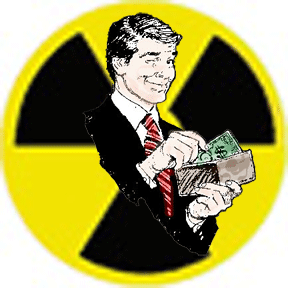 The nuclear power village is the nickname for a tight circle of government entities, utilities, manufacturers and others involved in the promotion of nuclear power who believe nuclear plants are safe and reject out of hand any opposing views….
But destroying the nuclear village is no easy task. The community involves heavy back-scratching and complex personnel relationships.
NUCLEAR CRISIS: HOW IT HAPPENED / ‘Nuclear power village’ a cozy, closed community, The Yomiuri Shimbun, 16 June 11 Three months have passed since the Great East Japan Earthquake triggered a nuclear crisis that shows little sign of ending anytime soon.
This is the sixth installment in a series that examines what caused the unprecedented crisis, which has dealt a fatal blow to the myth of the safety of nuclear power plants in this country.
“The ‘nuclear power village’–the promoters of atomic energy–was behind both the cause and expansion of the crisis at the Fukushima No. 1 plant,” said Tetsunari Iida, head of the nonprofit Institute for Sustainable Energy Policies.
The nuclear power village is the nickname for a tight circle of government entities, utilities, manufacturers and others involved in the promotion of nuclear power who believe nuclear plants are safe and reject out of hand any opposing views. Iida used the term “genshiryoku mura” (nuclear power village) in a magazine opinion piece in 1997, and it has now entered the vernacular. Mura means village, but also refers to a small, closed community.
The nuclear village has thrived under the government’s treatment of nuclear energy as “national policy run by the private sector.” The central government promotes nuclear power with subsidies and other support, and private utilities handle the building and operating of nuclear facilities. The nuclear-related portion of the national budget amounts to about 430 billion yen a year, and utilities invest 2 trillion yen every year in nuclear power. The nuclear village really started to grow after the 1973 oil crisis. Since then, the planning and construction of nuclear plants across the nation was promoted under the banner of “energy security.”
The parts of the science agency that had led nuclear power development were divided and merged into the Education, Culture, Sports, Science and Technology Ministry, the revamped Nuclear Safety Commission and other entities.
“The Science and Technology Agency was small and powerless, so it wasn’t very dependable,” a senior official of a heavy industries company said.
Integrating the nuclear industry’s safety regulators into the industry ministry was apparently carried out with the full approval of the nuclear power village.
Tatsuru Uchida, critic and professor emeritus at Kobe College, said, “Both NISA and the NSC are part of the system that promotes nuclear power, which is national policy, even though they call themselves regulators.”
“The state and politicians bear an extremely heavy responsibility for not fixing this unreasonable system that overestimated safety and underestimated risks,” Uchida added.
Former NSC Chairman Atsuyuki Suzuki, who worked as a regulator at the troubled prototype fast-breeder reactor Monju in Tsuruga, Fukui Prefecture, last year became head of the Japan Atomic Energy Agency, the operator of Monju.
Electric power firms have deepened relations with the bureaucracy by temporarily dispatching employees to government bodies and giving cushy jobs to retired bureaucrats in the so-called amakudari (descending from heaven) practice.
Since 2000, power companies have sent at least 100 employees to central government bodies for on-loan postings, according to the government. These government bodies include the NSC and other offices involved in safety at nuclear plants. TEPCO, which has sent 32 workers to the government, had de facto reserved seats at several posts, sources said.
…….
No comments yet.
1 This Month

of the week – Shut Down Drone Warfare!


Tell the Ukrainian Government to Drop Prosecution of Peace Activist Yurii Sheliazhenko

Petition to revoke the licensing of the Near Surface Nuclear Disposal Facility (NSDF) at Chalk River. https://www.ourcommons.ca/petitions/en/Petition/Details?Petition=e-7247
To see nuclear-related stories in greater depth and intensity – go to https://nuclearinformation.wordpress.com
-
Archives
- March 2026 (244)
- February 2026 (268)
- January 2026 (308)
- December 2025 (358)
- November 2025 (359)
- October 2025 (376)
- September 2025 (257)
- August 2025 (319)
- July 2025 (230)
- June 2025 (348)
- May 2025 (261)
- April 2025 (305)
-
Categories
- 1
- 1 NUCLEAR ISSUES
- business and costs
- climate change
- culture and arts
- ENERGY
- environment
- health
- history
- indigenous issues
- Legal
- marketing of nuclear
- media
- opposition to nuclear
- PERSONAL STORIES
- politics
- politics international
- Religion and ethics
- safety
- secrets,lies and civil liberties
- spinbuster
- technology
- Uranium
- wastes
- weapons and war
- Women
- 2 WORLD
- ACTION
- AFRICA
- Atrocities
- AUSTRALIA
- Christina's notes
- Christina's themes
- culture and arts
- Events
- Fuk 2022
- Fuk 2023
- Fukushima 2017
- Fukushima 2018
- fukushima 2019
- Fukushima 2020
- Fukushima 2021
- general
- global warming
- Humour (God we need it)
- Nuclear
- RARE EARTHS
- Reference
- resources – print
- Resources -audiovicual
- Weekly Newsletter
- World
- World Nuclear
- YouTube
-
RSS
Entries RSS
Comments RSS
 nuclear-news
Leave a comment