Dim outlook for real action on global warming
One Week on Earth” – Michael Tobias – Green Conversations – Forbes 13 June 11 The Netherlands: Ten Dutch Greenpeace lobbyists chain themselves to a train carrying nuclear waste to a reprocessing plant in France, while nations throughout the world debate the future of nuclear power, attempting to somehow reconcile greenhouse gas mitigation in a post-Fukushima minefield of unclear energy calculus. The status quo of coal/oil/natural gas/nuclear power slams nascent alternative energy enthusiasts (particularly in Russia) dimming hopes for anything like the carbon neutral renaissance so many green ethicists have urged at one carbon-indebted global conference after another. “One Week on Earth” – Michael Tobias – Green Conversations – Forbes
100 anti-nuclear rallies across Japan’s cities
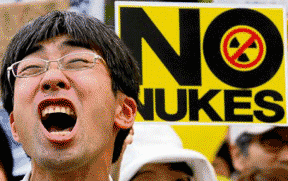 around 100 anti-nuclear events were staged nationwide, including in the western cities of Osaka and Hiroshima, which were devastated by a US atomic bomb in 1945. In the capital an estimated 6000 demonstrators, some carrying placards reading “We don’t want nuclear power plants”, marched by the head office of the Fukushima plant’s operator, Tokyo Electric Power Company (TEPCO), in a rally organised by the Japan Congress against Atomic and Nuclear Bombs..
Japan marks 3 months of pain News.com.au AAP * June 12, 2011 THOUSANDS of people rallied in Japan as the country marked three months since its horror quake and tsunami. Radiation continues to leak from the crippled Fukushima Daiichi nuclear power plant, 225 kilometres northeast of the capital, amid simmering public frustration over the government’s slow response to the triple catastrophe…. Continue reading
Lingering radioactive disaster for Japan’s ‘no go’nuclear zone
 The narrow strip of hilly coastal country between Fukushima City – a metropolis of 2 million – and the crippled Daiichi nuclear plant on Japan’s east coast, is a no-go zone occupied by an invisible enemy – potentially life-threatening radiation. It is in the ground, in the atmosphere and in the sewerage…..
‘Exploding clouds of radioactive steam and debris were swept by strong winds across a broad arch of countryside, including Iitate and Minamisoma. Mountain forests, streams, rice fields, school grounds and houses were contaminated
 A long wait for solace in a ravaged land, Sydney Morning Herald, Russell Skelton, June 11, 2011 Almost 100 days since the earthquake and tsunami devastated Japan, the nation struggles to give hope to its citizens Continue reading
In anti-nuclear Germany, Conservatives may partner with the Greens
 Environment Minister Norbert Roettgen said Monday the nuclear exit could end decades of ugly fighting in society. It may also render Mrs. Merkel a new coalition partner — the Greens.
 Will Merkel’s Nuclear Exit Lead to Coalition With the Greens? WSJ, June 7, 2011 Germany’s bold strategy for an exit from atomic power by 2022 was only announced by the cabinet of Chancellor Angela Merkel Monday. Yet it has already been attacked on multiple fronts, varying from the International Energy Agency and environmental organizations to “friendly fire” from within Mrs. Merkel’s center-right government coalition. What most critics are missing, however, is that Mrs. Merkel’s alternative to a rapid exit from nuclear energy would be an almost certain loss of power in general elections two years from now at the hands of an increasingly antinuclear electorate…. Continue reading
10 reasons why Italians should vote against nuclear energy
Even if you want to introduce again nuclear power in Italy, the natural structure of the country makes the installation of nuclear plants even more dangerous and unsustainable than in normal condition.
 Italians vote on future of nuclear energy, Peninsula Online,By Francesca Astorri, 13 June 11, ROME: Italians started voting for a referendum that can change the profile of the country. The country will have to express its opinion on four different subjects of which the adoption of nuclear power seems the most susceptible. Continue reading
Sri Lanka’s fears of nuclear radiation from India’s nuclear plant
the chance of a radiation affecting Sri Lanka is higher than places in India, because the former comes within 30-40 kilometres of India’s plant in Tamil Nadu.
India’s N-plan worries Lanka, seeks help for radiation safety, Business Standard, Shine Jacob / Kolkata June 13, 2011, A shock in Fukushima, Japan, was causing fear waves across the world and now even in Sri Lanka, which has no nuclear reactors at all. Concerned over the nuclear programmes in South India, Sri Lanka has sought India’s assistance in developing a radiation monitoring and safety centre in the north-western part of that country. Continue reading
Radioactive strontium found in groundwater and sea near Fukushima
 High level of strontium found at Fukushima plant | The Japan Times OnlineJune 13, 2011 Kyodo, Radioactive strontium up to 240 times the legal concentration limit has been detected in seawater samples collected near an intake at the crippled Fukushima Daiichi nuclear plant, Tokyo Electric Power Co. said Sunday.
The utility said the substance was also found in groundwater near the plant’s Nos. 1 and 2 reactors. The government’s Nuclear and Industrial Safety Agency said it is the first time that the substance has been found in groundwater.The agency said it is necessary to carefully monitor the possible effects of the strontium on fishery products near the plant.
Strontium tends to accumulate in bones and is believed to cause bone cancer and leukemia….High level of strontium found at Fukushima plant | The Japan Times Online
Economist urges Saudi Arabia to wards solar energy,not nuclear
 “Spending this amount on solar energy projects will be relatively safer compared with nuclear energy, which is a time bomb that could explode at any time, as with what occurred in Japan.”.
Region urged to embrace renewable energy projects Japan’s Fukushima plant disaster should serve as a warning to Middle East countries bent on spending billions of dollars on nuclear plants Gulf News By Orlando Crowcroft, Business News Editor June 13, 2011 “……..Speaking just months after the explosion at Japan’s Fukushima plant in April, Abdul Gani Bin Melaibari, coordinator of scientific collaboration at the King Abdullah City for Atomic and Renewable Energy, said that Saudi Arabia intended to build a total of 16 nuclear reactors by the end of 2030. At a cost of some $300 billion..
….. Critics point out that the investment in nuclear power comes at a time when other countries are shying away from nuclear energy, due to risks demonstrated all to clearly at Fukushima. For the kind of money that Saudi Arabia is willing to invest, there are far safer forms of renewable energy avaliable. Economic analyst Omar Al Jutraifani suggests that rather than spend billions of dollars on advancing nuclear energy — with all the risks that it involves — why not spend the money on other forms of renewable energy? ”
I think that the level of risks in such projects will be very high in all criteria,” he said. “Spending this amount on solar energy projects will be relatively safer compared with nuclear energy, which is a time bomb that could explode at any time, as with what occurred in Japan.”….. gulfnews : Region urged to embrace renewable energy projects
International Energy Agency predicts boom for natural gas
IEA forecasts a golden age for natural gas, The Financial Express,13 June 11The International Energy Agency (IEA) has forecast that natural gas will play an increasingly important role in meeting global energy consumption in the years to 2035 because of its easy availability and also due to its effectiveness in fighting global warming. Natural gas is an attractive option for countries like India where energy consumption is growing fast, according to the IEA. However, the big question is if India is prepared to switch over to the clean fuel on a large scale.“Gas is a particularly attractive fuel for regions such as China, India and the Middle East,” the IEA says in its report ‘World Energy Outlook 2011’ released recently. ….. IEA forecasts a golden age for natural gas
OECD warned about nuclear plants in earthquake areas
 Kosciusko-Morizet also called on the UN nuclear watchdog to review its safety standards – particularly on the construction and operation of nuclear plants in seismic zones – and “ensure their proper application.” “We cannot continue to think the way we did before Fukushima,” she said.
OECD urges global nuclear stress tests, natural gas gains ground – New Europe, 12 June 11, Ministers from 33 countries reached broad agreement in Paris on 7 June on the need for global nuclear stress tests. French Ecology Minister Nathalie Kosciusko-Morizet is chairing a two-day meeting on nuclear safety at the Nuclear Energy Agency of the Organization for Economic Cooperation and Development (OECD) in Paris. Continue reading
Disillusion of Japanese over TEPCO and Fukushima radiation
A long wait for solace in a ravaged land, Sydney Morning Herald, Russell Skelton, June 11, 2011″……..Emotions towards the government and some local authorities vary from fury to resignation. People are incensed by dithering politicians, and last week’s challenge to Prime Minister Kan’s leadership was seen as displaying callous disregard for the national recovery effort.
There is widespread contempt for the mostly anonymous, seemingly slippery and always secretive management of TEPCO. The company has a long history of dodgy auditing and cover-ups at the Fukushima plant.Since the nuclear meltdown, some 80,000 people have been evacuated from the towns and villages surrounding the crippled power station. Nobody interviewed by The Saturday Age within 200 kilometres of the reactor feels safe or has confidence in the government to effectively manage the recovery and reconstruction.
At first, the dithering Democratic Party government set the evacuation zone around the Fukushima plant at 10 kilometres, then 20 and by the end of this month it will be extended to a recommended but voluntary 30 kilometres. The International Atomic Energy Agency has said the exclusion zone should be 40 kilometres, and Australia’s radiation protection authority has suggested a precautionary zone of 80 kilometres….
A long wait for solace in a ravaged land
Government spending cuts raise fears for Faslane nuclear safety
Defence cuts ‘raise nuclear safety fears at Faslane’ – Scotsman.com News,By Andrew Whitaker, 13 June 2011rPoliticians are demanding answers from the Ministry of Defence after documents revealed fears over safety at Faslane nuclear base on the Clyde as a result of spending cuts…. Defence cuts ‘raise nuclear safety fears at Faslane’ – Scotsman.com News
1 This Month

of the week – Shut Down Drone Warfare!


Tell the Ukrainian Government to Drop Prosecution of Peace Activist Yurii Sheliazhenko

Petition to revoke the licensing of the Near Surface Nuclear Disposal Facility (NSDF) at Chalk River. https://www.ourcommons.ca/petitions/en/Petition/Details?Petition=e-7247
To see nuclear-related stories in greater depth and intensity – go to https://nuclearinformation.wordpress.com
-
Archives
- March 2026 (244)
- February 2026 (268)
- January 2026 (308)
- December 2025 (358)
- November 2025 (359)
- October 2025 (376)
- September 2025 (257)
- August 2025 (319)
- July 2025 (230)
- June 2025 (348)
- May 2025 (261)
- April 2025 (305)
-
Categories
- 1
- 1 NUCLEAR ISSUES
- business and costs
- climate change
- culture and arts
- ENERGY
- environment
- health
- history
- indigenous issues
- Legal
- marketing of nuclear
- media
- opposition to nuclear
- PERSONAL STORIES
- politics
- politics international
- Religion and ethics
- safety
- secrets,lies and civil liberties
- spinbuster
- technology
- Uranium
- wastes
- weapons and war
- Women
- 2 WORLD
- ACTION
- AFRICA
- Atrocities
- AUSTRALIA
- Christina's notes
- Christina's themes
- culture and arts
- Events
- Fuk 2022
- Fuk 2023
- Fukushima 2017
- Fukushima 2018
- fukushima 2019
- Fukushima 2020
- Fukushima 2021
- general
- global warming
- Humour (God we need it)
- Nuclear
- RARE EARTHS
- Reference
- resources – print
- Resources -audiovicual
- Weekly Newsletter
- World
- World Nuclear
- YouTube
-
RSS
Entries RSS
Comments RSS
 nuclear-news