Therefore, if we come today to seek the development of Egypt, we should review the experience of other nations and learn from them, beginning where they ended and not following the same path from its start to its finish.
Accordingly, when we consider establishing a nuclear project for generating energy, we should review the nuclear programmes of other countries and clearly assess their positive and negative aspects. …..
The former government commissioned a foreign company to make a new feasibility study that cost the country tens of millions of dollars and resulted in confirming the suitability of the location for the first nuclear power station. This was followed by a presidential declaration to present the El-Dabaa nuclear programme for international bids in order to choose the foreign company to implement it.
Nevertheless, voices were raised that opposed the project, warning of its huge costs, which would force the country to seek huge foreign loans from international institutions that would curb the country’s development for decades.
Some experts warned that having a nuclear power station fully created by a foreign company, would mitigate against Egyptians undertaking the required scientific studies and technological training.
They also cautioned against of the staggering cost to Egypt of maintaining nuclear plants and dismantling them after the end of their expiry date (around 60 years). There is the problem, as well, of the disposal of nuclear waste in addition to being fully dependent on foreign organisations to obtain the nuclear fuel to operate these stations.
The officials concerned turned a deaf ear to these logical warnings and went on with their preparations for the project.
Fortunately, the January 25 revolution has suspended all governmental steps taken in that direction with the ouster of Mubarak’s regime.
However, Minister of Electricity Hassan Younis, who was part of the Ahmed Nazif Government and has continued in this position in the acting Government of Essam Sharaf, is continuing to reiterate the same enthusiastic plans for creating the Egyptian nuclear programme.
Even when Japan suffered the Fukushima nuclear crisis following the devastating earthquake and tsunami that hit its eastern coast in March 11 this year, the Minister went on defending Egypt’s nuclear project. ……
The German government has decided to enhance dependence on renewable sources of energy, notably wind power, to narrow the gap between supply and demand created by the closure of these nuclear plants.
This civilised approach was in response to public opinion, prompted by pro-environment activists seeking reliance on environment friendly sources of energy instead of such destructive nuclear power projects. The German government finally acceded to the public’s desire with the unfolding of the Japanese nuclear catastrophe.
What should Egyptians do while consider building a giant development project to advance their country? Should we follow the example of some other advanced world countries and start creating nuclear power plants that will finally exhaust the State budget through huge debt interests and pollute the environment or decide to cancel all nuclear institutions and resort to renewable clean sources of energy? Apparently, we should begin from where other developed nations ended.
So, why is there this insistence on neglecting calls that we should depend more on solar energy for producing electricity, which could be the base for the country’s development, not only for producing the requisite amount of electricity for local consumption but also for having surplus for export?
It seems silly to hear some officials justify dropping this option because of its initially high expenses, forgetting the enormous costs of creating and maintaining a nuclear power plant.
Furthermore, a solar energy project in particular could be set up through partnership deals between Egypt and some European countries, such as Germany, to produce sufficient electricity for the two countries’ needs that could be transferred via a unified grid.
Egypt can well invest in covering the needs of many northern countries giving up nuclear energy and seeking cleaner means of producing electricity by establishing giant solar power networks in the Western Desert, as part of the large-scale and promising ‘Development Corridor’, proposed by the famous Egyptian-American scientist Farouq el-Baz.
Successive governments of Egypt have long neglected the environment and public health when considering development projects, which has cost the country and the people heavy loses.
Now, while we are rebuilding the country, it is no longer acceptable to see such governmental negligence of the environment protection factors, which should be the base for creating any sustainable development projects….
 why is there this insistence on neglecting calls that we should depend more on solar energy for producing electricity, which could be the base for the country’s development, not only for producing the requisite amount of electricity for local consumption but also for having surplus for export?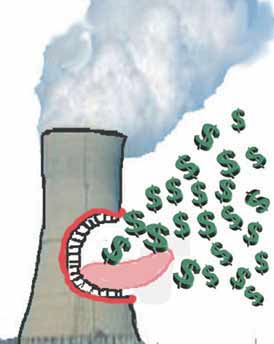
 The costs of nuclear energy By Manal Abdul Aziz – The Egyptian Gazette, June 6, 2011 CAIRO – The difference between humankind, homo sapiens, and other animals is that human beings have experience and learn from their mistakes, while other animals behave according to instinct. For this reason, human beings are the only creatures that have a civilisation.



 nuclear-news
Leave a comment