Latest on Fukushima, and USA nuclear waste worries
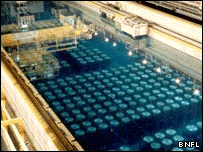 Additional concerns in the U.S. this week include the safety of spent fuel pools and reactor venting systems. A new report by the Institute for Policy Studies charges that we are at greater risk than Japan of an accident occurring in fuel pools due to overcrowding beyond design capacity. It has also surfaced that engineers warned the NRC of design flaws in venting systems 5 years ago, with little action taken.

 Japan Nuclear Disaster Update 2 June Clean Energy.org. France’s Institute for Radiological Protection and Nuclear Safety recommends that an additional 70,000 people be evacuated from areas outside the already established 20 km zone, which includes 10,000 children. These figures are based on radiation data collected by U.S. and Japanese radiation monitors. Presently, Japan’s emergency plans for nuclear disasters rely on an old standard of an 8-10 km evacuation zone, despite considerations to expand this to up to 30 km in 2006. The United States evacuation plans are based around a 10-mile radius standard (16 km). It is clear to many that evacuation zones need to be re-examined worldwide to determine how to best protect public health and safety. The nuclear debate here in the U.S. is becoming more intense. The Nuclear Regulatory Commission (NRC) has again raised concerns about the licensing of the AP1000 reactor design, pending revisions to address additional concerns about the reactor’s ability to withstand seismic activity, hurricanes, or tornadoes and potential problems with the design of the cooling system. This news comes over a month after the AP1000 Oversight Group petitioned the NRC to suspend approval of the design, citing similar concerns. Below are more resources regarding the proposed Toshiba-Westinghouse AP1000 reactor design:
- A presentation by Arnie Gundersen examining the possibility of containment leakage if an accident were to occur in the current revision of the AP1000 reactor design;
- Press release discussing the petition to halt licensing of the AP1000 reactor design;
- The Miami Herald examines the issue as it relates to the Turkey Point reactor, near Miami, Florida and hurricane activity;
- The Atlanta Journal Constitution discusses the issue as it relates to the recent tornadoes that decimated Tornado Alley and the Southeast;
- Residents near the beleaguered Crystal River plant in Florida are expressing concern, despite a history of support for the facility.
Additional concerns in the U.S. this week include the safety of spent fuel pools and reactor venting systems. A new report by the Institute for Policy Studies charges that we are at greater risk than Japan of an accident occurring in fuel pools due to overcrowding beyond design capacity. It has also surfaced that engineers warned the NRC of design flaws in venting systems 5 years ago, with little action taken. A key issue is the reliance on the power grid to operate the vents, which could contribute to hydrogen explosions in the event of an emergency. Although largely ignored, venting systems should be closely examined in light of the lessons we are learning from the Fukushima disaster.
TVA’s Browns Ferry nuclear power plant in Alabama made headlines again after the NRC gave the plant a poor rating, citing “repeated issues of degradation in performance.” The Tennesseean reports that citations include multiple problems with various components for back up power and cooling systems. Part of the issue appears to be faulty equipment complicated by an apparent lack of compliance by TVA in repairing the problems and an over-reliance on “temporary fixes.” This, coupled with patterns of disregarding necessary safety evaluations and improper reporting of safety issues, raises a red flag once again with inspectors at the troubled nuclear plant. Some of the issues where identified as early as the 1990’s, yet the NRC relicensed the aging reactors in 2006. TVA’s poor performance at Browns Ferry is something to take particular note of as it is the same flawed reactor design as the Fukushima Dai-ichi reactors and TVA is also contemplating the use of plutonium fuel, or MOX, which was loaded in reactor Unit 3 at Fukushima……..http://blog.cleanenergy.org/2011/06/02/june-2-japan-update/
No comments yet.
1 This Month

of the week – Shut Down Drone Warfare!


Tell the Ukrainian Government to Drop Prosecution of Peace Activist Yurii Sheliazhenko

Petition to revoke the licensing of the Near Surface Nuclear Disposal Facility (NSDF) at Chalk River. https://www.ourcommons.ca/petitions/en/Petition/Details?Petition=e-7247
To see nuclear-related stories in greater depth and intensity – go to https://nuclearinformation.wordpress.com
-
Archives
- March 2026 (230)
- February 2026 (268)
- January 2026 (308)
- December 2025 (358)
- November 2025 (359)
- October 2025 (376)
- September 2025 (257)
- August 2025 (319)
- July 2025 (230)
- June 2025 (348)
- May 2025 (261)
- April 2025 (305)
-
Categories
- 1
- 1 NUCLEAR ISSUES
- business and costs
- climate change
- culture and arts
- ENERGY
- environment
- health
- history
- indigenous issues
- Legal
- marketing of nuclear
- media
- opposition to nuclear
- PERSONAL STORIES
- politics
- politics international
- Religion and ethics
- safety
- secrets,lies and civil liberties
- spinbuster
- technology
- Uranium
- wastes
- weapons and war
- Women
- 2 WORLD
- ACTION
- AFRICA
- Atrocities
- AUSTRALIA
- Christina's notes
- Christina's themes
- culture and arts
- Events
- Fuk 2022
- Fuk 2023
- Fukushima 2017
- Fukushima 2018
- fukushima 2019
- Fukushima 2020
- Fukushima 2021
- general
- global warming
- Humour (God we need it)
- Nuclear
- RARE EARTHS
- Reference
- resources – print
- Resources -audiovicual
- Weekly Newsletter
- World
- World Nuclear
- YouTube
-
RSS
Entries RSS
Comments RSS
 nuclear-news
Leave a comment