Japanese public opinion might result in aborting the global “nuclear renaissance”
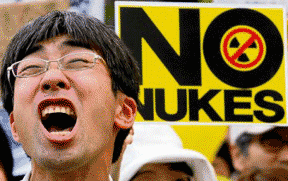 Could these angry, scattered voices from below congeal to topple Japan’s entire energy policy, or even abort the global turn to nuclear power?
photograph Kim Kyung Hoon, Reuters
The sun sets on Japan’s nuclear age, Irish Tims, 26 May 11, DAVID McNEILL, NUCLEAR FALLOUT: The meltdown at the Fukushima nuclear plant has grave implications for Japan’s planned atomic energy expansion, and also its long-term economic growth
IN A CITY where mass demonstrations are rare and generally tame, Tokyo has seen at least four in the past month, all against nuclear power. Thousands of people have marched past the headquarters of Tokyo Electric Power (Tepco) shouting slogans at the executives they hold responsible for the world’s worst atomic crisis since Chernobyl.
Furious parents from Fukushima Prefecture this month dumped irradiated soil from school playgrounds on the desks of government bureaucrats. More protests are planned in the sweltering summer months, when looming power cuts and leaking radiation from the ruined Fukushima Daiichi power plant will make life very uncomfortable for citizens in this densely populated, sprawling metropolis.
Could these angry, scattered voices from below congeal to topple Japan’s entire energy policy, or even abort the global turn to nuclear power? Prime minister Naoto Kan has already thrown a huge bone to the anti-nuclear lobby by asking for the temporary closure of the Hamaoka plant southwest of Tokyo.
Even as utility executives digested that unexpected request, polls suggest that nearly two-thirds of the public support the decision, which takes offline what many call the most dangerous power plant in the country. In a press conference this month, Kan further stunned the embattled industry by saying that energy policy in Japan must “go back to the drawing board,” which would mean reversing a four-decade focus on atomic power…….
Shrugging off the legacy of the Chernobyl disaster in 1986, the industry was attempting a comeback, driven by the demand for low-carbon alternatives to fossil fuels. But it faced a major problem: without government financial and political help, they would never be built because the nuclear option is still considered too risky and expensive for most commercial investors.
That’s why former British prime minister Tony Blair and other world leaders increasingly talked up the benefits of atomic power as a key strategy to fight climate change. “It’s difficult to see how to reduce CO2 emissions without nuclear power stations,” Blair told a Tokyo audience three years ago. It was notable too that even as Fukushima’s fires smouldered in late March, Kan stood side by side with French president Nicolas Sarkozy in Tokyo to defend their nuclear strategies…..
But nuclear opponents, largely ignored until this year, are increasingly getting a hearing, especially in the mass-selling weeklies. “In the end, building a nuclear plant in Japan with absolute safety is impossible,” says Atsushi Kasai, a member of the UN Scientific Committee on the Effects of Atomic Radiation. In an interview with theJapan Times, Kasai said Fukushima would force Tepco and the government to scrap its entire nuclear blueprint and eventually shut down all Japan’s reactors. Only time will tell if he is correct.
No comments yet.
1 This Month

of the week – Shut Down Drone Warfare!



Tell the Ukrainian Government to Drop Prosecution of Peace Activist Yurii Sheliazhenko

Petition to revoke the licensing of the Near Surface Nuclear Disposal Facility (NSDF) at Chalk River. https://www.ourcommons.ca/petitions/en/Petition/Details?Petition=e-7247

of the week – STOP SMALL MODULAR REACTORS IN CANADA
To see nuclear-related stories in greater depth and intensity – go to https://nuclearinformation.wordpress.com
-
Archives
- March 2026 (222)
- February 2026 (268)
- January 2026 (308)
- December 2025 (358)
- November 2025 (359)
- October 2025 (376)
- September 2025 (258)
- August 2025 (319)
- July 2025 (230)
- June 2025 (348)
- May 2025 (261)
- April 2025 (305)
-
Categories
- 1
- 1 NUCLEAR ISSUES
- business and costs
- climate change
- culture and arts
- ENERGY
- environment
- health
- history
- indigenous issues
- Legal
- marketing of nuclear
- media
- opposition to nuclear
- PERSONAL STORIES
- politics
- politics international
- Religion and ethics
- safety
- secrets,lies and civil liberties
- spinbuster
- technology
- Uranium
- wastes
- weapons and war
- Women
- 2 WORLD
- ACTION
- AFRICA
- Atrocities
- AUSTRALIA
- Christina's notes
- Christina's themes
- culture and arts
- Events
- Fuk 2022
- Fuk 2023
- Fukushima 2017
- Fukushima 2018
- fukushima 2019
- Fukushima 2020
- Fukushima 2021
- general
- global warming
- Humour (God we need it)
- Nuclear
- RARE EARTHS
- Reference
- resources – print
- Resources -audiovicual
- Weekly Newsletter
- World
- World Nuclear
- YouTube
-
RSS
Entries RSS
Comments RSS
 nuclear-news
Leave a comment