Nuclear power and the commons of this beautiful world – theme for June
It’s time that human societies made the change – started taking real co-operative action to look after our commons, in this beautiful world. – land, fresh water, air, and oceans. Already, national leaders are under pressure from their people to protect our common interests, rather than the interests of polluting corporations.
If the Fukushima nuclear crisis is doing one good thing, it is making it clear that radioactive pollution is an international problem, not just a problem for Japan.
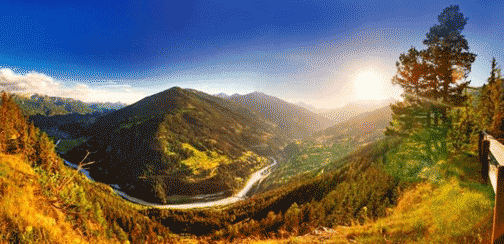
by photographer Edgar Moskopp http://acidcow.com/pics/14022-our-beautiful-planet-16-pics.html
Long lasting radioactive contamination of the sea, from Fukushima disaster
 for all the focus on land-based contamination, the continuing flood of radioactive materials into the ocean at Fukushima could have the most problematic long-term impacts. ….for centuries to come, at least some radioactive materials dumped into the sea at Fukushima will find their way into the creatures of the sea and the humans that depend on them. ……
 Is Fukushima Now Ten Chernobyls into the Sea? | Common Dreams, May 26, 2011 by Harvey Wasserman New readings show levels of radioisotopes found up to 30 kilometers offshore from the on-going crisis at Fukushima are ten times higher than those measured in the Baltic and Black Seas during Chernobyl.
“When it comes to the oceans, says Ken Buesseler, a chemical oceonographer at the Woods Hole Oceanographic Institution, “the impact of Fukushima exceeds Chernobyl.” Continue reading
G-8 wants nuclear safety standards, (but only voluntary ones!)
 binding standards will be an unacceptable constraint on the sovereignty of a growing number of countries that want to develop nuclear energy.
G-8 Affirms Need For Tightest Nuclear Safety, But Won’t Be Bound, FoxBusiness.com, By George Nishiyama and Geoffrey T. Smith May 26, 2011| Dow Jones Newswires DEAUVILLE, France – – Leaders of the Group of Eight industrialized countries Thursday affirmed the need to raise safety standards in nuclear energy after the March earthquake and tsunami in Japan triggered the world’s worst nuclear crisis since the 1986 Chernobyl accident. Continue reading
Radioactivity increasing in marine life around Japan
 Greenpeace: Japan nuclear plant radiation accumulating in marine life – CNN.com 27 May 11, Radiation from Japan’s damaged Fukushima Daiichi nuclear plant is accumulating in marine life off Japan’s coast above legal limits for food contamination, Greenpeace said Thursday. The environmental group said its findings run counter to Japanese government reports that radiation from the Fukushima plant, damaged in the March 11 earthquake and tsunami, is being diluted as time passes.“Despite what the authorities are claiming, radioactive hazards are not decreasing through dilution or dispersion of materials, but the radioactivity is instead accumulating in marine life,” Greenpeace radiation expert Jan Vande Putte said in a press release. Continue reading
Hospital doctors at risk of cancer from medical ionising radiation
 radiation can lead to cancer in doctors.
Radiation in hospitals prompts doctors to demand protection, JPost , By JUDY SIEGEL-ITZKOVICH 05/26/2011 Doctors say previous wage agreements did not take into account that technological advances make radiation much more widespread and pose greater risk Continue reading
Gender of babies is affected by nuclear radiation
Nuclear radiation affects baby gender, Machines Like Us, 26 May 2011 .………exposure to nuclear radiation leads to an increase in male births relative to female births, according to a new study by Hagen Scherb and Kristina Voigt from the Helmholtz Zentrum München. Continue reading
Germany wants global nuclear safety tests
Germany also wanted to become a model to the rest of the world on climate protection and producing green power.
“We want to reach the era of renewable energy more quickly,” she told the Bundestag.
Merkel calls for global nuclear reactor tests The Local, 26 May 11 Chancellor Angela Merkel called on the rest of the world to carry out atomic reactor “stress tests” and demanded the G8 take a leading role in nuclear security on Thursday, ahead of a meeting of the group of leading nations.
As Merkel prepares for a Group of Eight summit in Deauville, France, on Thursday and Friday, she told the German parliament that such nuclear plant checks needed to extend beyond Germany and the European Union. Continue reading
Russia touts nuclear industry – and wants mandatory safety rules
Russia Urges Mandatory Nuclear Safety Rules After Japan Accident, Bloomberg, By Henry Meyer – May 26, 2011 Russia called for nuclear safety rules to be tightened and made mandatory at an international level after the accident at Japan’s Fukushima atomic plant.
“There is no alternative but to strengthen these rules,” Nikolai Spassky, deputy head of Russia’s Rosatom Corp. holding, told reporters today during the Group of Eight summit in Deauville, France. “All countries which are developing a nuclear industry have to recognize this……Russia Urges Mandatory Nuclear Safety Rules After Japan Accident – Bloomberg
France’s Sarkozy to tout nuclear power safety at G8
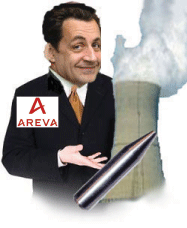 Reuters) 27 May 11– Leaders of the Group of Eight want more stringent international rules on nuclear safety following the disaster at Japan’s Fukushima plant, French President Nicolas Sarkozy said on Thursday….
“We all wish to get a very high standard of regulation on nuclear safety, that will apply to all countries involved in civilian nuclear energy and which will take safety to the highest levels ever,” Sarkozy told reporters at the summit in the northern French seaside resort of Deauville.
Sarkozy said there was no alternative to nuclear power and insisted that safety, not cost, had to drive projects……G8 leaders want tougher nuclear safety rule | Reuters
Rift in G8 countries over nuclear safety
Japan’s nuclear disaster following the March 11 earthquake opened a rift in the G-8.
So far, European countries remain at odds over whether to scale back their nuclear power projects or continue plans to expand…..
Middle east situation, nuclear safety top G-8 agenda PARIS, May 26 (Xinhua)Editor: Zhang Xiang — The two-day summit of the Group of Eight (G-8) begins Thursday in the French seaside resort of Deauville to discuss major issuing facing the world today.
……Thursday’s first working session will focus on nuclear safety. Continue reading
Japanese public opinion might result in aborting the global “nuclear renaissance”
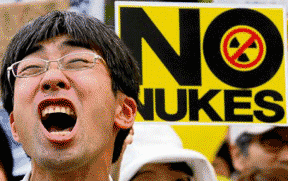 Could these angry, scattered voices from below congeal to topple Japan’s entire energy policy, or even abort the global turn to nuclear power?
photograph Kim Kyung Hoon, Reuters
The sun sets on Japan’s nuclear age, Irish Tims, 26 May 11, DAVID McNEILL, NUCLEAR FALLOUT: The meltdown at the Fukushima nuclear plant has grave implications for Japan’s planned atomic energy expansion, and also its long-term economic growth
IN A CITY where mass demonstrations are rare and generally tame, Tokyo has seen at least four in the past month, all against nuclear power. Thousands of people have marched past the headquarters of Tokyo Electric Power (Tepco) shouting slogans at the executives they hold responsible for the world’s worst atomic crisis since Chernobyl. Continue reading
Fukushima nuclear plant might now be used as a temporary nuclear waste dump
As the sites are for intermediary use, the nation is still searching for a deep underground storage site for the waste, according to the World Nuclear Association…

Fukushima set to become Nuclear waste graveyard Bloomberg / Tokyo May 27, 2011, Japan’s atomic energy specialists are discussing a plan to make the Fukushima Daiichi nuclear plant a storage site for radioactive waste from the crippled station run by Tokyo Electric Power Co.The Atomic Energy Society of Japan is studying the proposal, which would cost tens of billions of dollars, Muneo Morokuzu, a professor of energy and environmental public policy at the University of Tokyo, said in an interview yesterday. The society makes policy recommendations to the government. Continue reading
Unprecedented criticism of Tokyo Electric Power Company
The IAEA’s 10-day visit, which began on Monday, coincides with mounting criticism of the operator of the Fukushima Daiichi plant, as it becomes clear that the damage caused by the March 11earthquake and tsunami was far worse than initially thought. Its findings could have a significant impact on public attitudes toward both the plant’s operator and the Japanese government, and are certain to attract the interest of other countries with nuclear power plants.
Tepco’s handling of Japan’s nuclear crisis under severe scrutiny, The International Atomic Energy Agency’s visit to Japan this week coincides with unprecedented criticism of the Tokyo Electric Power Company’s handling of Japan’s nuclear crisis following the March 11 earthquake. CSMonitor.com, By Justin McCurry, May 26, 2011 Ichinoseki, Japan Continue reading
Renewable energy makes good economic sense forAustralia
Renewable energy will only get cheaper: study, Australian Broadcasting Corporation, By Michael Edwards May 26, 2011 A new study has found the future prices of wind, thermal and solar power will only keep falling as more alternative power sources are switched into the energy grid. Researchers say it proves the widespread adoption of renewable energy sources makes good economic sense. Continue reading
AREVA neglecting France’s old radioactive uranium mining sites
 Today, the site is the responsibility of Areva, a majority state-owned French multinational that builds nuclear power stations and manages uranium mines around the world……
France’s respected Independent Research and Information Commission on Radioactivity (CRIIRAD). is similarly critical of the situation. “These exposures are totally unjustified and levels should be reduced by properly redeveloping the site and removing radioactive material,”
Radiation fears surround France’s old uranium mines, Google News, By Simon Coss (AFP) 27 May 11, ROSGLAS, France — It looks like any other another leafy woodland path in Brittany, but campaigners say ramblers on this particular trail may face levels of radiation at least 10 times higher than normal. Continue reading
1 This Month



Tell the Ukrainian Government to Drop Prosecution of Peace Activist Yurii Sheliazhenko

Petition to revoke the licensing of the Near Surface Nuclear Disposal Facility (NSDF) at Chalk River. https://www.ourcommons.ca/petitions/en/Petition/Details?Petition=e-7247


of the week – STOP SMALL MODULAR REACTORS IN CANADA
To see nuclear-related stories in greater depth and intensity – go to https://nuclearinformation.wordpress.com
-
Archives
- March 2026 (222)
- February 2026 (268)
- January 2026 (308)
- December 2025 (358)
- November 2025 (359)
- October 2025 (376)
- September 2025 (258)
- August 2025 (319)
- July 2025 (230)
- June 2025 (348)
- May 2025 (261)
- April 2025 (305)
-
Categories
- 1
- 1 NUCLEAR ISSUES
- business and costs
- climate change
- culture and arts
- ENERGY
- environment
- health
- history
- indigenous issues
- Legal
- marketing of nuclear
- media
- opposition to nuclear
- PERSONAL STORIES
- politics
- politics international
- Religion and ethics
- safety
- secrets,lies and civil liberties
- spinbuster
- technology
- Uranium
- wastes
- weapons and war
- Women
- 2 WORLD
- ACTION
- AFRICA
- Atrocities
- AUSTRALIA
- Christina's notes
- Christina's themes
- culture and arts
- Events
- Fuk 2022
- Fuk 2023
- Fukushima 2017
- Fukushima 2018
- fukushima 2019
- Fukushima 2020
- Fukushima 2021
- general
- global warming
- Humour (God we need it)
- Nuclear
- RARE EARTHS
- Reference
- resources – print
- Resources -audiovicual
- Weekly Newsletter
- World
- World Nuclear
- YouTube
-
RSS
Entries RSS
Comments RSS
 nuclear-news