Nuclear Regulatory Commission under the thumb of Nuclear Industry
Deference to Industry The N.R.C.’s slowness in addressing serious problems is another 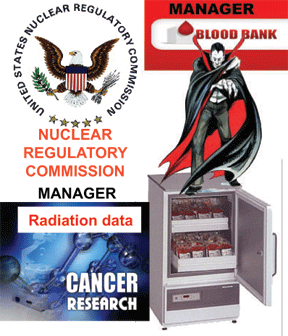 concern……The agency has little choice but to tolerate violations, ……… “Otherwise, nearly all the U.S. reactors would have to shut down,”
Nuclear Agency Is Criticized as Too Close to Its Industry. NYTimes.com, By TOM ZELLER Jr., May 7, 2011 “……..Exelon’s risky decisions occurred under the noses of on-site inspectors from the federal Nuclear Regulatory Commission. No documented inspection of the pipes was made by anyone from the N.R.C. for at least the eight years preceding the leak, and the agency also failed to notice that Exelon kept lowering the acceptable standard, according to a subsequent investigation by the commission’s inspector general.
Exelon’s penalty? A reprimand for two low-level violations — a tepid response all too common at the N.R.C., said George A. Mulley Jr., a former investigator with the inspector general’s office who led the Byron inquiry. “They always say, ‘Oh, but nothing happened,’ ” Mr. Mulley said. “Well, sooner or later, our luck — you know, we’re going to end up rolling craps.”
Critics have long painted the commission as well-intentioned but weak and compliant, and incapable of keeping close tabs on an industry to which it remains closely tied. The concerns have greater urgency because of the crisis at the Fukushima Daiichi plant in Japan, which many experts say they believe was caused as much by lax government oversight as by a natural disaster.
The Byron pipe leak is just one recent example of the agency’s shortcomings, critics say…….
safety experts, Congressional critics and even the agency’s own internal monitors say the N.R.C. is prone to dither when companies complain that its proposed actions would cost time or money. The promise of lucrative industry work after officials leave the commission probably doesn’t help, critics say, pointing to dozens over the years who have taken jobs with nuclear power companies and lobbying firms.
Now, as most of the country’s 104 aging reactors are applying for, and receiving, 20-year extensions from the N.R.C on their original 40-year licenses, reform advocates say a thorough review of the system is urgently needed.
The agency’s shortcomings are especially vexing because Congress created it in the mid-1970s to separate the government’s roles as safety regulator and promoter of nuclear energy — an inherent conflict that dogged its predecessor, the Atomic Energy Commission.
“It wasn’t much of a change,” said Peter A. Bradford, a former N.R.C. commissioner who now teaches at Vermont Law School. “The N.R.C. inherited the regulatory staff and adopted the rules and regulations of the A.E.C. intact.”
Mr. Bradford said the nuclear industry had implicitly or explicitly supported every nomination to the commission until Gregory B. Jaczko’s in 2005. Mr. Jaczko, who was elevated to chairman by President Obama in 2009, had previously worked for both Representative Edward J. Markey, the Massachusetts Democrat and longtime critic of the nuclear industry, and Senator Harry Reid, the Nevada Democrat and current Senate majority leader who sought to block a nuclear waste repository in his state…….
The Vermont Senate, concerned about the problems, voted overwhelmingly last year to prevent the plant from operating beyond the scheduled expiration of its license on March 21, 2012 — invoking a 2006 state law, unique to Vermont, that requires legislative approval for continued operations.
But one day before the quake and tsunami that set Japan’s crisis in motion, the N.R.C. approved Vermont Yankee’s bid for license renewal — just as it has for 62 other plants so far. Its fate is now the subject of a federal lawsuit.
“How does a place like that get a license renewal?” Mr. Lochbaum said. “Because they asked for one. Absent dead bodies, nothing seems to deter the N.R.C. from sustaining reactor operation.”
Indeed, no renewal application has been turned down by the agency since the first one was granted in 2000, …..
With billions of dollars of revenue and investment at stake for each plant, the N.R.C. changed the rules in 1995, scrapping the requirement that operators prove they were complying with their current license. Instead, the renewal process would focus only on the aging management plan. The agency described the change as providing a “more stable and predictable regulatory process for license renewal.”
But James Riccio, a nuclear policy analyst with Greenpeace, said, “The N.R.C. rule change gutted a substantive process and replaced it with a rubber stamp. They placed industry profits ahead of public safety.”….
Deference to Industry
The N.R.C.’s slowness in addressing serious problems is another concern……
The agency has little choice but to tolerate violations, said Mr. Lochbaum, who heads the Nuclear Safety Project with the Union of Concerned Scientists, an environmental and nuclear watchdog group based in Cambridge, Mass. “Otherwise, nearly all the U.S. reactors would have to shut down,” he said……
The agency’s deferential attitude also brought the Davis-Besse plant in Ohio to the brink of the worst American nuclear accident since the Three Mile Island meltdown of 1979.
Nuclear Regulatory Commission Criticized for Industry Ties – NYTimes.com
No comments yet.
1 This Month


Tell the Ukrainian Government to Drop Prosecution of Peace Activist Yurii Sheliazhenko

Petition to revoke the licensing of the Near Surface Nuclear Disposal Facility (NSDF) at Chalk River. https://www.ourcommons.ca/petitions/en/Petition/Details?Petition=e-7247


of the week – STOP SMALL MODULAR REACTORS IN CANADA
To see nuclear-related stories in greater depth and intensity – go to https://nuclearinformation.wordpress.com
-
Archives
- March 2026 (204)
- February 2026 (268)
- January 2026 (308)
- December 2025 (358)
- November 2025 (359)
- October 2025 (376)
- September 2025 (258)
- August 2025 (319)
- July 2025 (230)
- June 2025 (348)
- May 2025 (261)
- April 2025 (305)
-
Categories
- 1
- 1 NUCLEAR ISSUES
- business and costs
- climate change
- culture and arts
- ENERGY
- environment
- health
- history
- indigenous issues
- Legal
- marketing of nuclear
- media
- opposition to nuclear
- PERSONAL STORIES
- politics
- politics international
- Religion and ethics
- safety
- secrets,lies and civil liberties
- spinbuster
- technology
- Uranium
- wastes
- weapons and war
- Women
- 2 WORLD
- ACTION
- AFRICA
- Atrocities
- AUSTRALIA
- Christina's notes
- Christina's themes
- culture and arts
- Events
- Fuk 2022
- Fuk 2023
- Fukushima 2017
- Fukushima 2018
- fukushima 2019
- Fukushima 2020
- Fukushima 2021
- general
- global warming
- Humour (God we need it)
- Nuclear
- RARE EARTHS
- Reference
- resources – print
- Resources -audiovicual
- Weekly Newsletter
- World
- World Nuclear
- YouTube
-
RSS
Entries RSS
Comments RSS
 nuclear-news
Leave a comment