Nuclear Regulatory Commission under the thumb of Nuclear Industry
Deference to Industry The N.R.C.’s slowness in addressing serious problems is another 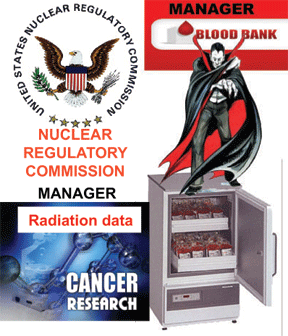 concern……The agency has little choice but to tolerate violations, ……… “Otherwise, nearly all the U.S. reactors would have to shut down,”
Nuclear Agency Is Criticized as Too Close to Its Industry. NYTimes.com, By TOM ZELLER Jr., May 7, 2011 “……..Exelon’s risky decisions occurred under the noses of on-site inspectors from the federal Nuclear Regulatory Commission. No documented inspection of the pipes was made by anyone from the N.R.C. for at least the eight years preceding the leak, and the agency also failed to notice that Exelon kept lowering the acceptable standard, according to a subsequent investigation by the commission’s inspector general.
Exelon’s penalty? A reprimand for two low-level violations — a tepid response all too common at the N.R.C., said George A. Mulley Jr., a former investigator with the inspector general’s office who led the Byron inquiry. “They always say, ‘Oh, but nothing happened,’ ” Mr. Mulley said. “Well, sooner or later, our luck — you know, we’re going to end up rolling craps.” Continue reading
Nuclear industry worldwide enjoys the “mother of all subsidies”
Twenty-five years after the disaster at Chernobyl’s reactor number 4, the global community is struggling to find 2.2 billion dollars to build a permanent shelter to replace the collapsing cement and steel sarcophagus hastily built after the accident.
That 2.2 billion dollars does not include the costs of dismantling the radioactive material nor the costs of building a safe storage facility for the spent and damaged nuclear fuel from the plant. This material will be dangerously radioactive for thousands of years.

The Nuclear Cost Shell Game, By Stephen Leahy, UXBRIDGE, Canada, May 6, 2011 (IPS) – The nuclear energy industry only exists thanks to what insurance experts call the “mother of all subsidies”, and the public is largely unaware that every nuclear power plant in the world has a strict cap on how much the industry might have to pay out in case of an accident.In Canada, this liability cap is an astonishingly low 75 million dollars. In India, it is 110 million dollars and in Britain 220 million dollars. If there is an accident, governments – i.e. the public – are on the hook for all costs exceeding those caps. Continue reading
Close Hamaoka Nuclear Plant – call by Japan’s Prime Minister
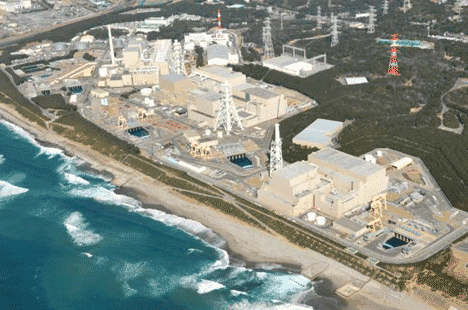 Japan PM Wants Another Nuclear Plant Closed Over Quake Fears, ABC News, By AKIKO FUJITA, TOKYO May 6 2011, Japan urged a power company today to temporarily shut down operations at another nuclear plant that straddles a major fault line for fear it would not survive a major earthquake and tsunami.
Prime Minister Naoto Kan said during a news conference today that he requested the suspension of reactors at the Hamaoka nuclear plant over safety concerns, citing a study that said there was an 87 percent chance of a magnitude 8.0 earthquake striking central Japan within the next 30 years.
The Hamaoka plant is located in Shizuoka, 155 miles west of Tokyo, and sits on an active earthquake fault. Officials estimate the shutdown could last two years…..Japan Wants Another Nuclear Plant Suspended Out of Quake Fears – ABC News
Radiation leak on Russian nuclear powered ice-breaker ship
“Even a small radiation leak inside the reactor structure is a serious event,” said independent military analyst Pavel Felgenhauer.
“If the leak is small, they might be able to repair it. But it is hard to do because the reactor is hot,” Felgenhauer noted.
 Nuclear leak on Russian icebreaker in Arctic sparks rescue mission THE AUSTRALIAN, May 06, 2011 RUSSIA have launched an urgent rescue mission after one of its atomic-powered icebreakers developed a nuclear leak in the frozen seas of the Arctic and was forced to abandon its mission. Continue reading
Toxic radioactive effects of thorium, uranium in rare earths
 Environmental groups have long criticised rare earths mining for spewing toxic chemicals and radioactive thorium and uranium into the air, water and soil, which can cause cancer and birth defects among residents and animals…..
 China pays price for world’s rare earths addiction, By Allison Jackson (AFP) – Google News, 7 May 11, BAOTOU, China — Peasant farmer Wang Tao used to grow corn, potatoes and wheat within a stone’s throw of a dumping ground for rare earths waste until toxic chemicals leaked into the water supply and poisoned his land.Farmers living near the 10-square-kilometre expanse in northern China say they have lost teeth and their hair has turned white while tests show the soil and water contain high levels of cancer-causing radioactive materials. Continue reading
Japan radiation monitoring – new comprehensive open source

 Radiation monitoring in Japan goes crowd, open source, CNET, by Eric Mack, May 6, 2011 A new open and crowdsourced initiative to deploy more geiger counters all over Japan looks to be a go. Safecast, formerly RDTN.org, recently met and exceeded its $33,000 fund-raising goal on Kickstarter, which should help Safecast send between 100 and 600 geiger counters to the catastrophe-struck country.
The data captured from the geiger counters will be fed into Safecast.org, which aggregates radiation readings from government, nonprofit, and other sources, as well as into Pachube, a global open-source network of sensors. Safecast is one of the larger crowdsourced monitoring efforts, not unlike a similar effort in the United States that predated the Japanese disaster.
For the last month, the Safecast crew and volunteers have been collaborating with universities in Japan and driving their geiger counters around the country and taking measurements. Safecast’s early monitoring trips north of Tokyo returned some disturbing findings, including elevated radiation levels in a kindergarten classroom….Radiation monitoring in Japan goes crowd, open source | Crave – CNET
Projections of costs for nuclear plants leave out full fuel cycle and risks
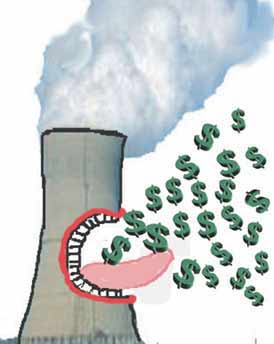 When comparing energy choices, nuclear versus solar for instance, the full life cycle costs are rarely used. Nor are the financial risks taken into account,
The Nuclear Cost Shell Game, By Stephen Leahy, UXBRIDGE, Canada, May 6, 2011 (IPS)“…….Experts estimate the U.S. nuclear industry’s liability cap of 10 billion dollars amounts to “an indirect subsidy of about 33 million dollars per plant per year over the lifetime of a nuclear plant,” according to a study published in Energy Policy in April.
If that 33 million dollars-per-plant-per-year indirect subsidy was instead used for loan guarantees for solar panel manufacturing plants, the U.S. would gain 5.3 trillion dollars worth of additional electricity over a 100-year time span, the study reported.”Wind might be even better than solar under this scenario,” said co- author Joshua Pearce, a mechanical and materials engineer at Queen’s University in Kingston, Ontario.
“We’re wasting money on nuclear energy. It makes no economic sense,” Pearce told IPS. Continue reading
Dirty energy making profits for Duke Energy nuclear company
Duke Energy: still profiting from environmental destruction by mdorozen – Greenpeace USA, May 6, 2011 At Duke Energy’s annual shareholder meeting, the company announced first quarter profits up 15%— profits that don’t reflect the hidden costs of dirty energy: the subsidies, healthcare costs and environmental costs that are passed on to the American public. Profits that Duke built on environmentally destructive practices and at the cost of human lives.
The meeting was marked by significant environmental protests as Duke announced plans for new nuclear plants in Florida and the Carolinas and coal plants in Indiana and North Carolina—in fact, the meeting came on the heels of controversial announcements about the potential merger of Duke Energy and Progress energy, and a weak policy on Mountaintop Coal.
The green coalition press conference and rally, MC’d by Greenpeace’s Charlotte organizer, Monica Embrey, took place on the doorstep of Duke Energy’s annual Shareholders’ Meeting. Speakers from NC WARN and other groups emphasized the risky nature of investing in dirty energy. About fifty environmental demonstrators came out from across the state to express concern about Duke’s merger with Progress Energy, which would make it an even more formidable force for dirty energy interests….. Duke Energy: still profiting from environmental destruction | Greenpeace USA
Japan’s most dangerous nuclear power plant
Hamaoka, Japan’s Most Infamous Nuclear Plant? WSJ May 6, 2011, The Hamaoka nuclear power plant may not be as well known around the world as Fukushima Daichi, crippled by the March 11 disasters. But the complex that Prime Minister Naoto Kan ordered closed down Friday is extremely well known in Japan. In fact, it’s infamous.
The plant, operated by Chubu Electric Power Co., is sited on Japan’s east coast, about 200 kilometers southwest of Tokyo, by Omaezaki city in Shizuoka prefecture. Omaezaki is known for its fishing and its green tea. And also for being sited pretty much, some say, on the fault line in the area that would be hit by the next, historically overdue “Tokai earthquake” – a long-feared “Big One” that could wreak havoc in the Kanto region that includes the capital…..Hamaoka, Japan’s Most Infamous Nuclear Plant? – Japan Real Time – WSJ
Entergy Nuclear Company – Nonchalant About Safety
It’s frightening that Entergy has such a cavalier attitude toward the safety of their nuclear power plants. Especially, given the fact that Indian Point and Pilgrim rank as the top two reactors with the highest risk of an earthquake causing core damage. What would it mean to have a Chernobyl or Fukushima scale accident at Indian Point?
 VIDEO Will Entergy learn anything from the Fukushima nuclear disaster in Japan? Greenpeace USA by Jarred Cobb – May 6, 2011 Entergy, the company trying to continue running dangerous old nuclear plants like Vermont Yankee, Indian Point in New York, and Pilgrim in Massachsusetts, is holding their annual shareholder meeting today. We sent them a letter highlighting the risks of these old plants, and questioning if the company has learned anything from the nuclear disaster in Japan. Continue reading
Nuclear radioactivity risks: iodine, cesium, plutonium, strontium
Health risk from troubled Japan nuclear plant, Reuters, By Mayumi Negishi and Tan Ee Lyn, TOKYO May 6, 2011“……IS SOME RADIATION MORE HARMFUL THAN OTHERS?Yes. Radioactive particles are most harmful when inhaled or ingested, and particles that are easily absorbed and which have longer half-lives can cause more damage to cells and genetic material inside.
When examining radiation from the Fukushima plant, health officials focus especially on Iodine-131. Inside the body of an adult, it has a half-life of 7 days, but it accumulates quickly in the thyroid gland. Children are especially at risk because their thyroids are still developing.Another by-product, Cesium, spreads throughout the body, concentrating in muscle tissue. Cesium-137 has a half-life of 30 years, but inside an adult, the amount will be halved in 90 days.
Strontium and plutonium are rarer by-products of nuclear fission. But if they are ingested, they tend to collect in bones, where they are likely to stay put. Strontium can cause bone cancer. Plutonium is more dangerous when inhaled, increasing the risk of lung cancer……..”Health risk from troubled Japan nuclear plant | Reuters
Nuclear Reactors – Safe as Long as Nothing goes Wrong
nuclear reactors are perfectly safe… so long as nothing goes wrong…..
Sure, other forms of energy also create waste, but isn’t that better than passing on radioactive waste to ourfuture generations. Unless our resolve is positive and focused on the alternatives, nuclear energy will continue to haunt us as a nightmare in the guise of a dream.
We owe it to ourselves and the generations to follow.
Nuclear is Unclear
| Amar Ambani |
| Head – Research (India Private Clients), India Infoline Group |
| May 06, 2011 |
| The Japan nuclear mess is still fresh in memory and the time has come when India rethinks its nuclear energy policy and reassesses the future construction of nuclear power plants. Iam no nuclear expert but one doesn’t need intricate knowledge toacknowledge one undeniable fact – a crack in the nuclear reactors is nothing short of fatal.
What happened recently in Japan, and Chernobyl and Three MileIsland in the past, does it merit further explanation on the havoc nuclearenergy plays if leaked inadvertently. But all we see are vociferous debates theworld over – countless in number and rather hopeless in outcome. For those largely unaware of the Chernobyl reactor damage, as many as 5 lakh workers had to be deputed to control the damage and were affected by radiation. The 30 km zone is still deserted – not a trace of humanity even after 25 long years. Even the capital city of Ukraine, 100 km away from the site, had 2 million affected people. Arecent magazine article reported that in financial terms, the tragedy cost 2.5%of the Soviet GDP and many attribute Chernobyl as the prime reason for theerstwhile USSR’s downfall. There’s a joke that’s doing therounds these days – a joke that’s a harsh reality for the ill-fatedpeople struck by the tragedies – That nuclear reactors are perfectly safe… so long as nothing goes wrong….. Experts worldwide have always been recommending a diverse mix of existing renewable technologies to meet energy needs… clean, safe and renewable energy sources like wind, solar,advanced hydroelectric and certain types of biomass and geothermal energy. How(not whether) they can reliably generate as much energy as conventional fuels without emissions, destructive mining or waste should be the focal point ofdiscussion and research worldwide. Sure, other forms of energy also create waste, but isn’t that better than passing on radioactive waste to ourfuture generations. Unless our resolve is positive and focused on the alternatives, nuclear energy will continue to haunt us as a nightmare in the guise of a dream. |
Justin Bieber will tour Japan, despite radiation fears
Justin Bieber committed to Japanese tour despite crew’s fear of radiation – NYPOST.com, 7 May, PERTH, Australia — Pop sensation Justin Bieber will tour Japan even if his crew refuses to travel for fear of radiation and the singer has to scale down his act, according to a new report.The 17-year-old’s crew has been lobbying the superstar to cancel his upcoming Japanese concerts in the wake of the nuclear crisis triggered by the March 11 earthquake and tsunami.Several artists, including Avril Lavigne and former Guns ‘N Roses guitarist Slash, have scrapped their concerts in the Asian nation this spring…..Justin Bieber committed to Japanese tour despite crew’s fear of radiation – NYPOST.com
Nuclear industry a greenhouse gas emitter
The nuclear industry’s oft-touted claims of a “nuclear renaissance” were never real, …. “Now that claim is absolutely dead unless governments want to foot the entire bill.
“Fukushima will have a bigger impact on the nuclear industry than Chernobyl,” …
The Nuclear Cost Shell Game, By Stephen Leahy, UXBRIDGE, Canada, May 6, 2011 (IPS)“…….The argument that nuclear power is needed to combat climate change is also incorrect. Mining uranium and processing ore into fuel and building nuclear facilities results in considerable carbon emissions. When the full life cycles are compared, the carbon emissions of nuclear on a per-kilowatt-of-power-generated basis exceeds that of wind and is about the same as solar, according to a 2008 study by the Centre for Integrated Sustainability Analysis at the University of Sydney, Australia. Continue reading
1 This Month


Tell the Ukrainian Government to Drop Prosecution of Peace Activist Yurii Sheliazhenko

Petition to revoke the licensing of the Near Surface Nuclear Disposal Facility (NSDF) at Chalk River. https://www.ourcommons.ca/petitions/en/Petition/Details?Petition=e-7247


of the week – STOP SMALL MODULAR REACTORS IN CANADA
To see nuclear-related stories in greater depth and intensity – go to https://nuclearinformation.wordpress.com
-
Archives
- March 2026 (204)
- February 2026 (268)
- January 2026 (308)
- December 2025 (358)
- November 2025 (359)
- October 2025 (376)
- September 2025 (258)
- August 2025 (319)
- July 2025 (230)
- June 2025 (348)
- May 2025 (261)
- April 2025 (305)
-
Categories
- 1
- 1 NUCLEAR ISSUES
- business and costs
- climate change
- culture and arts
- ENERGY
- environment
- health
- history
- indigenous issues
- Legal
- marketing of nuclear
- media
- opposition to nuclear
- PERSONAL STORIES
- politics
- politics international
- Religion and ethics
- safety
- secrets,lies and civil liberties
- spinbuster
- technology
- Uranium
- wastes
- weapons and war
- Women
- 2 WORLD
- ACTION
- AFRICA
- Atrocities
- AUSTRALIA
- Christina's notes
- Christina's themes
- culture and arts
- Events
- Fuk 2022
- Fuk 2023
- Fukushima 2017
- Fukushima 2018
- fukushima 2019
- Fukushima 2020
- Fukushima 2021
- general
- global warming
- Humour (God we need it)
- Nuclear
- RARE EARTHS
- Reference
- resources – print
- Resources -audiovicual
- Weekly Newsletter
- World
- World Nuclear
- YouTube
-
RSS
Entries RSS
Comments RSS
 nuclear-news