30,000 tons of Chernobyl radioactive waste to last thousands of years
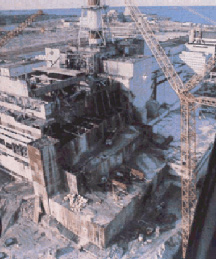 there is no long-term plan for dealing with a radioactive legacy that will remain for several millennia…..no one knows where the radioactive wreckage of the ruined reactor and the roughly 30,000 tons of material containing fuel are to be stored…the water problem remains unresolved.
 Beyond the Sarcophagus, The Overwhelming Challenge of Containing Chernobyl, Spiegel Online, By Benjamin Bidder, 1 May 11, Work on the new sarcophagus meant to contain Chernobyl’s reactor 4 is a decade behind schedule. But significant problems will remain even once it is complete. For one, it is only meant to last for 100 years. For another, no one knows what to do with the vast quantities of radioactive waste left behind.
…… the governments of 28 countries have now promised to provide €550 million ($780 million) to build a new containment, although €190 million are still needed for the new shell. It is designed to cover the old sarcophagus the Soviets built in only 200 days in 1986.
So far, engineers have had great difficulty preventing the collapse of the dilapidated ruin. If it did collapse, another cloud of radioactive dust would rise up from the site. But will the money truly help prevent this from happening?
Some €864 million had previously been pledged for the construction of a new containment, and much of that money has already been used up. The German Environment Ministry warns in a report of “substantial project risks” and criticizes the lack of transparency in the use of funds. Most critically, there is no long-term plan for dealing with a radioactive legacy that will remain for several millennia.
Work on the new sarcophagus hasn’t come far. Surveillance cameras and three rows of barbed wire protect the construction site. All photography and filming is forbidden, “out of fear of terrorist attacks,” explains project manager Viktor Salisezki. Some 500 employees of Novarka, an international consortium, are currently preparing the site for the planned construction of the new structure.
Men in white overalls are driving one of the 396 piers that will form the foundation of the massive structure 25 meters (82 feet) into the contaminated ground. The new semi-circular shelter will be 105 meters high, 150 meters long and 257.5 meters wide — a hangar four times as large as Hamburg’s main train station.
Not a Long Time
Salisezki’s men are assembling 18,000 tons of steel, more than was used for the Eiffel Tower in Paris, for the frame alone. To protect the workers from radiation, the construction site is located several hundred meters from the reactor. The project manager hopes that the sarcophagus will be ready by the fall of 2015, which would be 10 years later than originally planned. It will then be pushed over the reactor along special rails. Moving the steel structure alone will take two weeks.
“The new shelter will last 100 years,” says Vladimir Rudko of the National Institute for Nuclear Power Plant Safety. And that, he adds, isn’t a very long time…….
no one knows where the radioactive wreckage of the ruined reactor and the roughly 30,000 tons of material containing fuel are to be stored. In eastern Ukraine, where there are many mines and tunnels, the population is strongly opposed to a permanent repository. As an alternative, Rudko proposes drilling a deep shaft in the restricted zone.
20,000 Radioactive Fuel Rods
“We have to disassemble and dispose of the reactor. We owe that much to our grandchildren,” says Rudko. So far, however, there is neither a plan nor funding for such an undertaking.
Instead, short-term measures to limit the damage will have to suffice for the time being. To prevent the radioactivity from continuing to spread, members of the fire department stand guard on high observation towers in the summer. Forest fires could release radioactive materials that have accumulated in the ground and in plants. In 1992, for example, a large fire blew radioactive particles all the way to the Lithuanian capital Vilnius, about 500 kilometers away. The fine particles are highly carcinogenic if they enter the human body.
The fuel rods from the still-intact Chernobyl reactors 1 to 3 present another problem. About 20,000 radioactive fuel rods have been kept in temporary cooling ponds for years. The nuclear experts with Greenpeace Russia fear that these wet-storage facilities are now more dangerous than the ruined reactor itself.
The French nuclear company Areva was building a new storage complex until 2003. But the concrete began to crumble in the first Ukrainian winter, and cracks had to be filled with plastics. Furthermore, the storage facility had already proven to be too small for the old fuel elements. And the facility has been empty for years, a memorial to the costly planning errors at Chernobyl.
…… the water problem remains unresolved. Each month, 300,000 liters of radioactively contaminated water have to be pumped out of the plant. Some of it is precipitation that enters the sarcophagus through cracks and holes. And some of it is groundwater, which has risen artificially as a result of the 22-square-kilometer cooling water reservoir……http://www.spiegel.de/international/world/0,1518,759014,00.html
No comments yet.
1 This Month

of the week – Shut Down Drone Warfare!


Tell the Ukrainian Government to Drop Prosecution of Peace Activist Yurii Sheliazhenko

Petition to revoke the licensing of the Near Surface Nuclear Disposal Facility (NSDF) at Chalk River. https://www.ourcommons.ca/petitions/en/Petition/Details?Petition=e-7247
To see nuclear-related stories in greater depth and intensity – go to https://nuclearinformation.wordpress.com
-
Archives
- March 2026 (230)
- February 2026 (268)
- January 2026 (308)
- December 2025 (358)
- November 2025 (359)
- October 2025 (376)
- September 2025 (257)
- August 2025 (319)
- July 2025 (230)
- June 2025 (348)
- May 2025 (261)
- April 2025 (305)
-
Categories
- 1
- 1 NUCLEAR ISSUES
- business and costs
- climate change
- culture and arts
- ENERGY
- environment
- health
- history
- indigenous issues
- Legal
- marketing of nuclear
- media
- opposition to nuclear
- PERSONAL STORIES
- politics
- politics international
- Religion and ethics
- safety
- secrets,lies and civil liberties
- spinbuster
- technology
- Uranium
- wastes
- weapons and war
- Women
- 2 WORLD
- ACTION
- AFRICA
- Atrocities
- AUSTRALIA
- Christina's notes
- Christina's themes
- culture and arts
- Events
- Fuk 2022
- Fuk 2023
- Fukushima 2017
- Fukushima 2018
- fukushima 2019
- Fukushima 2020
- Fukushima 2021
- general
- global warming
- Humour (God we need it)
- Nuclear
- RARE EARTHS
- Reference
- resources – print
- Resources -audiovicual
- Weekly Newsletter
- World
- World Nuclear
- YouTube
-
RSS
Entries RSS
Comments RSS
 nuclear-news
Leave a comment