Poll shows Americans losing faith in nuclear power
 Fox News Poll: 83% Think Nuclear Crisis Like Japan Could Happen in U.S., FoxNews.com, By Dana Blanton April 08, 2011 Most American voters think a nuclear crisis like what is happening in Japan could happen in the United States. In addition, the number believing nuclear power is not safe is on the rise.
Fully 83 percent of voters think a disaster similar to Japan’s could happen in the U.S., while a small 15-percent minority doesn’t think so. That’s according to a Fox News poll released Friday.
No gender gap or partisan divide on that issue: most men, women, Democrats, Republicans and independents all agree it’s possible a major nuclear crisis could happen here. …..Click here for complete poll results……
Fox News Poll: 83% Think Nuclear Crisis Like Japan Could Happen in U.S. – FoxNews.com
Nuclear power industry – a sober warning to investors
“New nuclear generation is already more expensive to build than most other sources of electricity,” it continues, “its liability insurance is effectively socialized and material questions are being raised regarding its waste products.”
 Investors Warned: Fukushima Could Ignite Backlash Against U.S. Nuclear Power Industry, Forbes, – Osha Gray Davidson -Apr. 8 2011 A new report by Moody’s Investors Service has a title guaranteed to send chills through the nuclear power industry: “Re-evaluating Creditworthiness for Global Nuclear Generators.”
The report warns that “All nuclear operators…will suffer the consequences that emerge from a post Fukushima environment.” Continue reading
Prevention of nuclear meltdown causes radioactive water problem
Cleaning the water could take many years, if not decades to complete. The cost could run into tens of billions of dollars..
 Containing a calamity creates another nuclear nightmare, Sydney Morning Herald, Julie Makinen, Ralph Vartabedian April 9, 2011, TOKYO: For nearly four weeks, Japanese emergency crews have been spraying water on the damaged Fukushima nuclear reactors in a desperate attempt to avert the calamity of a full meltdown.The improvised solution to one nuclear nightmare is spawning another: what to do with the millions of litres of water that has become highly radioactive as it washes through the plant. Continue reading
One officer killed on nuclear submarine – it could have been much worse
 Officer killed in shooting on British nuclear submarine, Asia ONe News, 9 April 11, LONDON, ENGLAND – A Royal Navy officer was killed and another seriously injured in a shooting on a British nuclear-powered submarine, police said, which was only halted when a visiting politician tackled the gunman.
Another member of the navy was arrested on suspicion of murder following the incident on Friday in the southern English port of Southampton, officials said, stressing that the shooting was not “terrorist-related”. Continue reading
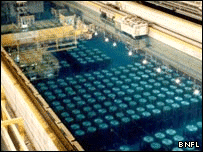
Facts on radioactive spent nuclear fuel rods
 How urgent is the situation?
Fairly urgent. The NRC predicts that at the rate we’re discarding rods—about 2,000 tons a year—we’ll run out of existing storage space by 2015…..
 Radioactive fuel rods: The silent threat – The Week, 9 April 11, Japan’s nuclear crisis has highlighted the danger of the spent fuel rods piling up outside America’s nuclear plants Continue reading
Continuing danger of explosion at Fukushima nuclear plant
The nitrogen injection was the latest in a series of efforts to prevent another nuclear catastrophe in Japan,…..Radioactive particles have settled in the area around the plant, contaminating water, vegetables, dairy products and other food. More explosions could spread the poisonous material farther.
But the nitrogen injection itself carries risk, since it could disperse radioactive vapour into the environment………
Explosion still a risk at Japan nuclear plant Workers inject nitrogen gas to reduce chances of blow-up but are running out of space to store radioactive water. Al Jazeera: 07 Apr 2011 After stopping the leak of highly radioactive water from a crippled nuclear plant north of Tokyo, Japanese authorities have begun injecting nitrogen into part of the facility in order to prevent a hydrogen explosion. Continue reading
Germany’s peak utility organisation calls for swift end to nuclear power
The group called on the government to set everything in motion to speed up the transition toward a stable, ecologically responsible and affordable energy mix without nuclear energy.
 Association of German utility companies calls for abolishing nuclear power by 2020, The Washington Post, 9 April 11, BERLIN — Germany’s utility companies want “swift and complete” abolishment of nuclear power in the wake of the disaster at Japan’s Fukushima reactors, says their umbrella organization. The technology should be phased out by 2020 or at the latest by 2023, the German Association of Energy and Water Industries, BDEW, said Friday following a board meeting. Continue reading
Authorities just don’t have accurate data on Fukushima nuclear crisis
nuclear fuel in the core of one of the stricken reactors had probably leaked from its thick steel pressure vessel, its most important protective barrier. If that proved to be accurate, it would raise the prospect of continuing fuel leaks and high levels of radioactive releases that would vastly complicate containment and the cleanup
Lack of Data Heightens Japan’s Nuclear Crisis, New York Times, By HIROKO TABUCHI and KEITH BRADSHER April 8, 2011 TOKYO — Nearly one month after Japan’s devastating nuclear accident, atomic energy experts, regulators and politicians around the world are still puzzling over a basic question: How much danger is still posed by the Fukushima Daiichi nuclear power plant? Continue reading
Earthquake prone Diablo a test case for risky nuclear license extension
 Diablo is drawing particular scrutiny because of its location in one of the country’s most seismically active areas and its long, troubled history of trying to deal with the risk of a major quake.
Nuclear Crisis Fuels Duel at Diablo, WSJ.com, 8 April 11, By BEN CASSELMAN In Earthquake-Prone California, License Extension Sought for Reactors Poses Major Test for Nation’s Atomic-Power Industry Japan’s unfolding reactor crisis is fueling a battle over nuclear power across the Pacific, in earthquake-prone California. Continue reading
French nuclear company denied license for Calvert Cliffs reactor
US NRC denies license to build nuclear reactor in Maryland WASHINGTON, April 8 (Reuters) – The U.S. Nuclear Regulatory Commission has denied Unistar a license to build a new reactor at the Calvert Cliffs nuclear power station in Maryland due to its foreign ownership, said the watchdog group Nuclear Information and Resource Service.The NRC could not be immediately reached. Unistar is owned by Electricite de France (EDF.PA: Quote)….
US NRC denies license to build nuclear reactor in Maryland | Energy & Oil | Reuters
Top scientists research radioactive waste in Pacific Ocean
“The levels that we observe are not likely to be dangerous to humans at present, but of course over time the levels will be magnified in the food web and with time the levels in the upper level of the food web and the higher predators will probably lead to levels that might be in conflict with human use of those organisms,”
 VIDEO Mid-Pacific search for Japan nuclear water : World News Australia on SBS, *By Jenny Curtis, 8 April 11, A Spanish research vessel that’s just finished testing the waters off the South coast of Australia, will head to the Pacific Ocean to search for traces of radioactive waste from Japan’s Fukushima nuclear plant. Hesperides research vessel is part of the Malaspina expedition that’s analysing the quality of the oceans around the world.Costing around 23 million dollars, it’s an ambitious project with hundreds of the world’s top scientists involved. Continue reading
Food imports from 12 Japanese areas now banned in China
China bans farm produce imports from 12 areas of Japan because of radiation worries Canadian Business Online, 9 April 11, BEIJING (AP) – China has banned imports of farm produce from 12 areas near Japan’s stricken nuclear power plant. Continue reading
The fearful town of Minamisoma.
by far the biggest problem is the Fukushima reactors. I think the accident shows we have to stop building nuclear plants. The radiation doesn’t stop in Japan: it goes all around the world.”
A city left to fight for survival after the Fukushima nuclear disaster – The Irish Times , Apr 09, 2011“……A common plot sees a modern city reduced overnight to a ghostly husk as fears of nuclear contamination empty it of people. Businesses shut and food, water and petrol run out. Old people left behind begin to die. The city mayor makes a desperate televised appeal for help. Such is real life in Sakurai’s city of Minamisoma. Continue reading
Wobbly nuclear words – how reassuring they are!

Christina Macpherson's websites & blogs
There are just so many of these wobbly words, pouring out of the pro nuclear lobby, as the lobby develops its current strategy, in response to the Japanese nuclear disaster, and with the anniversary of Chernobyl coming up. The two strategy themes are as follows:
1. Nuclear radiation “low level” radiation is not so bad, quite good really. Don’t mention the cancers and birth deformities from Chernobyl – or just gloss over the (relatively treatable) thyroid cancers.
2. Safety. New nuclear designs will be so safe – Fukushima just shows us how safe they are. And anyway, action is now taken to strengthen safety at old plants – Fukushima’s been a good reminder really.
 Nuclear doublespeak has crept into the mainstream media. And – note even a 7.1 earthquake is now labelled an “aftershock” – sounds better, doesn’t it? And – of course, any nuclear incident is “no immediate danger”
Radioactive spill after earthquake at Onagawa nuclear plant
The 7.1-magnitude quake that hit offshore late yesterday resulted in water flowing from containers onto the floor in all three reactor buildings at the Onagawa plant,
Japan quake makes radioactive water spill at nuclear plant Herald Sun, : AAP * April 08, 2011 A POWERFUL aftershock in northeast Japan rocked a nuclear plant, causing a small amount of radioactive water to spill, officials say, but the operator says there is no immediate danger. Continue reading
1 This Month

Protect Sazan Island from the Trump family! https://secure.avaaz.org/campaign/en/protect_sazan_island_from_the_trump_family_loc/?bqFCVab&v=174511&cl=22707147157&_checksum=5e9dde668860e8231c33699735e16a1fbf22ab2cb01da50c999fe8732b9775ef&utm_source=email&utm_medium=blast_email&utm_campaign=174511


Cuba Is Not a Failed State – It Is a Besieged State
PETITION: “Global Appeal to Endorse Palestinian Right of Return of Refugees”
To see nuclear-related stories in greater depth and intensity – go to https://nuclearinformation.wordpress.com
-
Archives
- June 2026 (129)
- May 2026 (306)
- April 2026 (356)
- March 2026 (251)
- February 2026 (268)
- January 2026 (308)
- December 2025 (358)
- November 2025 (359)
- October 2025 (376)
- September 2025 (257)
- August 2025 (319)
- July 2025 (230)
-
Categories
- 1
- 1 NUCLEAR ISSUES
- business and costs
- climate change
- culture and arts
- ENERGY
- environment
- health
- history
- indigenous issues
- Legal
- marketing of nuclear
- media
- opposition to nuclear
- PERSONAL STORIES
- politics
- politics international
- Religion and ethics
- safety
- secrets,lies and civil liberties
- spinbuster
- technology
- Uranium
- wastes
- weapons and war
- Women
- 2 WORLD
- ACTION
- AFRICA
- Atrocities
- AUSTRALIA
- Christina's notes
- Christina's themes
- culture and arts
- Events
- Fuk 2022
- Fuk 2023
- Fukushima 2017
- Fukushima 2018
- fukushima 2019
- Fukushima 2020
- Fukushima 2021
- general
- global warming
- Humour (God we need it)
- Nuclear
- RARE EARTHS
- Reference
- resources – print
- Resources -audiovicual
- Weekly Newsletter
- World
- World Nuclear
- YouTube
-
RSS
Entries RSS
Comments RSS
 nuclear-news