Germany planning transition from nuclear energy to renewables
a draft plan from Germany’s environment and economy ministries proposes to speed up the shift from nuclear power to renewable energy and increased energy efficiency.
Germany To Accelerate Shift From Nuclear Power To Renewable Energy Renewable Energy News 13 April 11, The Fukushima nuclear power station crisis in Japan, now designated a level 7 incident – on par with Chernobyl, continues to make itself felt around the world, with many nations reconsidering their pursuit of nuclear power sourced electricity generation. Continue reading
Residents asked to leave several areas due to radiation
Japan asks residents to leave due to radiation accumulation – Monsters and Critics, 11 April 11, Tokyo – The Japanese government asked Monday residents in some areas near a stricken nuclear power plant to leave due to accumulating radiation.Those who live in Iitate Village, Katsurao Village, Namie Town and part of Minami Soma City and part of Kawamata Town were asked to leave the area within a month amid the protracted crisis at the Fukushima Daiichi Nuclear Power Station….
Japan asks residents to leave due to radiation accumulation – Monsters and Critics
Concise account of nine nuclear accidents
This article gives a concise account of 9 nuclear accidents – BBC News – Timeline: Nuclear plant accidents
Timeline: Nuclear plant accidents. BBC News, 12 April 2011 The nuclear crisis in Japan has revived fears over the safety of nuclear power and the potential danger posed to public health when things go wrong.There have been a number of serious nuclear incidents since the 1950s. Below are details of the most serious: Continue reading
Yucca Mountain is NOT the answer to USA’s nuclear wastes
 This threat should disqualify the site, especially when combined with the fact that Southwestern water resources will be polluted with radiation as waste canisters at Yucca Mountain disintegrate over time.
Solving the problem of nuclear waste The Hill’s Congress Blog By Rep. Shelley Berkley (D-Nev.) 12 April 11 – At a time when our nation is making tough choices about spending, I am amazed that Congressman John Shimkus (R-Ill.) and other House Republicans are demanding we dump $100 billion into Yucca Mountain. This shuttered boondoggle, located 90 minutes from Las Vegas, is nothing more than an empty hole in the Nevada desert.
While some are seeking to use the tragic events in Japan to once again push for moving nuclear waste to Nevada, they fail to mention that Yucca Mountain is located smack in the middle of an earthquake zone. Continue reading
In-depth analysis of the Global Investment in Renewable Energy.
 For more information visit http://www.researchandmarkets.com/research/5bcf5b/global_investment
Research and Markets: Global Investment in Renewable Energy , | Business Wire, 11 April 11, The world’s hunger for energy and power is growing at a rapid pace. However, conventional fuels such as natural gas and coal only have a limited supply to provide for our insatiable demand for energy. So what happens when these conventional sources of energy run out? The world is going to become more and more dependent on renewable energy resources. Therefore, foreseeing this near future event, governments around the world are already developing and investing in renewable energy sources. Continue reading
Increased radiation in Ontario since Fukushima disaster
Radiation in Ontario higher since Japan crisis: officials TheRecord -, 12 April 11, TORONTO — Elevated levels of radiation have been found in Ontario since the Japanese nuclear disaster but health authorities say people should not be alarmed.On Tuesday, Energy Minister Brad Duguid said radiation levels have gone up slightly since a devastating earthquake struck off the northeast coast of Japan on March 11 crippling the Fukushima Daiichi nuclear reactors.Some U.S. states have also found elevated radiation levels, Duguid said. But he added there is no reason for alarm here as officials regularly test the air, water and food.The news comes the same day that Japan increased the severity rating of the crisis at the Fukushima nuclear plant to the same level as the Chornobyl disaster…. TheRecord – Radiation in Ontario higher since Japan crisis…
Coverup of Australia’s radiation fallout from atomic tests
 British monitoring of water commenced in the 1950s. The records of this early monitoring are unavailable in Australia. As British nuclear weapons testing in Australia commenced in the early l950s, this data is of great importance.
Propaganda Paul Langley’s Nuclear History Blog, 13 April 11, IntroductionFrom 1957 to 1978 the Australian Government carried out dissections on the bodies of people who had died of illness or accident. These dissections were carried out to monitor the amount of Strontium 90, a radioactive element, absorbed by Australians. Strontium 90 was a component of the fallout deposited from nuclear tests conducted in Australia, the Pacific and China. Continue reading
Not all nuclear accidents have been rated on the scale
Some of the events on this list predate the scale and do not appear to have been rated. They are listed by Mr. Cochran in chronological order.
Keeping Score on Nuclear Accidents – NYTimes.com, Matthew Wald 12 April 11, Now that Japan has raised its assessment of the Fukushima accident to a 7 on the International Atomic Energy Agency’s scale, equal to the 1986 accident at Chernobyl, it may be time to review past accidents. Thomas B. Cochran, a physicist at the Natural Resources Defense Council, just did that in preparing to testify on Tuesday afternoon before the Senate Environment and Public Works Committee. Continue reading
Volcanoes, earthquakes, corruption, but Indonesia still wants nuclear power
 concerns over Indonesia’s geological vulnerability – such as its ill-fated position atop the “ring of fire” – in addition to Indonesia’s history of inefficiently coordinated responses to disaster…..
Then there’s the pervasive culture of corruption in Indonesia.
Fukushima crisis fails to dampen Indonesia’s nuclear ambitions guardian.co.uk, 13 April 11, Gillian Terzis “……The government is talking up the country’s nuclear future…….the reverberations of the crises at Fukushima have scarcely cast a ripple in Indonesia‘s political quarters. Two weeks after Japan’s nuclear crisis, the Indonesian government stated that it will continue to pursue an ambitious nuclear power programme of its own that will triple the country’s electricity output by 2025…… Continue reading
Japan’s government and Tepco have been “economical” with the truth
the patient people of Japan are getting angry. They feel – not for the first time – that their government and Tepco, the power company, have been economical with the truth.
The oil leak in the Gulf was terrifying because of its relentless filthy incontinence. The leak of radiation is terrifying because it remains unseen and is in part dependent on the whim of the wind.
As radiation leaks, truth is slow to follow BBC Matt Frei , 12 April 2011 As radiation leaks, truth is slow to follow. I t is cruelly ironic that as we approach the first anniversary of the BP oil spill in the Gulf of Mexico, the world should once again be transfixed by the inability of humans to plug a poisonous leak created by our need for energy.
Last year it was the spewing orifice at the bottom of the sea brought to us 24/7 courtesy of the dozen or so “spillcams” that became a fixture in the corner of just about every cable news TV screen.
This year we have the unseen wafts, leaks and seepages of radiation from the Fukushima Daichi nuclear power plant in Japan. The fact that the threat level of this crisis has now been raised – one month later – to seven – the highest possible – is alarming.
The fact that Japanese authorities insist the radiation level is still one-tenth that of Chernobyl – the only other nuclear disaster that has earned a seven – is puzzling.
The leaking information has made the leaking radiation all the more perplexing. Not surprisingly, the patient people of Japan are getting angry. They feel – not for the first time – that their government and Tepco, the power company, have been economical with the truth.
The oil leak in the Gulf was terrifying because of its relentless filthy incontinence. The leak of radiation is terrifying because it remains unseen and is in part dependent on the whim of the wind…
BBC – American Frei: As radiation leaks, truth is slow to follow
The importance of the nuclear accident rating of Fukushima
The assessed INES level reflects negative impacts on health and the environment. It will be important to carefully monitor the incidence of leukemia and cancer as well as soil contamination. The crisis also could strongly affect the international image of Japan.
Effect of nuclear crisis on health, environment The Yomiuri Shimbun/Asia News Network, Apr 13, 2011 By Kyoichi SasazawaFor an incident to be rated on the International Nuclear and Radiological Event Scale (INES), it is assessed by the nuclear supervisory authorities in the nation where it occurred and is then reported to the International Atomic Energy Agency (IAEA). Continue reading
Video on the nuclear accident scale
 VIDEO A Look at the Nuclear Accident Scale – NYTimes.com A Look at the Nuclear Accident Scale – NYTimes.comapan has raised its assessment of the accident at the crippled Fukushima Daiichi nuclear power plant to the worst rating on an international scale, putting the disaster on par with the 1986 Chernobyl explosion.”
America keeps building up nuclear trash
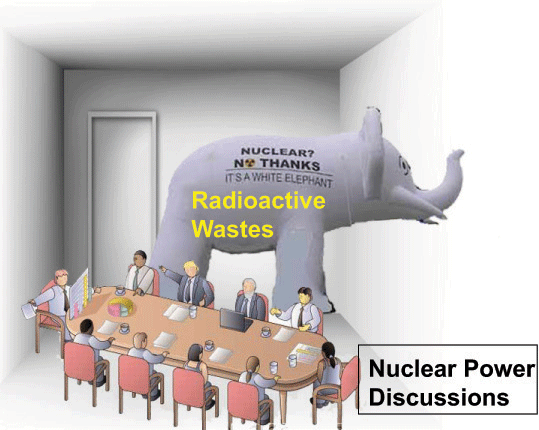 What is to be done with the country’s 70,000 tons of commercial spent nuclear fuel and the 3,000 additional tons per year that the nation will produce?
What to do with United States’ nuclear trash? – This Just In – CNN.com Blogs 13 April 11″……The Japan incident has American politicians advocating to move the United States’ nuclear waste, often stored in pools and casks on the grounds of nuclear power plants, away from highly populated areas. Continue reading
Two Koreas may meet for nuclear negotiations
Chief Nuclear Negotiators from Both Koreas ‘May Meet, The Chosun Ilbo , 12 April 11, ‘South Korea is likely to accept a proposal from China for a three-stage process to revive the stalled six-party talks that would start with an inter-Korean meeting between chief nuclear negotiators as a lead up to North Korea-U.S. talks and the resumption of six-party talks. Continue reading
Japan’s nuclear industry’s future looking gloomy
The Japanese government last June highlighted exports of nuclear-power plants as a pillar of its economic growth strategy….All that now is in doubt. Interest in the companies’ hardware—and nuclear power in general—has fallen sharply as a result of the Fukushima disaster.
Japan’s Nuclear-Reactor Industry Faces Challenge – WSJ.com, Chester Dawson, 12 April 11, As Japanese manufacturers consider moving some operations offshore, another industry is facing yet another challenge……. Before the March 11 earthquake and tsunami, Japanese companies had hoped to export ¥20 trillion, or about $230 billion, a year in nuclear plants and other infrastructure-related business, according to the Japan Bank for International Cooperation. Continue reading
1 This Month

Protect Sazan Island from the Trump family! https://secure.avaaz.org/campaign/en/protect_sazan_island_from_the_trump_family_loc/?bqFCVab&v=174511&cl=22707147157&_checksum=5e9dde668860e8231c33699735e16a1fbf22ab2cb01da50c999fe8732b9775ef&utm_source=email&utm_medium=blast_email&utm_campaign=174511


Cuba Is Not a Failed State – It Is a Besieged State
PETITION: “Global Appeal to Endorse Palestinian Right of Return of Refugees”
To see nuclear-related stories in greater depth and intensity – go to https://nuclearinformation.wordpress.com
-
Archives
- June 2026 (129)
- May 2026 (306)
- April 2026 (356)
- March 2026 (251)
- February 2026 (268)
- January 2026 (308)
- December 2025 (358)
- November 2025 (359)
- October 2025 (376)
- September 2025 (257)
- August 2025 (319)
- July 2025 (230)
-
Categories
- 1
- 1 NUCLEAR ISSUES
- business and costs
- climate change
- culture and arts
- ENERGY
- environment
- health
- history
- indigenous issues
- Legal
- marketing of nuclear
- media
- opposition to nuclear
- PERSONAL STORIES
- politics
- politics international
- Religion and ethics
- safety
- secrets,lies and civil liberties
- spinbuster
- technology
- Uranium
- wastes
- weapons and war
- Women
- 2 WORLD
- ACTION
- AFRICA
- Atrocities
- AUSTRALIA
- Christina's notes
- Christina's themes
- culture and arts
- Events
- Fuk 2022
- Fuk 2023
- Fukushima 2017
- Fukushima 2018
- fukushima 2019
- Fukushima 2020
- Fukushima 2021
- general
- global warming
- Humour (God we need it)
- Nuclear
- RARE EARTHS
- Reference
- resources – print
- Resources -audiovicual
- Weekly Newsletter
- World
- World Nuclear
- YouTube
-
RSS
Entries RSS
Comments RSS
 nuclear-news