Decentralised renewable energy – the way of the future
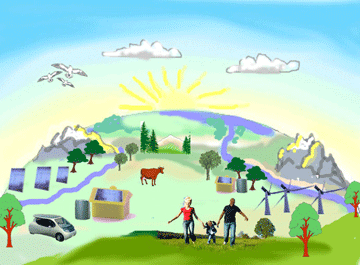 small and medium scale solar power has the potential to become the Internet of distributed electricity generation – a network resilient to a single point of failure; whether caused by natural disasters or attack by hostile parties.
Centralised Vs. Decentralised Solar Power Renewable Energy News, by Energy Matters, 28 April11, As the U.S. begins a major push to become the leading player in the global solar revolution, the topic of sprawling solar farms built away from communities vs. small and medium scale solar arrays utilising rooftops and smaller parcels of already developed or degraded land is becoming an increasingly important issue.
As we’ve reported in the past, small and medium scale solar power has the potential to become the Internet of distributed electricity generation – a network resilient to a single point of failure; whether caused by natural disasters or attack by hostile parties.
But this aspect only scratches the surface – decentralised solar power offers a multitude of other benefits over large scale plants; including avoiding “line loss” associated with remote generation, reduction in infrastructure investment while offering major permanent job creation potential and avoiding damage to wildlife habitats.
Instead of appropriating undisturbed public lands or utilising productive agricultural land for solar power generation on a massive scale, better use can be made of the very much under-utilised sea of rooftops in our towns and cities.
Solar Done Right, a coalition including public land activists, solar power and electrical engineering experts says when all the costs of establishing and maintaining large solar farms are considered; including factoring in transmission infrastructure and inefficiencies; local, distributed solar PV “is comparable in efficiency, faster to bring online, and more cost-effective than remote utility-scale solar plants”.
Earlier this month, the group released a report, “US Public Lands Solar Policy: Wrong From The Start,” which details some of the risks they say are associated with remote, utility-scale power generation and how increased focus on small to medium scale installations can help provide a solution.
However large or small, a solar farm will always be far more environmentally friendly than coal-fired or nuclear power generation facilities in terms of overall impact. But even within clean, renewable energy technology deployment, humanity can strive to have as little impact as possible – and in doing so, reap additional benefits. :http://goo.gl/jiw1K
No comments yet.
1 This Month

of the week – Shut Down Drone Warfare!


Tell the Ukrainian Government to Drop Prosecution of Peace Activist Yurii Sheliazhenko

Petition to revoke the licensing of the Near Surface Nuclear Disposal Facility (NSDF) at Chalk River. https://www.ourcommons.ca/petitions/en/Petition/Details?Petition=e-7247
To see nuclear-related stories in greater depth and intensity – go to https://nuclearinformation.wordpress.com
-
Archives
- March 2026 (244)
- February 2026 (268)
- January 2026 (308)
- December 2025 (358)
- November 2025 (359)
- October 2025 (376)
- September 2025 (257)
- August 2025 (319)
- July 2025 (230)
- June 2025 (348)
- May 2025 (261)
- April 2025 (305)
-
Categories
- 1
- 1 NUCLEAR ISSUES
- business and costs
- climate change
- culture and arts
- ENERGY
- environment
- health
- history
- indigenous issues
- Legal
- marketing of nuclear
- media
- opposition to nuclear
- PERSONAL STORIES
- politics
- politics international
- Religion and ethics
- safety
- secrets,lies and civil liberties
- spinbuster
- technology
- Uranium
- wastes
- weapons and war
- Women
- 2 WORLD
- ACTION
- AFRICA
- Atrocities
- AUSTRALIA
- Christina's notes
- Christina's themes
- culture and arts
- Events
- Fuk 2022
- Fuk 2023
- Fukushima 2017
- Fukushima 2018
- fukushima 2019
- Fukushima 2020
- Fukushima 2021
- general
- global warming
- Humour (God we need it)
- Nuclear
- RARE EARTHS
- Reference
- resources – print
- Resources -audiovicual
- Weekly Newsletter
- World
- World Nuclear
- YouTube
-
RSS
Entries RSS
Comments RSS
 nuclear-news
Leave a comment