Government and nuclear industry intertwined in Japan
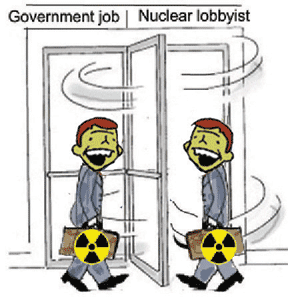 nuclear industry officials, bureaucrats, politicians and scientists — have prospered by rewarding one another with construction projects, lucrative positions, and political, financial and regulatory support. ……Japan would make the sale of nuclear reactors and technology the central component of a long-term export strategy to energy-hungry developing nations. A new company, the International Nuclear Energy Development of Japan, was created to do just that. Its shareholders were made up of the country’s nine main nuclear plant operators, three manufacturers of nuclear reactors and the government itself.
Safety Left Out in Japan’s ‘Nuclear  Power Village, Culture of Complicity Tied to Stricken Nuclear Plant, New York Times, By NORIMITSU ONISHI and KEN BELSON, April 26, 2011 “……..Revolving Door In Japan, the web of connections between the nuclear industry and government officials is now popularly referred to as the “nuclear power village.” The expression connotes the nontransparent, collusive interests that underlie the establishment’s push to increase nuclear power despite the discovery of active fault lines under plants, new projections about the size of tsunamis and a long history of cover-ups of safety problems.
Just as in any Japanese village, the like-minded — nuclear industry officials, bureaucrats, politicians and scientists — have prospered by rewarding one another with construction projects, lucrative positions, and political, financial and regulatory support. The few openly skeptical of nuclear power’s safety become village outcasts, losing out on promotions and backing.
Until recently, it had been considered political suicide to even discuss the need to reform an industry that appeared less concerned with safety than maximizing profits, said Kusuo Oshima, one of the few governing Democratic Party lawmakers who have long been critical of the nuclear industry.
“Everyone considered that a taboo, so nobody wanted to touch it,” said Mr. Oshima, adding that he could speak freely because he was backed not by a nuclear-affiliated group, but by Rissho Kosei-Kai, one of Japan’s largest lay Buddhist movements.
“It’s all about money,” he added.
At Fukushima Daiichi and elsewhere, critics say that safety problems have stemmed from a common source: a watchdog that is a member of the nuclear power village.
Though it is charged with oversight, the Nuclear and Industrial Safety Agency is part of the Ministry of Trade, Economy and Industry, the bureaucracy charged with promoting the use of nuclear power. Over a long career, officials are often transferred repeatedly between oversight and promotion divisions, blurring the lines between supporting and policing the industry.
Influential bureaucrats tend to side with the nuclear industry — and the promotion of it — because of a practice known as amakudari, or descent from heaven. Widely practiced in Japan’s main industries, amakudari allows senior bureaucrats, usually in their 50s, to land cushy jobs at the companies they once oversaw.
According to data compiled by the Communist Party, one of the fiercest critics of the nuclear industry, generations of high-ranking officials from the ministry have landed senior positions at the country’s 10 utilities since Japan’s first nuclear plants were designed in the 1960s. In a pattern reflective of the clear hierarchy in Japan’s ministries and utilities, the ministry’s most senior officials went to work at Tepco, while those of lower ranks ended up at smaller utilities.
At Tepco, from 1959 to 2010, four former top-ranking ministry officials successively served as vice presidents at the company. When one retired from Tepco, his junior from the ministry took over what is known as the ministry’s “reserved seat” of vice president at the company.
In the most recent case, a director general of the ministry’s Natural Resources and Energy Agency, Toru Ishida, left the ministry last year and joined Tepco early this year as an adviser. Prime Minister Naoto Kan’s government initially defended the appointment but reversed itself after the Communist Party publicized the extent of amakudari appointments since the 1960s. Mr. Ishida, who would have normally become vice president later this year, was forced to step down last week.
Kazuhiro Hasegawa, a spokesman for Tepco, denied that it was an amakudari appointment, adding that the company simply hired the best people. The company declined to make an executive available for an interview about the company’s links with bureaucrats and politicians.
…….“Because of this collusion, the Nuclear and Industrial Safety Agency ends up becoming a member of the community seeking profits from nuclear power,” said Hidekatsu Yoshii, a Communist Party lawmaker and nuclear engineer who has long followed the nuclear industry.
Collusion flows the other way, too, in a lesser-known practice known as amaagari, or ascent to heaven. Because the regulatory panels meant to backstop the Nuclear and Industrial Safety Agency lack full-time technical experts, they depend largely on retired or active engineers from nuclear-industry-related companies. They are unlikely to criticize the companies that employ them.
Even academics who challenge the industry may find themselves shunned. As Japan has begun looking into the problems surrounding collusion since March 11, the Japanese news media has highlighted the discrimination faced by academics who raised questions about the safety of nuclear power.
In Japan, research into nuclear power is financed by the government or nuclear power-related companies. Unable to conduct research, skeptics, especially a group of six at Kyoto University, languished for decades as assistant professors.
One, Hiroaki Koide, a nuclear reactor expert who has held a position equivalent to assistant professor for 37 years at Kyoto University, said he applied unsuccessfully for research funds when he was younger.
“They’re not handed out to outsiders like me,” he said.
………Dominion in Parliament
The political establishment, one of the great beneficiaries of the nuclear power industry, has shown little interest in bolstering safety. In fact, critics say, lax oversight serves their interests. Costly renovations get in the way of building new plants, which create construction projects, jobs and generous subsidies to host communities.
The Liberal Democrats, who governed Japan nearly without interruption from 1955 to 2009, have close ties to the management of nuclear-industry-related companies. The Democratic Party, which has governed since, is backed by labor unions, which, in Japan, tend to be close to management.
“Both parties are captive to the power companies, and they follow what the power companies want to do,” said Taro Kono, a Liberal Democratic lawmaker with a reputation as a reformer.
……..So entrenched is the nuclear power village that it easily survived postwar Japan’s biggest political shake-up. When the Democratic Party came to power 20 months ago, it pledged to reform the nuclear industry and strengthen the Nuclear and Industrial Safety Agency……..The new minister, Akihiro Ohata, was a former engineer at Hitachi’s nuclear division and one of the most influential advocates of nuclear power in the Democratic Party. He had successfully lobbied his party to change its official designation of nuclear power from a “transitional” to “main” source of energy…..
As moves to strengthen oversight were put on the back burner, the new government dusted off the energy plan designed by Mr. Kano, the Tepco adviser and former lawmaker. It added fresh details, including plans to build 14 new reactors by 2030 and raise the share of electricity generated by nuclear power and minor sources of clean energy to 70 percent from 34 percent.
What is more, Japan would make the sale of nuclear reactors and technology the central component of a long-term export strategy to energy-hungry developing nations. A new company, the International Nuclear Energy Development of Japan, was created to do just that. Its shareholders were made up of the country’s nine main nuclear plant operators, three manufacturers of nuclear reactors and the government itself.
The nuclear power village was going global with the new company. The government took a 10 percent stake. Tepco took the biggest, with 20 percent, and one of its top executives was named the company’s first president……http://www.nytimes.com/2011/04/27/world/asia/27collusion.html?src=me
No comments yet.
1 This Month

of the week – Shut Down Drone Warfare!


Tell the Ukrainian Government to Drop Prosecution of Peace Activist Yurii Sheliazhenko

Petition to revoke the licensing of the Near Surface Nuclear Disposal Facility (NSDF) at Chalk River. https://www.ourcommons.ca/petitions/en/Petition/Details?Petition=e-7247
To see nuclear-related stories in greater depth and intensity – go to https://nuclearinformation.wordpress.com
-
Archives
- March 2026 (244)
- February 2026 (268)
- January 2026 (308)
- December 2025 (358)
- November 2025 (359)
- October 2025 (376)
- September 2025 (257)
- August 2025 (319)
- July 2025 (230)
- June 2025 (348)
- May 2025 (261)
- April 2025 (305)
-
Categories
- 1
- 1 NUCLEAR ISSUES
- business and costs
- climate change
- culture and arts
- ENERGY
- environment
- health
- history
- indigenous issues
- Legal
- marketing of nuclear
- media
- opposition to nuclear
- PERSONAL STORIES
- politics
- politics international
- Religion and ethics
- safety
- secrets,lies and civil liberties
- spinbuster
- technology
- Uranium
- wastes
- weapons and war
- Women
- 2 WORLD
- ACTION
- AFRICA
- Atrocities
- AUSTRALIA
- Christina's notes
- Christina's themes
- culture and arts
- Events
- Fuk 2022
- Fuk 2023
- Fukushima 2017
- Fukushima 2018
- fukushima 2019
- Fukushima 2020
- Fukushima 2021
- general
- global warming
- Humour (God we need it)
- Nuclear
- RARE EARTHS
- Reference
- resources – print
- Resources -audiovicual
- Weekly Newsletter
- World
- World Nuclear
- YouTube
-
RSS
Entries RSS
Comments RSS
 nuclear-news
Leave a comment