World Heritage Kakadu parkland poisoned by Rio Tinto’s uranium wastes
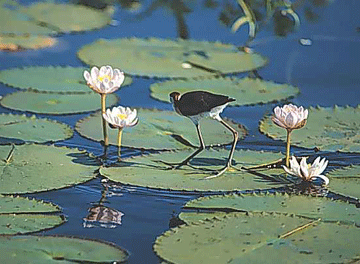 For 30 years about 100,000 litres of contaminated water a day has been leaking from the tailings dam into fissures beneath Kakadu
Radioactive water threatens Kakadu, The Age, Lindsay Murdoch, April 16, 2011 Radioactive water is in danger of spilling into an Aboriginal community and Kakadu’s World Heritage-listed wetlands if record rainfalls continue to deluge the vast Ranger uranium mine.
Mine management faces drastic action to avert an environmental disaster and avoid costly delays that could stall high-grade ore extraction for months or even years.
Rio Tinto-controlled Energy Resources of Australia relies on the Ranger mine, 230 kilometres south-east of Darwin, to supply 10 per cent of the world’s uranium market, including Japan’s stricken Fukushima plant.
ERA will be forced to pump more than 10 billion litres of highly contaminated water from an almost overflowing dam into its operating open cut mine, known as Pit 3, if the Kakadu area receives about 100 millimetres more rain.
This level of rainfall is likely with three weeks of the Top End’s wet season still remaining.
The company conceded this week it will not be able to resume production in the pit until the end of July at the earliest and that its “ultimate contingency” to protect the environment is to transfer water from the tailings dam.
But Pit 3 – the only place available to put the water – already contains 3.6 billion litres of water that is sitting above high high grade ore deposits.
If forced to pump water containing heavy metals and radioactive material from the tailings dam into the pit, ERA would then have to treat all of the water there as highly contaminated.
Sources at the mine say its treatment plants do not have anywhere near the capacity to solve existing water management problems despite recent upgrading of equipment.
For 30 years about 100,000 litres of contaminated water a day has been leaking from the tailings dam into fissures beneath Kakadu but an 18-month review completed last year failed to establish where the water has gone or whether it will damage the environment.
2 Comments »
Leave a comment
1 This Month


Tell the Ukrainian Government to Drop Prosecution of Peace Activist Yurii Sheliazhenko

Petition to revoke the licensing of the Near Surface Nuclear Disposal Facility (NSDF) at Chalk River. https://www.ourcommons.ca/petitions/en/Petition/Details?Petition=e-7247


of the week – STOP SMALL MODULAR REACTORS IN CANADA
To see nuclear-related stories in greater depth and intensity – go to https://nuclearinformation.wordpress.com
-
Archives
- March 2026 (212)
- February 2026 (268)
- January 2026 (308)
- December 2025 (358)
- November 2025 (359)
- October 2025 (376)
- September 2025 (258)
- August 2025 (319)
- July 2025 (230)
- June 2025 (348)
- May 2025 (261)
- April 2025 (305)
-
Categories
- 1
- 1 NUCLEAR ISSUES
- business and costs
- climate change
- culture and arts
- ENERGY
- environment
- health
- history
- indigenous issues
- Legal
- marketing of nuclear
- media
- opposition to nuclear
- PERSONAL STORIES
- politics
- politics international
- Religion and ethics
- safety
- secrets,lies and civil liberties
- spinbuster
- technology
- Uranium
- wastes
- weapons and war
- Women
- 2 WORLD
- ACTION
- AFRICA
- Atrocities
- AUSTRALIA
- Christina's notes
- Christina's themes
- culture and arts
- Events
- Fuk 2022
- Fuk 2023
- Fukushima 2017
- Fukushima 2018
- fukushima 2019
- Fukushima 2020
- Fukushima 2021
- general
- global warming
- Humour (God we need it)
- Nuclear
- RARE EARTHS
- Reference
- resources – print
- Resources -audiovicual
- Weekly Newsletter
- World
- World Nuclear
- YouTube
-
RSS
Entries RSS
Comments RSS
 nuclear-news
One week ago I had the chance to Helen Caldicott live, here are my clips of her speech at Berlin, April 9th 2011, during the IPPNW Fukushima / Chernobyl congress:
http://tekknorg.wordpress.com/2011/04/17/video-dr-helen-caldicott-the-threat-of-atomic-bombs-and-atomic-reactors-april-9th-2011-berlin/
what can we do to keep our sacred kakadu safe and the local traditional owners free form uranium poisoning?