New USA standards will allow higher levels of radiation
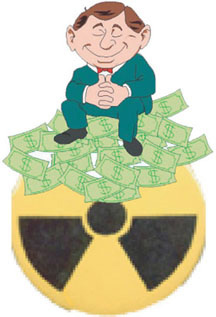 This is being accomplished, of course, to protect the nuclear lobby and its stakeholders from threats to its financial health.
Radiation Spreads Worldwide. The Poisoning of Mother Earth, Global Reseach Ca, by Freedom Against Censorship Thailand (FACT), 14 April 11,“…….However, what we’re seeing, according to the American NGO Public Employees for Environmental Responsibility is the application of new standards which will drastically raise the levels of radiation allowed in food, water, air and the general environment. Access to internal US Environmental Protection Agency communications has revealed a 1,000% increase for exposure to Strontium-90; a 3,000-100,000% rise for Iodine-131; a 25,000% rise for Nickel-63 in drinking water. Continue reading
New surge of radiation above Fukushima reactor No 4
 Tepco said the fuel rods in the Unit 4 pool had released cesium-134 and -137 in the process of being damaged. Cesium-137 has a half-life of 30 years. “Contaminated water leaked From the Unit 2 may have gathered as a lump and drifted offshore,”
Radiation surges above 4’s fuel pool The Japan Times Online By KANAKO TAKAHARA STAFF WRITER, 14 April 11, Radiation has risen to high levels above the spent-fuel pool at reactor No. 4 and its temperature is rising, the nuclear safety agency said Wednesday, indicating the fuel rods have been further damaged and are emitting radioactive substances. Continue reading
Using up USA’s depleted uranium – for weapons in Libya
given the amount of depleted uranium in the hands of the US—one of the few countries that has refused to sign on to the UN’s Human Rights Commission’ ban on the element—we’re going to only further saturate foreign battlefields with the toxic metal in years to come.
 NATO using depleted uranium in Libya RT, 13 April, 2011, Conn Hallinan is a columnist with Foreign Policy in Focus and says that, after examining the impact wounds left on tanks in Libya, he is almost certain that depleted uranium is being utilized. “Politically, it’s a bad idea. Medically, it’s an extremely bad idea. It’s just one of those things that’s an effective weapon that you have to step away from,” says Hallinan, who attests that, while the element is both affordable and powerful, “It’s just a very, very bad idea.” Continue reading
Public pays for “rare event” of a nuclear disaster
If TEPCO were to be held fully responsible for the entire long term costs of the disaster, they would probably go insolvent. In a capitalist system, this ought to happen, otherwise we perpetuate the endemic problem of short-term and sociopathic behaviour on the part of corporations who operate in the knowledge that they’ll never really be held accountable for the negative consequences of their operations…..
Probability and responsibility at Fukushima, Crikey, April 14, 2011 – , by John Hepburn In the long run, the least likely event will occur. Such is the nature of probability, and the nature of risk. Continue reading
Nuclear financial disaster – even without Fukushima
 Energy policy professor Steve Thomas points out that the scale of problems at newbuild reactors in Finland and France has taken even sceptics by surprise. Originally priced at €3bn, the Finnish reactor’s cost is estimated to be at least €5.7bn, and the French reactor is doing just as badly. Britain’s nuclear waste bill is still growing too: liability estimates have grown from £50bn in the mid-2000s to as much as £80bn at present.
Who to trust on nuclear? | Paul Dorfman The Guardian 14 April 11, Even without Fukushima sceptics might wonder why Britain ignores the German lead on energy In the continuing disaster at Fukushima, Japan’s nuclear safety agency has now raised the crisis level to seven: the highest category of nuclear accident. The government is widening the evacuation zone. The unpalatable truth is that the legacy of Fukushima will be with us for a long time to come.
The numbers are staggering. Latest information from nuclear consulting engineer John Large tells us the six reactor cores held 487 tonnes of uranium (of which 95 tonnes includes 230kg of plutonium, an even nastier substance, from the Mox assemblies), with a further 1,838 tonnes of stored spent fuel, including 1,097 tonnes in the central pool store. There is no question there have been very significant and “ongoing” releases of this radioactive inventory.
But even away from this disaster, facts about the industry’s cost and scope to meet Europe’s energy needs should be enough to give nuclear supporters pause. For instance, government figures state that a very ambitious new nuclear-build programme will give us only 4% of the energy we need. Electricity provides only 20% of our energy, and at its peak nuclear only provided 20% of electricity.
Energy policy professor Steve Thomas points out that the scale of problems at newbuild reactors in Finland and France has taken even sceptics by surprise. Originally priced at €3bn, the Finnish reactor’s cost is estimated to be at least €5.7bn, and the French reactor is doing just as badly. Britain’s nuclear waste bill is still growing too: liability estimates have grown from £50bn in the mid-2000s to as much as £80bn at present.
In stark contrast to the “measured exit” from nuclear power of Angela Merkel, the German chancellor, the chief executive of EDF insists that new UK reactors “will have to go ahead” – maybe something to do with the £12.4bn they’ve already spent on buying UK nuclear sites. And when Nick Clegg suggested that the next generation of nuclear power stations may never be built because the recommended higher and more costly safety standards would make them too expensive, Chris Huhne launched an astonishing attack on his party leader, accusing him of behaving like a “headless chicken” on the issue.
Who to trust on nuclear? | Paul Dorfman | Comment is free | The Guardian
Three aspects of Fukushima nuclear crisis
 VIDEO Arnie Gundersen: Three Things You Should Know About Fukushima –– Forbes, Osha Gray Davidson , 13 April 11– Nuclear engineer Arnie Gundersen has plenty of experience with nuclear “events.” He was an expert witness during the investigation of the 1979 Three Mile Island accident and has studied the catastrophic failure at Chernobyl in 1986. He has critics aplenty — primarily from inside the nuclear industry who see him as a turncoat.Still, he’s one of the more knowledgeable sources you can find on nuclear power.In the video below, Gunderson discusses three aspects of the disaster at Fukushima that are worth considering.
Arnie Gundersen: Three Things You Should Know About Fukushima – Osha Gray Davidson – Edison 2.0 – Forbes
Climate change and earthquakes
Earthquakes linked to climate change, The Age, 13 April 11, Long-term climate change could be responsible for moving the Earth’s tectonic plates.A team of scientists based in Australia, France and Germany has established a link between monsoons in India over the past 10 million years and the motion of the Indian plate.The scientists have found that, as monsoons in the area increased, the plate moved by almost one centimetre a year.
The researchers say it’s the first time climate change has been recognised as having the potential to influence the motion of tectonic plates.
“It is known that certain geologic events caused by plate motions have the ability to influence climate patterns over a period of a million years,” Dr Giampiero Iaffaldano from the Australian National University said in a statement. “Now we know that the opposite holds as well…… Earthquakes linked to climate change
Saskatchewan petition against nuclear fuel cycle
Petition against nuclear waste to go to Saskatchewan legislature – Winnipeg Free Press By: The Canadian Press 04/13/2011 SASKATOON – A group says it will present the Saskatchewan government with a petition calling for a law that bans nuclear waste.
The Coalition for A Clean Green Saskatchewan has a petition with more than 4,800 signatures. Spokeswoman Cathy Holtslander says the petition opposes nuclear reactors, uranium refineries, uranium conversion, reprocessing or nuclear waste storage and disposal facilities.
The coalition hopes the petition pushes the government to ban nuclear waste from being stored in the province.It also hopes it raises awareness of the issue.Saskatoon Nutana MLA Pat Atkinson will present the petition in the legislature Thursday morning.Petition against nuclear waste to go to Saskatchewan legislature – Winnipeg Free Press
Radiation contamination in Grand Canyon
Uranium Mining Threatens Grand Canyon Communities | Truthout Cathie Bird, 14 April 11, Over a thousand uranium mines have already contaminated water across the Southwest, poisoning communities with radiation that leads to cancer, harming the biodiversity of rivers and dissipating toxic ore dust into the air. Despite the immeasurable damage the mess of these abandoned mines has inflicted, including the official designation of the Four Corners as a “national sacrifice area,” the federal government and foreign mining companies want to continue uranium mining in the Grand Canyon… Uranium Mining Threatens Grand Canyon Communities | Truthout – MicroHawk’s NewsScan
Fukushima cleanup – unknown cost, unknown magnitude
count on cleanup costing $10 billion. Engineers can break the problem down to the basics, and they know how to do each individual step — but nobody’s ever tried a nuclear cleanup on this scale before….
 AUDIO Cleaning Up Fukushima: A Challenge To The Core : NPR 13 April 2011, “…….Nuclear engineers working at the Japanese plant are dealing with two problems at the same time: They are working to fully stabilize the plant’s reactors, and they are trying to control the release of radioactive material. Continue reading
Connecticut might tax nuclear plant out of existence
Conn. tax plan could shut nuclear plant -lawmakers | Reuters, 13 April, * Dominion could shut Millstone if state passes tax* State seeks $340 million from proposed tax* Power rates in Connecticut second highest in nation The proposed legislation, An Act Concerning Electric Rate Relief (Senate Bill 1176), aims to raise revenue, provide ratepayer relief and fund clean energy projects.The money would come from a tax on the power produced at nuclear, coal and oil-fired generators in the state.The bill is expected to raise about $340 million a year, but Dominion said $330 million of that would come from Millstone, the only nuclear plant in the state.”If the tax passes we will be forced to shut Millstone. That burden of $330 million will make the plant no longer economically viable to operate,” Dominion spokesman Ken Holt told Reuters…..
The stripping of Australian Aboriginal land for the nuclear industry
In May 2010, Ranger – a uranium mine in the Kakadu which local indigenous people resisted since the 1970s – released large quantities of radioactive water into ecologically sensitive wetlands. And in late 2010, controversy emerged over attempts by local officials and mining giant Rio Tinto Alcan to sideline independent indigenous voices during negotiations to re-sign leases for the Nabalco bauxite mine. (Irving, 2011)
Sound familiar? Anyone heard of Tar Creek? Closer to home (relatively), in Oklahoma, there exists an Environmental Protection Agency superfund site called Tar Creek. A terrifying documentary, directed by Matt Myers in 2007 , detailing an American history in which mining for lead (Pb) and zinc (Zn) had been allowed on Native American territory regardless of the Indigenous community’s consent and rightful concern (those in the Bureau of Indian Affairs who objected to the mining were overruled as incompetent and stripped of authority). Over a hundred years has passed and the exploitation had left both Indigenous and non-Indigenous communities marginalized and suffering from Pb and Zn poisoning and water pollution…….
non-governmental organizations , interested in Indigenous human rights, continue to present one example after another in which land tenure and native rights of forest peoples are being ignored.
As we moved forward into the 21st century, consuming our way through limited resources, we need to re-consider the cost of our fuel, our technology, our lifestyles; and I’m not talking about in the sense of pounds, euros or dollars. Your tank of gas, my computer’s electric consumption, is costing us our humanity. The price paid is the continual marginalization, oppression and dehumanization of the original inhabitants of colonized territories. They are losing their culture, their livelihoods, their country.
We can help. We can change. That’s the greatest part about being human: we’re quite resilient and adaptable. Start thinking about where things come from, support those who do it right and debunk those who don’t.
Debunk unjust mineral extraction propaganda that tells you that everything is all right: April Fools, it’s not. Support research that shows that Aboriginal land management equates to a healthy environment and truly see that Australia is amazing.
WIP Talk: Aboriginal Land Management Equates to a Healthy Environment
Who should really be doing the risky cleanup work at Fukushima?
what if there was a kind of conscription, where the names of directors and shareholders were put into a hat, to be randomly selected for frontline roles helping to cool the reactor? What about staff at the banks that financed the plant? Should they be in the conscription pool as well?
Probability and responsibility at Fukushima, Crikey, April 14, 2011 – , by John Hepburn “……It seems to me that it is these workers who are actually the ones who are really taking the responsibility for Fukushima. They are the ones who will live with the consequences. And I think it is useful to ask, who SHOULD be doing this dangerous work? Continue reading
The spread of radiation from Fukushima
Fish in nearby waters are now being measured at 4,000% above the Codex Alimentarius limits for Iodine-131 and 447% of Caesium-137. Radioactive caesium has a half-life of 30 years. Radiation levels for the isotope are not considered “safe” for 10 to 20 times longer. The caesium released today will remain dangerous six centuries from now.
Radiation Spreads Worldwide. The Poisoning of Mother Earth, Global Reseach Ca,by Freedom Against Censorship Thailand (FACT), 14 April 11, “………Radiation in milk in Hawaii is now at least 2,033% above Federal drinking water safety limits. The US safety limit is 3 pCi/l (picoCuries per litre). Note this is the minimum percentage found over EPA requirements. This figure is reached by adding together the Caesium-134 (800%); −137 (633%); and Iodine-131 (600%) levels und in milk. Continue reading
1 This Month


Tell the Ukrainian Government to Drop Prosecution of Peace Activist Yurii Sheliazhenko

Petition to revoke the licensing of the Near Surface Nuclear Disposal Facility (NSDF) at Chalk River. https://www.ourcommons.ca/petitions/en/Petition/Details?Petition=e-7247


of the week – STOP SMALL MODULAR REACTORS IN CANADA
To see nuclear-related stories in greater depth and intensity – go to https://nuclearinformation.wordpress.com
-
Archives
- March 2026 (204)
- February 2026 (268)
- January 2026 (308)
- December 2025 (358)
- November 2025 (359)
- October 2025 (376)
- September 2025 (258)
- August 2025 (319)
- July 2025 (230)
- June 2025 (348)
- May 2025 (261)
- April 2025 (305)
-
Categories
- 1
- 1 NUCLEAR ISSUES
- business and costs
- climate change
- culture and arts
- ENERGY
- environment
- health
- history
- indigenous issues
- Legal
- marketing of nuclear
- media
- opposition to nuclear
- PERSONAL STORIES
- politics
- politics international
- Religion and ethics
- safety
- secrets,lies and civil liberties
- spinbuster
- technology
- Uranium
- wastes
- weapons and war
- Women
- 2 WORLD
- ACTION
- AFRICA
- Atrocities
- AUSTRALIA
- Christina's notes
- Christina's themes
- culture and arts
- Events
- Fuk 2022
- Fuk 2023
- Fukushima 2017
- Fukushima 2018
- fukushima 2019
- Fukushima 2020
- Fukushima 2021
- general
- global warming
- Humour (God we need it)
- Nuclear
- RARE EARTHS
- Reference
- resources – print
- Resources -audiovicual
- Weekly Newsletter
- World
- World Nuclear
- YouTube
-
RSS
Entries RSS
Comments RSS
 nuclear-news