Fukushima nuclear crisis now rated at maximum level 7
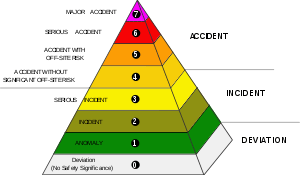 Japan’s reactor crisis hits maximum level, equal to Chernobyl Rick Wallace, Tokyo corresponden The Australian * April 12, 2011 JAPAN will upgrade the rating of the Fukushima nuclear crisis to the same level as the 1986 Chernobyl disaster in the former Soviet Union.
News of the re-rating of the nuclear crisis came as Japan’s main island, Honshu, was battered by another series of strong aftershocks today.
Japan’s chief cabinet secretary Yukio Edano confirmed this morning that the crisis at the Fukushima Daiichi plant would be upgraded from a level 5 to a level 7, which is the maximum, on the international scale…..Japan’s reactor crisis hits maximum level, equal to Chernobyl | The Australian
The difference between radiation emitters – external and internal
The grave effects of internal emitters are of the most profound concern at Fukushima. It is inaccurate and misleading to use the term “acceptable levels of external radiation” in assessing internal radiation exposures. To do so, as Monbiot has done, is to propagate inaccuracies and to mislead the public worldwide (not to mention other journalists) who are seeking the truth about radiation’s hazards.

 How nuclear apologists mislead the world over radiation George Monbiot and others at best misinform and at worst distort evidence of the dangers of atomic energy Helen Caldicott * guardian.co.uk, 11 April 2011
1) Mr Monbiot, who is a journalist not a scientist, appears unaware of the difference between external and internal radiation Continue reading
Off Japan’s coast, radioactive fish found
Radioactive fish found off Japan’s coast Australian Broadcasting CorporationBroadcast: 06/04/2011 Reporter:The Fukushima nuclear emergency in Japan has now led to radiation monitoring in 1,400 schools and a fishing suspension. TONY JONES, PRESENTER: Radiation monitoring has begun at 1,400 schools in Japan because of the Fukushima nuclear emergency.
In seawater close to the facility, the plant’s operator has detected radioactive iodine at 7.5 million times the legal limit. And off Japan’s east coast, radioactive traces have now been found in popular small fish known as young lance. Ten fishing co-operatives in the affected zone have now banned or suspended fishing for that delicacy.
Lateline – 06/04/2011: Radioactive fish found off Japans coast
Radioactive Cesium in Hawaii and other USA locations
 AUDIO Japan Nuclear Radiation In Hawaii Milk At LEAST 600% Above Federal Drinking Water Limits : The Intel Hub By Alexander Higgins – Contributing Writer April 12, 2011 Title of article now represents the minimum percentage that the radiation found in Hawaii is over EPA standards.
New EPA milk samples in Hawaii show radiation in milk at 800% above limits for Cs-134, 633% above limits for Cs-137 and 600% above EPA maximum for I-131 for a total of 2033%, or 20.33 times, above the federal drinking water limits.
New readings have also been posted for Phoenix AZ with milk being above the federal limit and Los Angeles with milk being slightly below the limit for Iodine.
Montpelier VT milk has tested positive for radioactive CS-137, above about 2/3rds the EPA maximum and Spokane WA milk testing less than half the limit for i-131….Japan Nuclear Radiation In Hawaii Milk At LEAST 600% Above Federal Drinking Water Limits :
Dangerously high levels of radiation in northwestern Fukushima Prefecture,
 Radiologist Jan van de Putte told the same news conference that areas with high levels of radioactivity were concentrated in northwestern Fukushima Prefecture, especially in areas between the villages of Iitate and Tsushima, which registered 48 microsieverts per hour.
“This is really dangerous and a very high level,” van de Putte said.
High radiation well past no-go zone: Greenpeace, The Japan Times Online, 12 April 11By JUN HONGO, Staff writer Radiology experts from Greenpeace urged the government to revise their evacuation protocol Monday after they found high levels of radiation around the greater Fukushima area and in the region’s fresh produce.
Nuclear ‘renaissance’ turning into nuclear stillbirth
 Before Fukushima, a “nuclear renaissance” — as it was termed in the press — seemed well underway, except for this point: Nuclear power, as a total of world energy supply, has been in steady decline for the past decade.
Japan: The ‘nuclear renaissance’ that wasn’t | Finance Business News, CNN) 11 April 11, — A month after a devastating earthquake sent a wall of water across the Japanese landscape, the global terrain of the atomic power industry has been forever altered.The ongoing drama at the power plant in Fukushima — a name now ranked alongside Three Mile Island and Chernobyl as history’s worst nuclear accidents — has erased the momentum the nuclear industry has seen in recent years……
Before Fukushima, a “nuclear renaissance” — as it was termed in the press — seemed well underway, except for this point: Nuclear power, as a total of world energy supply, has been in steady decline for the past decade.
From 2000 to 2008, nuclear energy dropped from 16.7% to 13.5% of global energy production, according to the World Nuclear Industry Status Report 2009. The 2010-11 preliminary report, expected to be released Wednesday, will show the downward trend has continued, according to study author Mycle Schneider. While nuclear energy production has steadily increased, its piece of the global electricity pie is shrinking compared to traditional sources such as coal and alternatives like wind and solar power…
Japan: The ‘nuclear renaissance’ that wasn’t | Finance Business News
Nuclear barons queasy, as UK turning anti-nuclear?
The bosses at EDF, Centrica, RWE npower, E.ON and all must be feeling distinctly queasy, after all the time and money they’ve spent on pushing for nuclear power in Britain. They’ve been pretty successful at gaining subsidies for it too – with UK billpayers expected to pay at least £17 more per year by the middle of the decade to encourage the construction programme. Could the years of lobbying fail to pay off?
 Is Chris Huhne preparing for his second U-turn on nuclear? – Telegraph, By Rowena Mason 12 April 11, The previously anti-nuclear Lib Dem, who famously became pro-nuclear on appointment to Energy Secretary, is yet to pronounce definitively on what the Japan atomic disaster may mean for UK plans for 10 new stations. But he has ordered an inquiry into safety concerns and several ministers seem to be smoothing the way for a new official line – that we don’t need nuclear power after all. Continue reading
Pulling apart George Monbiot’s pro nuclear statements
In all this prolific writing in support of nuclear power, Monbiot never quite answers the most difficult questions regarding cost, liability for accidents, nuclear waste disposal and link with nuclear bomb manufacturing. Instead, he chooses to attack his previous allies in the environmental NGOs and movements, ridiculing their struggles as resulting from delusions of ignorant people. No matter how cool he thinks he might look with his supposedly highly rational approach to environmentalism, I’d like to know what exactly is his stance on this critical issue. Is that asking too much?
Why George Monbiot is STILL wrong on nuclear power | Links, By Ricardo Sequeiros Coelho, 11 April 11, “……...Double standard 1: deaths and injuries. According to Monbiot, anti-nuclear campaigners cry in despair over the deaths and injuries caused by nuclear accidents, yet don’t say a word about the victims of the coal industry. …….The game goes on by playing with statistics from Chernobyl. Monbiot again quotes the highly disputed number of 43 deaths from the Chernobyl nuclear meltdown, taken from the Chernobyl Forum report. Not only does he uncritically follow the statistics given by an international body that incorporates one of the strongest pro-nuclear lobbies in the world, he is dishonest enough not to quote it correctly, as Joe Giambrone neatly exposes (see Counterpunch). Continue reading
A Fukushima chill growing over global nuclear energy business
Will Fukushima crisis chill civilian nuclear energy deals? Experts warn that Fukushima should sound an alarm on the safety and security dangers inherent in the spread of civilian nuclear fuels and the proliferation of nuclear technology. CSMonitor.comBy Howard LaFranchi, April 11, 2011Washington
A year after President Obama’s landmark nuclear security summit brought dozens of world leaders to Washington, global powers are making progress at locking down unsecured nuclear materials, some experts say. But at the same time, others caution that the Fukushima nuclear disaster in Japan should put the world – including the United States – on notice about the dangers of spreading nuclear energy technology around the globe….. Will Fukushima crisis chill civilian nuclear energy deals? – CSMonitor.com
How George Monbiot misleads the world on nuclear radiation
by reassuring the public that things aren’t too bad, Monbiot and others at best misinform, and at worst misrepresent or distort, the scientific evidence of the harmful effects of radiation exposure – and they play a predictable shoot-the-messenger game in the process.
How nuclear apologists mislead the world over radiation George Monbiot and others at best misinform and at worst distort evidence of the dangers of atomic energy Helen Caldicott * guardian.co.uk, 11 April 2011 Soon after the Fukushima accident last month, I stated publicly that a nuclear event of this size and catastrophic potential could present a medical problem of very large dimensions. Events have proven this observation to be true despite the nuclear industry’s campaign about the “minimal” health effects of so-called low-level radiation. Continue reading
Continued decline in uranium price
Uranium Prices Drop as Demand Declines on Japan Crisis, Ux Says, Bloomberg By Jason Scott – Apr 12, 2011 “…..The magnitude-9 earthquake and ensuing tsunami on March 11 that caused radiation leaks at the Tokyo Electric Power Co.- operated plant led buyers of the nuclear fuel to retreat, according to Ux. The crisis is likely to hurt the atomic power industry’s credibility more than the 1986 Chernobyl disaster, UBS AG analysts said April 4.
“Activity on the spot market remains limited with very few active buyers or sellers,” Ux said in the report. “Sellers that had been active appear to be taking a more protracted approach to the market,……
Jaitapur nuclear project highlights conflict of interest
 Despite assurances by the government, experts feel an honest assessment of hazards is impossible. “Like the International Atomic Energy Authority, the Indian DAE too is trapped in conflict of interest. They are both the promoters and regulators of atomic energy. How can one expect an honest assessment from them?” asks Krishna. “Safety audit should be independent,” says Bidwai. Even Environment Minister Jairam Ramesh has called for an independent regulatory body for nuclear energy. “Fukushima has changed everything,” says Krishna
JAITAPUR’S own Fukushima | Hard News After the Fukushima nuclear disaster, it’s time for a moratorium on all unsafe nuclear complexes in India, Sadiq Naqvi 12 April 11, “…….”JAPAN HAS CHANGED the paradigm of debate vis-à-vis the proposed Jaitapur nuclear park,” says Vivek Montero of the Konkan Bachao Samiti. He says that the Fukushima disaster has shown that radioactivity affects everything, all life, agriculture, plantations, animals, human lives. “People have categorically stated their position. The question is not of compensation. We don’t want the project, that’s all,” he adds. Continue reading
Steady growth in renewable energy in USA
Energy Use Down, Renewables Up | RenewablesBiz, Wind grew by one-third in 2009 Bill Opalka | Apr 12, 2011, Renewable energy is growing steadily even while the overall economy slumps and energy use from other sources is falling.That’s the gist of a new report from the federal Energy Information Administration, which tracks energy use and projects future supplies. It just released a report that showed that overall use declined for consecutive years, in 2008 and 2009, for reasons outside of the energy sector, for the first time in decades.
U.S. energy consumption declined for the second year in a row in 2009, falling 4.8 percent between 2008 and 2009 to 94.6 quadrillion Btus. This follows a 2.1-percent decline between 2007 and 2008. As a result, total energy consumption in 2009 dropped to its lowest level since 1996…….
the overall shift to renewables from 2005 to 2009 is impressive. Wind has come from a relatively minor renewable energy source to accounting for nearly 10 percent of total renewable energy consumption. Energy Use Down, Renewables Up | RenewablesBiz
Delay in clearance for Nuclear Power Corporation of India’ Jaitapur project
Centre’s clearance for nuke reactors awaited – Hindustan Times, 12 April 11, The aftershocks of the nuclear emergency in Japan are being felt in India, leading to a delay in getting clearance for constructing the first two reactors at the proposed Jaitapur Nuclear Power Plant in Ratnagiri district. The Nuclear Power Corporation of India (NPCIL) that builds and operates nuclear plants is yet to get the Jaitapur project sanctioned by the Central government. Continue reading
Supreme Court upholds State’s rights over water intake at nuclear plant
SJC upholds state’s right to regulate water intake at Pilgrim nuclear – Boston Globe , by Beth Daley, 12 April 11, The state Supreme Judicial Court has upheld Massachusetts’ right to regulate the intake of vast amounts of water by the Pilgrim Nuclear Station and other power plants, which can harm fish and other marine organisms.Power plants use the water to cool equipment then discharge it later — and hotter — into waterways. Environmental studies show the heated water can harm aquatic life. The state and environmentalists have also long argued that the sucking in of water can kill vast amounts of fish larvae, eggs, shellfish, and other aquatic organisms – larger creatures become trapped on screens covering the intake pipes, and smaller ones are sucked into the cooling system. Continue reading
1 This Month

of the week – Shut Down Drone Warfare!


Tell the Ukrainian Government to Drop Prosecution of Peace Activist Yurii Sheliazhenko

Petition to revoke the licensing of the Near Surface Nuclear Disposal Facility (NSDF) at Chalk River. https://www.ourcommons.ca/petitions/en/Petition/Details?Petition=e-7247
To see nuclear-related stories in greater depth and intensity – go to https://nuclearinformation.wordpress.com
-
Archives
- April 2026 (114)
- March 2026 (251)
- February 2026 (268)
- January 2026 (308)
- December 2025 (358)
- November 2025 (359)
- October 2025 (376)
- September 2025 (257)
- August 2025 (319)
- July 2025 (230)
- June 2025 (348)
- May 2025 (261)
-
Categories
- 1
- 1 NUCLEAR ISSUES
- business and costs
- climate change
- culture and arts
- ENERGY
- environment
- health
- history
- indigenous issues
- Legal
- marketing of nuclear
- media
- opposition to nuclear
- PERSONAL STORIES
- politics
- politics international
- Religion and ethics
- safety
- secrets,lies and civil liberties
- spinbuster
- technology
- Uranium
- wastes
- weapons and war
- Women
- 2 WORLD
- ACTION
- AFRICA
- Atrocities
- AUSTRALIA
- Christina's notes
- Christina's themes
- culture and arts
- Events
- Fuk 2022
- Fuk 2023
- Fukushima 2017
- Fukushima 2018
- fukushima 2019
- Fukushima 2020
- Fukushima 2021
- general
- global warming
- Humour (God we need it)
- Nuclear
- RARE EARTHS
- Reference
- resources – print
- Resources -audiovicual
- Weekly Newsletter
- World
- World Nuclear
- YouTube
-
RSS
Entries RSS
Comments RSS
 nuclear-news