Pacific peoples endangered by radiation in fish
 claims by some Japanese scientists said that the radioactivity found in fish will be concentrated in the bones, and thus not harmful to humans, didn’t make sense. “Each year, thousands of tons of fish and their bones are processed into fish meal, animal food and in part to fish sticks,”
Radioactive Decay an Emerging Threat for Pacific People, Online Journal Apr 5, 2011, by David Hope Radioactive decay is looming as a tremendous threat to the Pacific people. Radioactivity unleashed by the Japanese Fukushima reactor into the Pacific Ocean endangers the livelihoods of millions of people, Continue reading
No one knows how to deal with Fukushima’s radioactive water
 international law forbids Japan from dumping contaminated water into the ocean if there are viable technical solutions available down the road….So Tepco is considering bringing in barges and tanks, including a “megafloat” that can hold about 2.5 million gallons….Yet even using barges and tanks to temporarily handle the water creates a future problem of how to dispose of the contaminated vessels.
 Cleaning up Japan’s radioactive water could take decades, latimes.com, 7 April 11, No one is sure how to safely dispose of millions of gallons of highly radioactive water at the Fukushima Daiichi nuclear plant. ‘There is nothing like this, on this scale, that we have ever attempted to do before,’ a U.S. expert says. Continue reading
Never mind the Fukushima tragedy, it’s the nuclear COST, stupid!
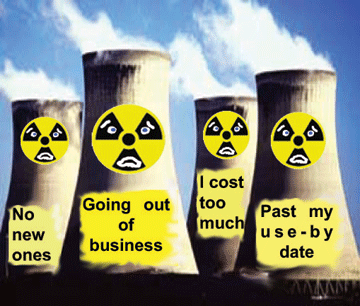 It’s time to let the market pick our winners, not outrageous government subsidies for nuclear power…..we should abandon this costly boondoggle for more cost-effective and renewable energy sources.
Cost, Not Japan Crisis, Should Scrub Nuclear Power, RENEWABLE ENERGY WORLD, By John FarrellApril 6, 2011 The plumes of smoke rising, and radiation leaking, from Japan’s Fukushima Daiichi nuclear reactor provoke a visceral reaction. But the crisis should not persuade Americans to abandon nuclear power.
Instead, Americans should abandon nuclear power for its prohibitive and un-competitive costs. Continue reading
Radioactive Cesium can travel up the food chain, in fish
Power company back pedals over reactor plans, Sydney Morning Herald, Andrew Higgins April 7, 2011, FUKUSHIMA:”…….After unsuccessful attempts with concrete, and even newspapers and sawdust, engineers used sodium-silicate to stop the leak, but radioactivity in fish exceeding health guidelines has been detected for the first time off northern Japan.Caesium radioactivity in sand lance caught south of the Fukushima Daiichi plant was 526 becquerel per kilogram, compared with a health ministry standard of 500 becquerel.With a radioactive half-life of 30 years, caesium can build up in the meat of marine predators as they eat smaller animals…..Power company back pedals over reactor plans
Increase in CT scans for children brings radiation danger
 Children are far more vulnerable to radiation exposure than are adults:
- Children’s organs are more sensitive to radiation than adults’ organs.
- Children have a longer life expectancy than adults, giving cancer a longer time to form.
- Radiation settings often may not be set to match children’s body size.
- Because CT use is increasing, children may eventually receive a higher lifetime dose of medical radiation……..
As Kids’ CT Scans Rise, So Do Radiation WorriesMore Kids Getting More Scans at ERs, but Few See Pediatric Radiologists By Daniel J. DeNoon WebMD Health News Reviewed by Laura J. Martin, MD April 6, 2011 — Emergency CT scans for kids are on the rise — and so are worries that too many children are getting too much radiation too early in life. Continue reading
Nuclear power’s secrets and lies to protect the industry from public scrutiny
 Secrets, lies and why we need scrutiny of the nuclear industry The Guardian, David Byers, Founder director, Renewable Energy Association, ex-nuclear integrity scientist, 7 April 2011 “…..the essential truth. Civil nuclear power is shrouded in the UK not to protect facts from terrorists but because it has well understood risks and is captured under the Official Secrets Act. The economics, the legacy situation and the carbon cycle are hidden from the population. The Sellafield site is “privately managed” but publicly owned, its liabilities being passed like a parcel between successive “managers”, because of its toxic contents.
I am not anti-nuclear but pro-renewable energy. The scrutiny exacted upon renewable energy is absent when it comes to nuclear energy. My objection is not the nuclear option, it is the secrecy. This is a political and economic decision related to energy futures, security of supply and carbon. I find it mesmerising when journalists and politicians conspire to debate the issue, never telling the technical truth of the legacy, mostly because they don’t know.
I call for a public and independent assessment of our UK Sellafield complex. Risks and costs need to be explained to the population. If this technology is part of our future energy mix, take the lies and the secrecy away. Letters: Secrets, lies and why we need scrutiny of the nuclear industry | Environment | The Guardian
Risk of new explosion at Fukushima, -gas being pumped in
Experts say the risk of a detonation could rise as the nuclear fuel rods cool and as the steam inside the containment vessel condenses into water, reducing pressure inside the unit and drawing air in through cracks.
Japan using gas to avoid explosion at nuclear plant, THE STRAITS TIMES, Apr 7, 2011 Japan using gas to avoid explosion at nuclear plantTOKYO – WORKERS at Japan’s stricken nuclear plant on Thursday pumped nitrogen gas into a crippled reactor in a bid to contain the world’s worst atomic accident for 25 years and prevent a possible explosion. Continue reading
Anti nuclear enthusiasm brings political triumph to Germany’s Green Party
German Greens surge on anti-nuclear fervour, FT.com, By Gerrit Wiesmann in BerlinPublished: April 6 2011 Anti-nuclear sentiment and regional election triumphs have helped Germany’s Greens to unprecedented popularity, according to a poll which puts them ahead of the Social Democrats and just shy of the ruling Christian Democrats.Forsa, the polling group, on Wednesday said the Greens gained seven points since the Baden-Württemberg March election at the end of March to hit a record 28 per cent – enough to lead a “green-red” government with the Social Democrats.
The result beats the Greens’ previous record of 25 per cent in a Forsa poll, which they achieved last autumn …FT.com / Europe – German Greens surge on anti-nuclear fervour
In USA renewable energy climbing, nuclear going down
Surging Renewable Sector Pulls Even With Nuclear Power in U.S. OnEarth Magazine By Douglas Fischer April 6, 2011 Declining nuclear power and a strengthening renewable fuels sector have left the two energy sources neck-and-neck for their share of U.S. energy production, according to the most recent figures from the U.S. Energy Information Administration.
The percent of domestic energy production obtained from renewable fuels — biomass, geothermal, solar, wind and water — rose to 10.9 percent last year, up from 10.6 percent in 2009. Meanwhile nuclear energy dipped from 11.5 percent in 2009 to 11.3 percent in 2010……The data were compiled before the 9.0 temblor and subsequent tsunami devastated Japan’s Fukushima nuclear power plant and cast doubts on nuclear power worldwide….
Nuclear plant for sale – but no buyers
Hey, Wanna Buy a Nuclear Power Plant? – The Source – WSJ, 6 April 11, “………Nestled on the bank of the Isar river, there’s an unusual piece of real estate for sale in Bavaria. It’s the Isar II nuclear energy plant, or at least a 25% stake in it, for sale by Stadtwerke Muenchen, Munich’s regional utility.
SWM has in fact been trying to sell its stake in Isar II since the 1990s, but without success. In the early 2000s, the utility published an international call for bids in the Financial Times, a spokesman said, but that also did not end in a sale, and the utility appears to be saddled with the power plant until it becomes obsolete.
“With the future of nuclear energy totally uncertain [in Germany], there’s no buyer who would go into such a deal blind,” said Ingo Becker, an energy analyst at Kepler Capital Markets……investors are unable to assess the potential value of the plant.
On top of that, in the wake of Fukushima, the fact that nuclear power plants can’t be insured has made investors take an even more sober view of the industry…..Hey, Wanna Buy a Nuclear Power Plant? – The Source – WSJ
Citizens battle to save Grand Canyon from uranium mining
Razing Arizona? Citizens Fight to Protect the Grand Canyon from Uranium Mining, Change.org News by Jess Leber · April 04, 2011 Every year, 5 million tourists from all over the world flock to the Grand Canyon in Arizona, where they can view 2 billion years of geologic history in its glory.
Today, this national landmark is under threat. Continue reading
Serious threats remain at Fukushima nuclear plant
New Dangers Emerge at FukushimaA confidential document includes new information about the damage at the plant, and new threats. Technology review, Kevin Bullis 04/06/2011 A confidential Nuclear Regulatory Commission document obtained by the New York Times details serious threats still facing workers at the severely damaged Fukushima nuclear plant, as well as previously undisclosed details about what has happened at the plant so far. Ordinarily, fuel in a nuclear plant cools to the point that it is easy to manage within several days after the reactor is shut down. But difficulty circulating water and damage to the fuel rods suggest keeping them cool could be a challenge for months….
New Dangers Emerge at Fukushima – Technology Review
Fish off Japan found to contain radioactive Cesium
Toxic caesium found in fish off Japan, ABC News (Australian Broadcasting Corporation), By North Asia correspondent Mark Willacy, 7 April 11 Traces of radioactive caesium have been found for the first time in fish off Japan’s east coast.
It is believed the contamination came from overheated fuel rods at the crippled Fukushima nuclear plant. Continue reading
Inadequate radiation monitoring in USA
.. elevated levels of iodine-131 in rain “a red flag” for public health and said that he is concerned that the Nuclear Regulatory Commission, which has less stringent radiation exposure guidelines, has superseded the EPA in US response activities……
Adequacy of EPA radiation monitoring system called into question | Michigan Messenger, 6 April 11, Data from the U.S. Environmental Protection Agency’s network of radiation monitors does not reach the public quickly and some monitors are not functional, critics say. Continue reading
Two days after Fukushima disaster TEPCO planned 2 new reactors there
Tepco announced last week that four reactors at the centre of the crisis will never go back into service. At the same time, however, it submitted a report to the Ministry of Economy, Trade and Industry that included a proposed timetable for the construction and commissioning of two new reactors – No. 7 and No. 8 – at the same complex….
Power company back pedals over reactor plans, Sydney Morning Herald, Andrew Higgins April 7, 2011, FUKUSHIMA: Even as it struggled to contain the world’s worst nuclear disaster in a quarter of a century, Tokyo Electric Power Company late last month quietly set out big plans for the future: it proposed building two new nuclear reactors at its radiation-spewing Fukushima Daiichi power plant. Continue reading
1 This Month

of the week – Shut Down Drone Warfare!


Tell the Ukrainian Government to Drop Prosecution of Peace Activist Yurii Sheliazhenko

Petition to revoke the licensing of the Near Surface Nuclear Disposal Facility (NSDF) at Chalk River. https://www.ourcommons.ca/petitions/en/Petition/Details?Petition=e-7247
To see nuclear-related stories in greater depth and intensity – go to https://nuclearinformation.wordpress.com
-
Archives
- March 2026 (230)
- February 2026 (268)
- January 2026 (308)
- December 2025 (358)
- November 2025 (359)
- October 2025 (376)
- September 2025 (257)
- August 2025 (319)
- July 2025 (230)
- June 2025 (348)
- May 2025 (261)
- April 2025 (305)
-
Categories
- 1
- 1 NUCLEAR ISSUES
- business and costs
- climate change
- culture and arts
- ENERGY
- environment
- health
- history
- indigenous issues
- Legal
- marketing of nuclear
- media
- opposition to nuclear
- PERSONAL STORIES
- politics
- politics international
- Religion and ethics
- safety
- secrets,lies and civil liberties
- spinbuster
- technology
- Uranium
- wastes
- weapons and war
- Women
- 2 WORLD
- ACTION
- AFRICA
- Atrocities
- AUSTRALIA
- Christina's notes
- Christina's themes
- culture and arts
- Events
- Fuk 2022
- Fuk 2023
- Fukushima 2017
- Fukushima 2018
- fukushima 2019
- Fukushima 2020
- Fukushima 2021
- general
- global warming
- Humour (God we need it)
- Nuclear
- RARE EARTHS
- Reference
- resources – print
- Resources -audiovicual
- Weekly Newsletter
- World
- World Nuclear
- YouTube
-
RSS
Entries RSS
Comments RSS
 nuclear-news