Why a doctor chose not to have airport radiation scanning
Radiation exposure, however small, is a known risk to our health. My bottom line: Must I receive radiation for lack of an alternative? In this scenario, thankfully, no. The alternative in this case is that full body pat-down, completely devoid of any radiation exposure. So, for now, I choose the latter
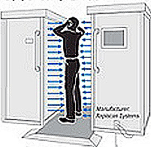
Dr. Cindy Haines: Why I Said ‘No’ to Backscatter Scanning, THE HUFFINGTON POST 1 April 11, There are two types of these advanced imaging technologies: the backscatter scanners [at left] (which use ionizing radiation) and millimeter-wave scanners[at right] 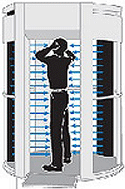 (which emit low-energy waves).
This terminal happened to have the backscatter scanners and — lo and behold — I was chosen for it. My only alternative? The controversial physical screen. And surely nothing says “Good Morning” like a full body pat-down, with lots of on-lookers to enjoy the show.
I was certainly not happy about this invasive maneuver but I found it to be preferable over the quicker and more efficient scan. This, despite the fact that I have researched and written on the very low risk that is associated with these backscatter scanners. So why my refusal of the scan?
It is purported that the long-term health dangers from these radiation-emitting scanners are inconsequential. In fact, this past Monday a study was released online in the Archives of Internal Medicine, proclaiming the relative safety of these devices.
The researchers report that one scan delivers only about three to nine minutes of the radiation received through everyday living. “Based on what is known about the scanners, passengers should not fear going through the scans for health reasons, as the risks are truly trivial,” the authors wrote. “If individuals feel vulnerable and are worried about the radiation emitted by the scans, they might reconsider flying altogether since most of the small, but real, radiation risk they will receive will come from the flight and not from the exceedingly small exposures from the scans.”
Still, questions remain over radiation risks and not all experts are in agreement of the safety of this “security blanket.” What’s more: Science is fallible. What we think we know today, may not be the case tomorrow, next week, next year …
What we do know is this: Radiation has risks. Of course, this is a graded phenomenon. Some types of radiation are more risky than others; more exposure, more risk. These scans intend to emit very, very low doses. In fact, you’d need to get 1000 of them a year to approach the same level of radiation you’d get from one chest x-ray (so says the manufacturer of one of these devices).
But experts have noted that scientists have not been able to independently measure and verify radiation doses from these machines because they have not been allowed such access to the scanners. Furthermore, one expert has expressed concern over hypothetical situations where system failure might cause an inadvertent high dose of radiation rather than the low dose intended………
In my book, The New Prescription: How to Get the Best Health Care in a Broken System, I discuss how little things, day in and day out, can add up to better — or worse — health. Radiation exposure, however small, is a known risk to our health. My bottom line: Must I receive radiation for lack of an alternative? In this scenario, thankfully, no. The alternative in this case is that full body pat-down, completely devoid of any radiation exposure.
So, for now, I choose the latter
Dr. Cindy Haines: Why I Said ‘No’ to Backscatter Scanning
No comments yet.
1 This Month


Tell the Ukrainian Government to Drop Prosecution of Peace Activist Yurii Sheliazhenko

Petition to revoke the licensing of the Near Surface Nuclear Disposal Facility (NSDF) at Chalk River. https://www.ourcommons.ca/petitions/en/Petition/Details?Petition=e-7247


of the week – STOP SMALL MODULAR REACTORS IN CANADA
To see nuclear-related stories in greater depth and intensity – go to https://nuclearinformation.wordpress.com
-
Archives
- March 2026 (212)
- February 2026 (268)
- January 2026 (308)
- December 2025 (358)
- November 2025 (359)
- October 2025 (376)
- September 2025 (258)
- August 2025 (319)
- July 2025 (230)
- June 2025 (348)
- May 2025 (261)
- April 2025 (305)
-
Categories
- 1
- 1 NUCLEAR ISSUES
- business and costs
- climate change
- culture and arts
- ENERGY
- environment
- health
- history
- indigenous issues
- Legal
- marketing of nuclear
- media
- opposition to nuclear
- PERSONAL STORIES
- politics
- politics international
- Religion and ethics
- safety
- secrets,lies and civil liberties
- spinbuster
- technology
- Uranium
- wastes
- weapons and war
- Women
- 2 WORLD
- ACTION
- AFRICA
- Atrocities
- AUSTRALIA
- Christina's notes
- Christina's themes
- culture and arts
- Events
- Fuk 2022
- Fuk 2023
- Fukushima 2017
- Fukushima 2018
- fukushima 2019
- Fukushima 2020
- Fukushima 2021
- general
- global warming
- Humour (God we need it)
- Nuclear
- RARE EARTHS
- Reference
- resources – print
- Resources -audiovicual
- Weekly Newsletter
- World
- World Nuclear
- YouTube
-
RSS
Entries RSS
Comments RSS
 nuclear-news
Leave a comment