Don’t be the nuclear industry’s April fool

Christina Macpherson's websites & blogs
When you check out the nuclear news, you find plenty of cosy little items saying how Chernobyl  wasn’t so bad – very few deaths etc. How low level radiation is not harmful to you, might even be good. How ‘progress’ is being made on the Fukushima cleanup. How it was all the fault of TEPCO anyway – the industry as a whole is safe, really. The new model nuclear reactors are really really really safe.
Don’t believe it. In 2011 – 25 years after the Chernobyl explosion, it’s just the right time for cancers to emerge in those who were subjected to “low level” radiation in the Ukraine. While it is true that one individual’s risk of cancer is small from exposure to low levels of radiation, exposure of many to this radiation will produce cancers in some of them. The world’s scientific authorities are united in pronouncing that there is no safe level for ionising radiation.
As to the safety of nuclear reactors, and the effects of radiation from even the normal operations of the nuclear fuel cycle – ask yourself who is supplying this information – “What’s in it for whom?
There may be some legitimate grounds for minimising the effects of the Fukushima radiation – a reasonable aim by authorities to prevent panic, and perhaps to save the businesses of farmers whose produce is not radioactive. To avoid unnecessary anxiety in countries distant from Japan. Just ask “What’s in it for whom? – Christina Macpherson
100 years before Fukushima’s nuclear fuel rods are safe
 Crews ‘facing 100-year battle’ at Fukushima, ABC News (Australian Broadcasting Corporation)By David Mark, Mark Willacy, 1 April 11, A nuclear expert has warned that it might be 100 years before melting fuel rods can be safely removed from Japan’s Fukushima nuclear plant. Continue reading
The ‘Fukushima 50’ heroic workers expect to die from radiation
 Japan nuclear crisis: Fukushima 50 ‘expect to die’ Workers who have been fighting to bring the reactors under control at Japan’s strick nuclear plant expect to die from radiation sickness, according to the mother of one of the men. – Telegraph, By Danielle Demetriou in Tokyo 31 Mar 2011
The so-called Fukushima 50, the group of around 300 technicians, soldiers and firemen who work in shifts of 50, have been exposed repeatedly to dangerously high radioactive levels as they attempt to avert a nuclear disaster.The mother of one of the men has admitted that the group have discussed their situation and have accepted that death is a strong possibility.
“My son and his colleagues have discussed it at length and they have committed themselves to die if necessary in the long-term.” Japan nuclear crisis: Fukushima 50 ‘expect to die’ – Telegraph
1000 Japanese bodies irradiated near Fukushima Dai-ichi nuclear plant
 Radiation leaves 1,000 tsunami bodies near nuke plant off-limits, USA Today, Mar 31, 2011 Radiation within 12 miles of the leaking Fukushima Dai-ichi nuclear plant has prevented the recovery of about 1,000 victims of the March 11 earthquake and tsunami, Kyodo News reports.
Even after the bodies are recovered and returned to families, how relatives choose to say goodbye to loved ones will pose health and safety dielmmas, sources said: Cremation could spread radioactive material, while conventional burial would contaminate soil.
Police sources said today that bodies had been exposed to high levels of radiation after death and that officials are reconsidering their plan to inspect the bodies after removing them from the evacuation zone……Radiation leaves 1,000 tsunami bodies near nuke plant off-limits –
Unsafe for rescuers to retrieve irradiated bodies around Fukushima No 1 plant
 The rescuers are now in a bind. Even if they retrieve the bodies, anyone who comes into contact with them risks being irradiated, too, whether they’re in the evacuation zone or not.
In Japan, a grisly consequence of radiation ajc.com March 31, 2011, by JayBoy, hadn’t thought about this aspect of the tragedy in Japan … from the Japan Times: Radiation is preventing the retrieval of hundreds of bodies from inside the 20-km evacuation zone around the Fukushima No. 1 nuclear power plant, police sources said Thursday……. Continue reading
Aerial views of Fukushima Dai-ichi nuclear power complex
 PHOTOS Bird’s-Eye View Of Japan’s Stricken Nuclear Plant Shows Vast Damage : The Picture Show : NPR, by Andrew Prince, 31 March, Our reporters and photographers on the ground in Japan have helped us hear and see the destruction wrought by the massive quake and tsunami that struck the island nation March 11. In contrast, the crisis unfolding at the Fukushima Dai-ichi nuclear power complex remains largely opaque.
Mostly, that’s because damage to the nuclear reactors and the buildings that house them makes for hazardous and radioactive conditions. Forget about access for journalists: Workers can’t even get too close for too long. Four of the facility’s six reactor units have been badly damaged by explosions and fires triggered by failures in emergency cooling systems in the wake of the quake and tsunami. These aerial photographs of the facility, taken by a drone on March 20 and 24, put a new face on the ongoing nuclear crisis….. Bird’s-Eye View Of Japan’s Stricken Nuclear Plant Shows Vast Damage : The Picture Show : NPR
Nuclear power now losing its glow in France
 France has quietly begun reassessing the risks of nuclear power…… “Climate change is changing the situation,” he said, “Extreme events that so far happened every thousand years along the coast now happen every hundred years.”…..
 France Gives Its Nuclear Power Industry a 2nd Look NYTimes.com By KATRIN BENNHOLD and DAVID JOLLY March 31, 2011 PARIS — The Fukushima nuclear crisis has prompted anti-nuclear marches across the world, persuaded the Chinese authorities to delay the construction of new reactors and helped the German government lose an important state election. Continue reading
The uranium boom- over before it’s begun
 virtually impossible to get new financing to develop projects for which there will be no economic justification. This will all be reflected in a slow, inexorable decline in share prices
The bull market in uranium is over, – MoneyWeek. By Dominic Frisby Mar 31, 2011 “The worldwide backlash against the nuclear power industry is only beginning to be felt and promises to deal a devastating blow long-term to the uranium stock sector. The catastrophic events in Japan were followed by a precipitous drop in uranium share prices, which have just had their obligatory dead cat bounce. Continue reading
Why a doctor chose not to have airport radiation scanning
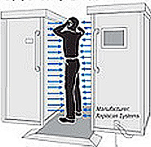
Radiation exposure, however small, is a known risk to our health. My bottom line: Must I receive radiation for lack of an alternative? In this scenario, thankfully, no. The alternative in this case is that full body pat-down, completely devoid of any radiation exposure. So, for now, I choose the latter
Dr. Cindy Haines: Why I Said ‘No’ to Backscatter Scanning, THE HUFFINGTON POST 1 April 11, There are two types of these advanced imaging technologies: the backscatter scanners [at left] (which use ionizing radiation) and millimeter-wave scanners[at right]  (which emit low-energy waves).
This terminal happened to have the backscatter scanners and — lo and behold — I was chosen for it. My only alternative? The controversial physical screen. And surely nothing says “Good Morning” like a full body pat-down, with lots of on-lookers to enjoy the show.
I was certainly not happy about this invasive maneuver but I found it to be preferable over the quicker and more efficient scan. This, despite the fact that I have researched and written on the very low risk that is associated with these backscatter scanners. So why my refusal of the scan? Continue reading
Low level radiation increases the probability of cancer
Any increase in radiation increases the probability that you’ll get cancer. And that’s not radiation sickness but that is a much more pervasive effect than acute radiation sickness. When you look at the nuclear fuel cycle you have to look at how much radiation is released in its many different forms and how many people that over their lifetime would have shortened their lifetimes.
VIDEO Q&A: Japan nuclear crisis ‘getting worse’ : World News Australia on SBS : World News Australia on SBS31 March 2011 Australia won’t be exposed to a substantial increase in radioactivity as Japan’s nuclear crisis unfolds, but the situation at Fukushima’s crippled power plants is getting worse, Continue reading
Call for stopping India’s nuclear industry, and for independence in regulatory authority
The nuclear regulator must also be completely independent of the department of atomic energy (DAE),”……….Balaram’s demand for a moratorium — stopping nuclear power production for the time being — is likely to embarrass the government because of the positions he holds…….India’s nuclear power regulator – the Atomic Energy Regulatory Board – reports to the DAE, which is in charge of approving projects, creating a potential conflict of interest.
Top scientist calls for halt to N-power Charu Sudan Kasturi , Hindustan Times New Delhi, April 01, 2011 A top scientist on the Prime Minister’s scientific advisory council on Thursday demanded a nuclear moratorium following the Fukushima nuclear plant disaster in quake-ravaged Japan. This is the first direct call from within the government for a temporary stop to nuclear power production. P Balaram, Continue reading
Swiss nuclear power industry office attacked by letter bomb
Letter bomb at Swissnuclear TODAYonline Apr 01, 2011 OLTEN (Switzerland) – A letter bomb exploded yesterday at an office of the Swiss nuclear power industry in the northern city of Olten, injuring two people, according to the police.
he explosion happened shortly after 8am local time, as staff were opening the morning’s post in the fourth-floor office of Swissnuclear, said police spokeswoman Thalia Schweizer. She added that two female employees were taken to hospital with superficial burns and hearing damage. Police cordoned off the office of Swissnuclear – a lobby representing national power companies Axpo, Alpiq and BKW – and Ms Schweizer said they had forensic specialists on the ground.
Switzerland has five nuclear reactors currently in operation and opponents of nuclear power in the country have become more vocal in recent weeks following Japan’s nuclear crisis……….TODAYonline | World | Letter bomb at Swissnuclear
Fukushima nuclear plant news items 31 March
China May Double Solar Goal After Japan Nuclear Leak: Report
China may double its target for photovoltaic power capacity over the next five years in the wake of Japan’s nuclear crisis, the official China Securities Journal reported on Wednesday.
http://planetark.org/enviro-news/item/61634
Japan PM says stricken nuclear plant to be scrapped
Japan said Thursday its crisis-hit nuclear plant must be scrapped, but currently had no plans to evacuate more people, despite calls for a larger exclusion zone around the crippled facility.
http://news.theage.com.au/breaking-news-world/japan-pm-says-stricken-nuclear-plant-to-be-scrapped-20110331-1cnm0.html
Japan’s nuclear setbacks mount
Setbacks are growing in the crisis over Japan’s tsunami-damaged nuclear facility, with nearby seawater testing at its highest radiation levels yet.
http://www.theage.com.au/world/japans-nuclear-setbacks-mount-20110331-1cn9f.html
Fukushima effect hits uranium producer
Occasionally, during market panic, good-quality companies are thrown out with the bad. This can create opportunities and one is right at ground zero as far as the present volatility is concerned. Paladin Energy suffered a vicious bout of selling as soon as the market became aware of Japan’s nuclear crisis.
http://www.theage.com.au/money/investing/fukushima-effect-hits-uranium-producer-20110329-1ce2n.html
Radiation rising beyond exclusion zone
TOKYO: Pressure is growing on Japan to expand the 20-kilometre exclusion zone around Fukushima after the International Atomic Energy Agency said radiation in one village 40 kilometres away had reached evacuation level.
http://www.smh.com.au/environment/radiation-rising-beyond-exclusion-zone-20110331-1cnh1.html
‘Minuscule’ radiation in US milk
A “minuscule” amount of radiation from iodine-131 has been detected in a sample of milk that was tested from the US north-west, US authorities say.
http://www.smh.com.au/environment/minuscule-radiation-in-us-milk-20110331-1cnkl.html
Japan’s crippled reactors may be shrouded
Japan is considering draping crippled reactor buildings at the Fukushima nuclear plant with a fabric to reduce radiation and using a tanker to siphon off contaminated water, a report says.
http://www.smh.com.au/world/japans-crippled-reactors-may-be-shrouded-20110330-1cg5a.html
Radiation hits Japan ‘safe’ zone
JAPAN was resisting pressure last night to expand the evacuation zone around the crippled Fukushima Daiichi nuclear plant.
http://www.theaustralian.com.au/news/world/radiation-hits-japan-safe-zone/story-e6frg6so-1226031625236
Nuclear plant must be scrapped: Japan PM
JAPANESE Prime Minister Naoto Kan said that the nuclear plant at the centre of the world’s worst atomic accident since Chernobyl must be scrapped.
http://www.theaustralian.com.au/news/world/fukushima-nuclear-plant-must-be-scrapped-says-naoto-kan/story-e6frg6so-1226031522480
Radical measures at Japan reactor
JAPAN is weighing up a series of solutions to its nuclear disaster, from draping reactors with special fabric to sending in military robots to do the risky work.
http://www.theaustralian.com.au/news/world/blankets-air-filters-robots-among-nuclear-reactor-remedies/story-e6frg6so-1226031245526
Radioactive groundwater below nuclear plant
HIGH levels of radioactive iodine-131 that are 10,000 times the government safety standard have been found in groundwater below Japan’s stricken nuclear plant, its operator TEPCO says.
http://www.heraldsun.com.au/news/breaking-news/radioactive-groundwater-below-nuclear-plant/story-e6frf7jx-1226031723826
Man crashes truck through nuke plant gates
A MAN driving a truck yesterday crashed his vehicle through the gates of a Japanese nuclear plant and was arrested by police, officials said.
http://www.heraldsun.com.au/news/breaking-news/man-crashes-truck-through-nuke-plant-gates/story-e6frf7jx-1226031721362
IAEA says Fukushima fallout warrants more evacuation
The International Atomic Energy Agency says that contamination outside the Fukushima evacuation zone has exceeded levels at which people should relocate
http://www.newscientist.com/article/dn20324-iaea-says-fukushima-fallout-warrants-more-evacuation.html
Are nuclear reactions restarting at Fukushima?
Two unusual measurements could be caused by small bursts of chain reactions in nuclear fuel, says one analyst: others doubt this interpretation
http://www.newscientist.com/article/dn20322-are-nuclear-reactions-restarting-at-fukushima.html
Emails from Fukushima workers reveal mental strain
Blog postings by workers at the Fukushima Daiichi nuclear plant in Japan reveal the mental and physical strain they are suffering
http://www.newscientist.com/blogs/shortsharpscience/2011/03/emails-from-fukushima-workers.html
Radiation found in Japanese beef
Japan finds radiation in beef Herald Sun From correspondents in Tokyo April 01, 2011 JAPAN has found radiation above the legal limit in beef from near a stricken nuclear plant, the first such finding in meat since a quake and tsunami triggered the atomic crisis, local media reports…..Japan finds radiation in beef | Herald Sun
America send “elite” robots to Fukushima nuclear plants
U.S. Sends Radiation-Hardened Robots to Battle Nuclear Threat in Japan, Forbes, 31 March 11, The United States government has dispatched an elite squad of radiation-hardened robots to reinforce overwhelmed emergency working battling the relentless threat of nuclear catastrophe at Japan’s Fukushima Daiichi nuclear power plants……
The robots could be sent into areas that would be dangerous for humans to enter because of high radiation levels. Lyons did not say how many robots are being sent, but noted that the Japanese government had requested them……U.S. Sends Radiation-Hardened Robots to Battle Nuclear Threat in Japan – William Pentland – Clean Beta – Forbes
1 This Month


Tell the Ukrainian Government to Drop Prosecution of Peace Activist Yurii Sheliazhenko

Petition to revoke the licensing of the Near Surface Nuclear Disposal Facility (NSDF) at Chalk River. https://www.ourcommons.ca/petitions/en/Petition/Details?Petition=e-7247


of the week – STOP SMALL MODULAR REACTORS IN CANADA
To see nuclear-related stories in greater depth and intensity – go to https://nuclearinformation.wordpress.com
-
Archives
- March 2026 (212)
- February 2026 (268)
- January 2026 (308)
- December 2025 (358)
- November 2025 (359)
- October 2025 (376)
- September 2025 (258)
- August 2025 (319)
- July 2025 (230)
- June 2025 (348)
- May 2025 (261)
- April 2025 (305)
-
Categories
- 1
- 1 NUCLEAR ISSUES
- business and costs
- climate change
- culture and arts
- ENERGY
- environment
- health
- history
- indigenous issues
- Legal
- marketing of nuclear
- media
- opposition to nuclear
- PERSONAL STORIES
- politics
- politics international
- Religion and ethics
- safety
- secrets,lies and civil liberties
- spinbuster
- technology
- Uranium
- wastes
- weapons and war
- Women
- 2 WORLD
- ACTION
- AFRICA
- Atrocities
- AUSTRALIA
- Christina's notes
- Christina's themes
- culture and arts
- Events
- Fuk 2022
- Fuk 2023
- Fukushima 2017
- Fukushima 2018
- fukushima 2019
- Fukushima 2020
- Fukushima 2021
- general
- global warming
- Humour (God we need it)
- Nuclear
- RARE EARTHS
- Reference
- resources – print
- Resources -audiovicual
- Weekly Newsletter
- World
- World Nuclear
- YouTube
-
RSS
Entries RSS
Comments RSS
 nuclear-news