USA’s nuclear wastes continue to pile up, mainly in cooling ponds
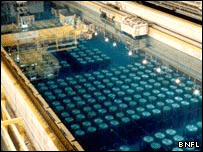 There is about 70,000 tons of spent fuel stored at reactor sites around the country. Three-quarters of the material sits in cooling pools.
While Nuclear Waste Piles up in U.S., Billions in Fund to Handle It Sit Unused, ProPublica, by Joaquin SapienProPublica, March 30, 2011 “……In 1982, Congress passed the Nuclear Waste Policy Act, and the federal government effectively struck a deal with the nuclear industry: Reactor operators and their customers would pay a tax on the waste they produced, and the government would use the money to create a safe place to store it for generations.
The idea at the time was to build a repository inside volcanic rock on Yucca Mountain, about 100 miles northwest of Las Vegas. That plan proved to be wildly controversial and was eventually abandoned by the Obama administration in 2010. After 29 years, there are billions of dollars in the fund and no plan for the waste.
To compound the problem, the 1982 law only allows the money to be spent on a permanent solution,…….
Department of Energy statistics show that new lawsuits and other costs could eventually push the government’s legal liability to $16.2 billion.
Senate Majority Leader Harry Reid, D-Nev., who opposes storing waste at Yucca Mountain in his home state, introduced legislation in 2007 [4] to amend the law so the fund could be used for interim waste storage. But the bill never came to the floor for a vote……
There is about 70,000 tons of spent fuel stored at reactor sites around the country. Three-quarters of the material sits in cooling pools. Reactor operators have been re-racking the rods so they can fit more of them in the pools — a practice that makes the pools more radioactive and potentially more dangerous in the event of an accident.
The pools in the United States have been criticized by nuclear industry watchdogs who say they are too crowded and in some cases have been known to leak low levels of radioactive water
Some reactor operators have begun building large tomb-like structures called dry casks to contain the waste after the rods have cooled for five years or more in the pools. The dry casks are considered a safer way to store the rods.
But the industry has been reluctant to use dry casks on a large scale because it’s extremely expensive to transfer the radioactive rods. A 2003 study [7] by a former Energy Department official and a team of nuclear experts concluded it would cost at least $3.5 billion to move all rods that had been in pools for over five years….
While Nuclear Waste Piles up in U.S., Billions in Fund to Handle It Sit Unused – ProPublica
No comments yet.
1 This Month


Tell the Ukrainian Government to Drop Prosecution of Peace Activist Yurii Sheliazhenko

Petition to revoke the licensing of the Near Surface Nuclear Disposal Facility (NSDF) at Chalk River. https://www.ourcommons.ca/petitions/en/Petition/Details?Petition=e-7247


of the week – STOP SMALL MODULAR REACTORS IN CANADA
To see nuclear-related stories in greater depth and intensity – go to https://nuclearinformation.wordpress.com
-
Archives
- March 2026 (212)
- February 2026 (268)
- January 2026 (308)
- December 2025 (358)
- November 2025 (359)
- October 2025 (376)
- September 2025 (258)
- August 2025 (319)
- July 2025 (230)
- June 2025 (348)
- May 2025 (261)
- April 2025 (305)
-
Categories
- 1
- 1 NUCLEAR ISSUES
- business and costs
- climate change
- culture and arts
- ENERGY
- environment
- health
- history
- indigenous issues
- Legal
- marketing of nuclear
- media
- opposition to nuclear
- PERSONAL STORIES
- politics
- politics international
- Religion and ethics
- safety
- secrets,lies and civil liberties
- spinbuster
- technology
- Uranium
- wastes
- weapons and war
- Women
- 2 WORLD
- ACTION
- AFRICA
- Atrocities
- AUSTRALIA
- Christina's notes
- Christina's themes
- culture and arts
- Events
- Fuk 2022
- Fuk 2023
- Fukushima 2017
- Fukushima 2018
- fukushima 2019
- Fukushima 2020
- Fukushima 2021
- general
- global warming
- Humour (God we need it)
- Nuclear
- RARE EARTHS
- Reference
- resources – print
- Resources -audiovicual
- Weekly Newsletter
- World
- World Nuclear
- YouTube
-
RSS
Entries RSS
Comments RSS
 nuclear-news
Leave a comment