USA Freedom of Information request on Fukushima nuclear radiation
Groups Demand Data on Radiation Release – NYTimes.com, 28 March 11, As the Japanese authorities order a wider evacuation area around the stricken Fukushima reactor complex to as far out as 19 miles, three health and environmental groups in the United States announced that they were seeking further information about why American officials recommended that its citizens keep at least 50 miles away……
-The American groups — Friends of the Earth, the Nuclear Information and Resource Service and Physicians for Social Responsibility — said on Friday that they were filing a Freedom of Information Act request with the Nuclear Regulatory Commission and the Department of Energy. They are seeking access to all information about radiation levels gathered by American radiological monitoring equipment and helicopter overflights…..
Groups Demand Data on Radiation Release – NYTimes.com
Workers struggle as Fukushima nuclear plant radiation increases
 Mounting problems, including badly miscalculated radiation figures and no place to store dangerously contaminated water, have stymied emergency workers struggling to cool down the overheating plant and avert a disaster with global implications.
Radiation in seawater may be spreading in Japan, – NZ Herald News, By Shino Yuasa Mar 28,2011. Highly radioactive iodine seeping from Japan’s damaged nuclear complex may be making its way into seawater farther north of the plant than previously thought, officials said today, adding to radiation concerns as the crisis stretches into a third week. Continue reading
Wall Street spooked on nuclear industry’s future outlook

the nuclear industry has also been working hard to increase its share of the market, hiring armies of lobbyists to press their case with power brokers on Capitol Hill……In the words of one long term industry analyst, “Three mile island turned from a $1 billion dollar asset into a $2 billion liability in just 90 minutes.”..Wall Street was spooked then and it’s even more spooked now……
 AUDIO Correspondents Report – Nuclear re-think in the US 27/03/2011 ELIZABETH JACKSON: ABC Radio The crisis in Japan is causing many countries elsewhere in the world to look again at their nuclear industry – the United States is certainly one of them.Of the 104 reactors in operation, 23 of them in the US are similar to the stricken Fukushima plant, and two of them are also perched precariously over a Pacific Rim fault line. Continue reading
Australian expert, Barry Brook, downplays Japan’s nuclear problem
“I think overtime people will become more understanding of small risk and big benefits that nuclear brings,”
Japan’s nuclear crisis is mainly public panic, not radiation risk: Australian expert By Vienna MaCANBERRA, March 26 (Xinhua) — Japan’s nuclear crisis was mainly public panic, not radiation risk, an Australian expert told Xinhua, expressing optimism over the future development of international nuclear industry.

However, workers are still trying to contain radiation leaks at Fukushima Daiichi nuclear power plants in Japan, since reactors were damaged by the massive earthquake and tsunami.
Although prevailing winds would likely carry contaminated smoke or steam released from nuclear power plant away from the densely populated city to dissipate over the Pacific Ocean, millions in Tokyo of Japan remained indoors, fearing a blast of radioactive material from Fukushima.
The crisis has triggered global alarm and reviews of safety at atomic power plants around the world. Continue reading
Shares in uranium likely to be doomed
Even more ominous in this new environment is the fact that storage pools for spent uranium rods are now recognized as a threat. Every reactor has one of these glowing pools, specifically because the world has not found a way to dispose of nuclear waste…..
the developed world will eventually turn very sharply away from nuclear energy and towards cheap and abundant natural gas…….
Is Uranium A Buy Again? Beware of These Radioactive Stocks ETF DAILY NEWS, byn George Wolff, 27 March 11, “………The industry’s future is “red hot” according to CBS Business News writer David Phillips. Cameco and other uranium miners are already spending heavily on the construction of new mines and processing facilities. They’re still scrambling in anticipation of the global nuclear boom which seemed so inevitable before the Japanese disaster……
But, in the wake of the Japanese crisis, I believe that the optimists touting a rebound in the nuclear industry are premature at best. At worst, they may be flogging a dead horse. Continue reading
Should earthquake prone Japan have nuclear reactors?
 Fear grows near another nuclear plant in Japan – The Globe and Mail, 27 March 11, “……..The Fukushima disaster has raised the volume of a decades-old debate over whether Japan, a country crisscrossed and surrounded by some 2,000 major and minor fault lines, should have 55 nuclear plants on its soil. Some 300 Japanese demonstrators – some of them wearing gas masks – marched past TEPCO’s Tokyo headquarters on Sunday chanting “We don’t need nuclear plants!”…….Fear grows near another nuclear plant in Japan – The Globe and Mail
Radioactive iodine and thyroid cancer
 RADIATION RISKS TO HEALTH A Joint Statement from the American Association of Clinical Endocrinologists, the American Thyroid Association, The Endocrine Society, & the Society of Nuclear Medicine March 18, 2011 The recent nuclear reactor accident in Japan due to the earthquake and tsunami has raised fears of radiation exposure to populations in North America from the potential plume of radioactivity crossing the Pacific Ocean. The principal radiation source of concern is radioactive iodine including iodine-131, a radioactive isotope that presents a special risk to health because iodine is concentrated in the thyroid gland and exposure of the thyroid to high levels of radioactive iodine may lead to development of thyroid nodules and thyroid cancer years later. Continue reading
Little hope now of resuscitating the nuclear industry
little hope for development of new nuclear generation methods, the proponents of which believe they solve some of the intractable problems of today’s fission reactors. Chief among fission’s shortcomings is the risk of a reactor core meltdown and release of large amounts of highly toxic radiation, and the disposal of radioactive waste.
Nuclear power likely casualty in tide of change, NZ Herald News, By Anthony Doesburg y Mar 28, 2011 Nuclear power can be all but written off in the wake of Japan’s reactor emergency, believes the director of energy studies at Otago University.
“I would have thought that Japan will pretty much spell the end of the nuclear industry,” Continue reading
George Monbiot does not understand the public health effects of nuclear radiation
workers have received high doses and it’s anyone’s guess how many thousands (or millions) of people have received very small doses. Monbiot seems not to understand that the weight of scientific opinion holds that there is no safe dose of radiation.For a tiny, unlucky percentage of the many people who have received small radiation doses as a result of Fukushima, that radiation exposure will prove to be fatal.
George Monbiot’s nuclear mistakes | Green Left Weekly, Jim Green, 26 March 11, Prominent British columnist George Monbiot announced in the British Guardian on March 21 that he now supports nuclear power………….Monbiot is understating the radiological impacts of Fukushima and ignoring the other impacts. Continue reading
Nuclear power a public health danger even without earthquakes
A study by the Radiation and Public Health Project (RPHP) found that the incidence of thyroid cancer in three counties near the Indian Point nuclear plant in New York state were about twice the U.S. rate.
It’s time to say ‘no’ to nuclear power – The Holland Sentine, lLaketown Township, MI, 27 march 11 —The crisis in Japan is making many of us think twice about nuclear power, and with good reason. In many ways, we cannot afford nuclear power. According to a report from the Union of Concerned Scientists, the cost of subsidizing nuclear power exceeds the value of the power produced. No wonder the private sector doesn’t want to finance new nuclear power plants. Continue reading
Claim that US using depleted uranium weapons in Libya
‘US drops uranium bombs on Libya’ PressTV , 27 march 11, The Stop the War Coalition says the bombs and missiles that the US-led military alliance has dropped on several Libyan cities contain depleted uranium (DU). The report recently published on the Coalition’s website said that in the first 24 hours of the war on Libya, dozens of bombs and cruise missiles were launched by US, British, and French forces — all with depleted uranium warheads. Continue reading
Russian nuclear czar – selling $6 billion enriched uranium to USA?
 Rosatom Signs $2.8 Billion Contract to Enrich Uranium for U.S. Bloomberg, By Ilya Khrennikov – Mar 26, 2011 Rosatom Corp., Russia’s government- owned nuclear holding company, agreed a contract valued at about $2.8 billion to supply enriched uranium to the U.S., Russian state-run newspaper Rossiyskaya Gazeta said, citing the company.The accord includes an option to double supplies, possibly boosting the value of the deal to $6 billion, Kommersant said in a separate report, citing Rosatom Chief Executive Officer Sergei Kirienko.….Rosatom Signs $2.8 Billion Contract to Enrich Uranium for U.S. – Bloomberg
2.000 Taiwanese protest against nuclear power
DPP Taipei City Councilwoman Hsu Chia-ching told IPS that “no one is advocating an immediate cessation of generation, but a gradual and balanced phase-out”.
In response to questions as to whether refusing to allow the new facility to operate would be a waste of money, Tsai said that “allowing Nuclear Four to operate and generate more radioactive spent fuel and waste would create a greater tragedy.”
TAIWAN Opposition Urges Nuclear Phase-out By 2025, IPS ipsnews.net, By Dennis Engbarth, 28 March 11, Over 2,000 protestors participated in a “We Love Taiwan, We Don’t Want Nuclear Disaster” march in Taipei City. Opposition Democratic Progressive Party (DPP) Chairwoman and former Vice Premier Tsai Ing-wen has announced a proposal for a “2025 Non-Nuclear Home Plan” that will allow Taiwan to eliminate reliance on nuclear power by the end of 2025….
……. DPP Taipei City Councilwoman Hsu Chia-ching told IPS that “no one is advocating an immediate cessation of generation, but a gradual and balanced phase-out”.
In response to questions as to whether refusing to allow the new facility to operate would be a waste of money, Tsai said that “allowing Nuclear Four to operate and generate more radioactive spent fuel and waste would create a greater tragedy.”
“The damage to Japan’s society and economy, including tourism, agriculture, fishing and industry, is simply too huge, not to mention the costs of rebuilding,” National Taiwan University Professor of Atmospheric Sciences Hsu Kuang-jung told IPS, stressing that “the Fukushima incident is not yet over”.
“Nuclear power is the most expensive and risky method of power generation and if we don’t absolutely need it, why should we create so much danger and cause our people to live in fear?” asked Hsu. “The Taiwan people have never had a chance to directly express their will on whether to accept the risk of nuclear power.”
Over 2,000 residents near the fourth plant, environmentalists and opposition politicians participated in a rally last week with the theme “We Love Taiwan, We Don’t Want Nuclear Disasters”. …….
TAIWAN: Opposition Urges Nuclear Phase-out By 2025 – IPS ipsnews.net
Russian scientist estimate 100s of thousands of Chernobyl fallout deaths
Russian scientists recently reviewed the impacts of Chernobyl’s 1986 meltdown, and concluded: “The calculations suggest that the Chernobyl catastrophe has already killed several hundred thousand human beings in a population of several hundred million that was unfortunate enough to live in territories affected by the fallout. The number of Chernobyl victims will continue to grow over many future generations.”
Unsafe at any remove? Nuclear energy: time for a closer look SFGate, Steve Heilig : 27 March 11, Is atomic energy safe? Proponents say it is. Then doubters point to a near-disaster. Following this, safeguards against that particular accident are engineered into the system and proponents say ‘See? It’s safe now!’ and the dance goes on. The dialectic sounds like a broken record.” – Garrett Hardin, 1976
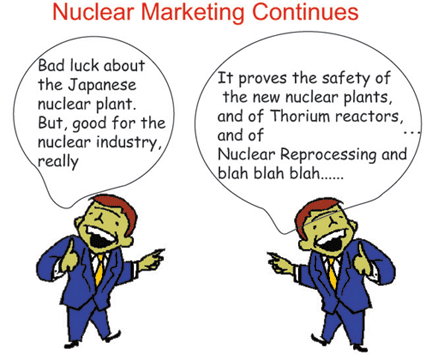
The US Nuclear Regulatory Commission has just affirmed that no real changes are being considered for US reactors following the Japan earthquake. President Obama and energy secretary Chu likewise continue to support nuclear power as an important part of American energy policy. But perhaps officials there, and President Obama, who has been a supporter of nuclear energy, need to take a closer look. Given the stakes, a much closer look.. Continue reading
87 percent chance of big earthquake near Hamaoka nuclear plant
The possibility of an imminent magnitude 8-plus earthquake in the Tokai region near the Hamaoka plant was brought to the public’s attention by geologist Ishibashi Katsuhiko in the 1970s and a government report has estimated there is an 87 percent chance of such an earthquake within the next 30 years……
Japan activist warns another ‘nuclear quake’ looms | Reuters, 27 march 11,“ “……….except for the location -Hirose had predicted an imminent megaquake and nuclear accident at the Hamaoka plant 200 km southwest of Tokyo, not the Fukushima Daiichi plant 240 km northeast — the scenario depicted in his first book on nuclear power in 15 years has proved eerily prescient. Continue reading
1 This Month
Chernobyl: The Lost Tapes – A good documentary on Chernobyl on SBS available On Demand for the next 3 weeks– https://www.sbs.com.au/ondemand/tv-program/chernobyl-the-lost-tapes/2352741955560

of the week–London Campaign for Nuclear Disarmament

Tell the Ukrainian Government to Drop Prosecution of Peace Activist Yurii Sheliazhenko
To see nuclear-related stories in greater depth and intensity – go to https://nuclearinformation.wordpress.com
-
Archives
- April 2026 (126)
- March 2026 (251)
- February 2026 (268)
- January 2026 (308)
- December 2025 (358)
- November 2025 (359)
- October 2025 (376)
- September 2025 (257)
- August 2025 (319)
- July 2025 (230)
- June 2025 (348)
- May 2025 (261)
-
Categories
- 1
- 1 NUCLEAR ISSUES
- business and costs
- climate change
- culture and arts
- ENERGY
- environment
- health
- history
- indigenous issues
- Legal
- marketing of nuclear
- media
- opposition to nuclear
- PERSONAL STORIES
- politics
- politics international
- Religion and ethics
- safety
- secrets,lies and civil liberties
- spinbuster
- technology
- Uranium
- wastes
- weapons and war
- Women
- 2 WORLD
- ACTION
- AFRICA
- Atrocities
- AUSTRALIA
- Christina's notes
- Christina's themes
- culture and arts
- Events
- Fuk 2022
- Fuk 2023
- Fukushima 2017
- Fukushima 2018
- fukushima 2019
- Fukushima 2020
- Fukushima 2021
- general
- global warming
- Humour (God we need it)
- Nuclear
- RARE EARTHS
- Reference
- resources – print
- Resources -audiovicual
- Weekly Newsletter
- World
- World Nuclear
- YouTube
-
RSS
Entries RSS
Comments RSS
 nuclear-news