Questions about safety of Illinois’ old nuclear reactors
Nuclear watchdogs and environmental groups have been critical because the reactors got 20-year license extensions after surpassing their original 40-year lifespans…Kirk and Durbin peppered officials with questions about the safety of the storage of spent fuel rods, some of which are near populated areas and key waterways in the state……
Kirk, Durbin quiz nuclear experts – Chicago Sun-Times, 26 March 11, In light of the crisis in Japan, Illinois needs to review the size of evacuation zones around its six nuclear power plants Continue reading
NRC says new nuclear plant poses no environmental risk
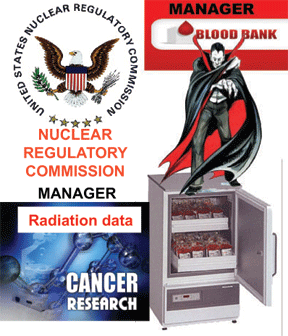 The NRC still needs to complete a safety report on the project and finish a review of the proposed reactor’s design……Some members of Congress and environmental groups have called for the NRC to suspend action on new licenses until it completes its investigation of existing facilities’ safety..
New Reactors Clear Hurdle Amid Nuclear Review WSJ.com, 26 March 11 By NAUREEN MALIK And TENNILLE TRACY U.S. nuclear regulators on Friday removed a key hurdle facing Southern Co.’s bid to build two nuclear reactors near Augusta, Ga., saying the project doesn’t pose environmental risks. Continue reading
Radioactive iodine 1250 times legal limit in sea off Japan
Radioactive iodine in sea off Japan, Sydney Morning Herald, March 26, 2011 – The operator of Japan’s disaster-hit Fukushima nuclear plant has detected radioactive iodine 1250 times the legal limit in Pacific Ocean waters nearby, the nuclear safety agency says…….Radioactive iodine in sea off Japan
Upward trend of radiation from Fukushima causes anxiety over tap water
The overall situation at the Fukushima plant remains of serious concern, the International Atomic Energy Agency said. The deposition of radioactive iodine and cesium varies across 10 prefectures on a day to day basis but “the trend is generally upward,”
Anxiety in Tokyo over radiation in tap water The Star, 24 March 11, TOKYO (AP): Workers loaded trucks with boxes of bottled water to distribute across the city Thursday after residents cleared store shelves following warnings that Tokyo’s tap water had elevated radiation coming from Japan’s tsunami-damaged nuclear complex. Continue reading
USA nuclear plants have limited backup power for emergencies
there are different threats that could cause similar problems with reactors in the United States, ….“Many of our reactors are in situations where earthquakes or hurricanes in the Gulf or ice storms in the Northeast or a tree in Cleveland can cause an extensive blackout that puts us in a very similar situation,….
Japan Disaster Raises Questions About Backup Power at U.S. Nuclear Plants, NYTimes.com, By MIKE SORAGHAN March 24, 2011 The batteries that back up power at most U.S. nuclear plants are required to last about as long as the average cellphone battery — four hours.
The Nuclear Regulatory Commission says that’s enough. The agency’s critics say it’s not. And those critics are pointing to the Fukushima Daiichi plant in Japan, which is teetering on the brink of meltdown because it lost power. Continue reading
USA’s nuclear waste storage raises safety dangers
in light of the overheating of spent fuel at Japan’s Fukushima Daiichi plant, some elected officials have renewed calls to remove waste from nuclear plants, many of which are near heavily populated areas…..the nuclear industry has raised the risk of a fire by reconfiguring its pools over the years to squeeze in more fuel.
Storage of Nuclear Waste Gets New Scrutiny. WSJ.com, 24 March 11, By STEPHEN POWER The nuclear crisis in Japan is reviving a battle over what should be done with the spent nuclear fuel that has been piling up around the U.S. for decades. Continue reading
Nuclear Regulatory Commission reports gaps in USA nuclear reactors’ safety
US watchdog sees gaps in reactor safety, FT.com , By Shannon Bond New York March 24 2011 Defects in components of US nuclear plants are going unreported because of “contradictory and unclear” regulations, according to a report from the federal nuclear regulator’s watchdog.
The Nuclear Regulatory Commission inspector general’s report, released on Thursday, is based on a review conducted in January, before the crisis at Japan’s Fukushima Daiichi plant and the ensuing concern over the safety of nuclear sites in the US. The inspector general’s findings, however, raise questions about risks at the 104 operating reactors across the country. Nuclear plants provide 20 per cent of US electricity, according to the Nuclear Energy Institute, the industry’s lobbying organisation……FT.com / US & Canada – US watchdog sees gaps in reactor safety
USA’s only new nuclear plant – safety reports falsified?
Tennessee man charged with falsifying nuclear reports (Reuters) 24 March 11, – A Tennessee man pleaded not guilty on Thursday to charges that he falsified inspection reports at the Tennessee Valley Authority’s Watts Bar nuclear facility now under construction. Prosecutors allege that last August, Matthew Correll, 31, completed paperwork falsely claiming that he had measured cables intended to supply energy to safety systems to be built at Watts Bar, the only nuclear power plant under construction in the U.S.
The federal charges come as the nuclear industry faces increased scrutiny in the aftermath of radioactive releases from power plants in Japan following an earthquake and tsunami…….Tennessee man charged with falsifying nuclear reports | Reuters
US-India nuclear agreement locks India into subordinate role
The WikiLeaks disclosures don’t bring out any new facts. Many of them had been raised earlier, ………particularly on the Indo-US nuclear agreement…..That the civilian nuclear accord was merely a ruse to seal a strategic partnership and interlock a proud, independent nation into a subordinate relationship is established by these revelations…….The US government has admitted the cables are genuine
Nuclear deal was ruse to subordinate India to the US, DNA Mar 25, 2011, By Nilotpal Basu | Mumbai The stream of almost unending revelations that comes out everyday punctures the credibility of the Manmohan Singh government.
Libya should have kept its nuclear program, says North Korea
North Korea Suggests Libya Should Have Kept Nuclear Program, NYTimes.com, By MARK McDONALD March 24, 2011 SEOUL, South Korea — A North Korean statement that Libya’s dismantling of its nuclear weapons program had made it vulnerable to military intervention by the West is being seen by analysts as an ominous reinforcement of the North’s refusal to end its own nuclear program. Continue reading
Radioactive iodine and cesium from Fukushima nuclear plant
Report: Emissions from Japan plant approach Chernobyl levels, USA Today, By Michael Winter, 24 March 11. Emissions of radioactive iodine and cesium from the crippled Fukushima Dai-ichi nuclear plant have approached levels after the Chernobyl nuclear disaster in 1986, New Scientist reports. Austrian researchers made the calculations by using the global network of detectors designed to sniff out clandestine nuclear bomb tests.
Iodine-131 is being released at daily levels 73% of those detected after Chernobyl, while the daily amount of cesium-137 is about 60%, according to researcher from Austria’s Central Institute for Meteorology and Geodynamics…… Report: Emissions from Japan plant approach Chernobyl levels –
TEPCO shareholders to lose their whole investment
After repaying borrowings due this year and next, Tepco should have 8 trillion of net debt,
Tokyo nuclear firm protected, but not shareholders. Reuters , Mar 24, 2011 By John Foley HONG KONG — The owner of Japan’s stricken nuclear reactors should emerge from the wreckage intact. But shareholders in Tokyo Electric Power, whose Fukushima complex was damaged by this month’s earthquake, could lose their entire investment. Continue reading
Lithuania against Russian nuclear projects near its border
The Japanese situation has generated anxiety in Europe over existing and future nuclear plants, and the new nuclear project in Belarus is no exception. This project is particularly concerning to Lithuania because the proposed site for the nuclear plant is Astraviec, a Belarusian town 23 kilometers (14 miles) from the Lithuanian border and just 50 kilometers from the capital of Vilnius…..
Lithuania Agitates Against Russian Nuclear Projects Mar. 24 2011 Forbes,by STRATFOR, Lithuanian Prime Minister Andrius Kubilius said Tuesday that Lithuania is considering asking the European Union to impose restrictions on electricity trading by third parties that generate electric power without complying with nuclear safety requirements. Continue reading
Don’t throw good money after bad to the nuclear industry
we have to stop making the problem worse. We shouldn’t be throwing good money after bad and using taxpayer dollars to subsidize the construction of new nuclear plants. Instead, we should be deepening our commitment to an aggressive transition toward cleaner energy resources, like solar and wind, that don’t cause catastrophic meltdowns, don’t cause massive spills on our coastlines, and don’t contribute to global warming. Clean energy can also create more jobs and make our energy supply much more safe and secure.
What’s next for nuclear power: Michael Brune – CNNMoney.com, 24 march 11, “……The situation at Fukushima is still developing, so we don’t yet know how bad it is, but certainly it’s quite frightening. Over the past few years those of us who have been critical of nuclear power have been perhaps a little bit lonelier than we were 20, 25 years ago. But the reality is that the industry hasn’t changed all that much, and the risks that were inherent in nuclear power in the 1970s and 1980s, as we’re seeing, are still very present today……we’ve known for a long time that the consequences of partial or full meltdowns are high, and that it’s almost impossible to design backup systems that eliminate human error or eliminate the impact of natural tragedies.
What do we do with the Diablo Canyon nuclear plant in California, for instance, which is designed to withstand an earthquake of only 7.5? There are a lot of plants like this one in the United States that aren’t fully equipped to deal with a range of catastrophic events.
I’d say that there are a couple of different rational responses to a crisis like this. One, we should look at the country’s most vulnerable, riskiest plants and set them on a rapid timeline for being decommissioned. We probably can’t shut down the entire nuclear fleet in the short term. It’s providing about 20% of our electricity.
Two, we have to stop making the problem worse. We shouldn’t be throwing good money after bad and using taxpayer dollars to subsidize the construction of new nuclear plants. Instead, we should be deepening our commitment to an aggressive transition toward cleaner energy resources, like solar and wind, that don’t cause catastrophic meltdowns, don’t cause massive spills on our coastlines, and don’t contribute to global warming. Clean energy can also create more jobs and make our energy supply much more safe and secure.
What’s next for nuclear power: Michael Brune – FORTUNE Features – Fortune on CNNMoney.com
Iowa residents will pay up in advance for nuclear reactor build
“Advanced cost recovery is nothing more or less than a tax on ratepayers to fund nuclear reactors that the capital market won’t touch,”
Possible nuclear expansion costs to Iowans: $50 a month, Des Moines Register, 25 March 11, Iowa’s average MidAmerican customer could see their monthly bills spike by $50 or more a month under a proposal being considered by the state’s legislature, according to a report released today Continue reading
1 This Month
Chernobyl: The Lost Tapes – A good documentary on Chernobyl on SBS available On Demand for the next 3 weeks– https://www.sbs.com.au/ondemand/tv-program/chernobyl-the-lost-tapes/2352741955560

of the week–London Campaign for Nuclear Disarmament

Tell the Ukrainian Government to Drop Prosecution of Peace Activist Yurii Sheliazhenko
To see nuclear-related stories in greater depth and intensity – go to https://nuclearinformation.wordpress.com
-
Archives
- April 2026 (114)
- March 2026 (251)
- February 2026 (268)
- January 2026 (308)
- December 2025 (358)
- November 2025 (359)
- October 2025 (376)
- September 2025 (257)
- August 2025 (319)
- July 2025 (230)
- June 2025 (348)
- May 2025 (261)
-
Categories
- 1
- 1 NUCLEAR ISSUES
- business and costs
- climate change
- culture and arts
- ENERGY
- environment
- health
- history
- indigenous issues
- Legal
- marketing of nuclear
- media
- opposition to nuclear
- PERSONAL STORIES
- politics
- politics international
- Religion and ethics
- safety
- secrets,lies and civil liberties
- spinbuster
- technology
- Uranium
- wastes
- weapons and war
- Women
- 2 WORLD
- ACTION
- AFRICA
- Atrocities
- AUSTRALIA
- Christina's notes
- Christina's themes
- culture and arts
- Events
- Fuk 2022
- Fuk 2023
- Fukushima 2017
- Fukushima 2018
- fukushima 2019
- Fukushima 2020
- Fukushima 2021
- general
- global warming
- Humour (God we need it)
- Nuclear
- RARE EARTHS
- Reference
- resources – print
- Resources -audiovicual
- Weekly Newsletter
- World
- World Nuclear
- YouTube
-
RSS
Entries RSS
Comments RSS
 nuclear-news