Fukushima’s spent nuclear fuel rods are critically dangerous
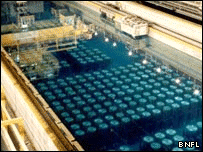 Figures provided by the Tokyo Electric Power Company on Thursday show that most of the dangerous uranium at the powerplant is in the spent fuel rods, not the reactor cores.
The company said that a total of 11,195 spent fuel rod assemblies were stored at the site. That is about four times as much radioactive material as in the reactor cores combined…….the zirconium cladding on the fuel rods could burst into flames if exposed to air for hours when a storage pool lost its water
Spent rods the biggest hazard, Sydney Morning Herald, Keith Bradsher and Hiroko Tabuchi, March 19, 2011 YEARS of procrastination in deciding on long-term disposal of highly radioactive fuel rods from nuclear reactors are coming back to haunt Japanese authorities as they try to control fires and explosions at the stricken Fukushima Daiichi nuclear power station.
Some countries have tried to limit the number of spent fuel rods that accumulate at nuclear power plants: Germany stores them in costly casks, for example, and China sends them to a desert storage compound in the western province of Gansu.
But Japan, like the United States, has kept ever-larger numbers of spent fuel rods in temporary storage pools at the powerplants, where they can be guarded with the same security provided for the plants.
Figures provided by the Tokyo Electric Power Company on Thursday show that most of the dangerous uranium at the powerplant is in the spent fuel rods, not the reactor cores.
The company said that a total of 11,195 spent fuel rod assemblies were stored at the site. That is about four times as much radioactive material as in the reactor cores combined…….
Now those temporary pools are proving the power plant’s Achilles heel, with the water in the pools either boiling away or leaking out of their containments, and efforts to add more water having gone awry.
While spent fuel rods generate significantly less heat than newer ones, there are strong indications that some fuel rods have begun to melt and release extreme levels of radiation. Japanese workers struggled on Thursday to add more water to the storage pool at reactor No.3. It is unclear if that effort worked.
Richard Lahey jnr, a retired nuclear engineer who oversaw General Electric’s safety research in the early 1970s for the kind of nuclear reactors used in Fukushima, said the zirconium cladding on the fuel rods could burst into flames if exposed to air for hours when a storage pool lost its water. Zirconium burns extremely hot and is difficult to extinguish, he said.
No comments yet.
1 This Month

of the week – Shut Down Drone Warfare!


Tell the Ukrainian Government to Drop Prosecution of Peace Activist Yurii Sheliazhenko

Petition to revoke the licensing of the Near Surface Nuclear Disposal Facility (NSDF) at Chalk River. https://www.ourcommons.ca/petitions/en/Petition/Details?Petition=e-7247
To see nuclear-related stories in greater depth and intensity – go to https://nuclearinformation.wordpress.com
-
Archives
- April 2026 (114)
- March 2026 (251)
- February 2026 (268)
- January 2026 (308)
- December 2025 (358)
- November 2025 (359)
- October 2025 (376)
- September 2025 (257)
- August 2025 (319)
- July 2025 (230)
- June 2025 (348)
- May 2025 (261)
-
Categories
- 1
- 1 NUCLEAR ISSUES
- business and costs
- climate change
- culture and arts
- ENERGY
- environment
- health
- history
- indigenous issues
- Legal
- marketing of nuclear
- media
- opposition to nuclear
- PERSONAL STORIES
- politics
- politics international
- Religion and ethics
- safety
- secrets,lies and civil liberties
- spinbuster
- technology
- Uranium
- wastes
- weapons and war
- Women
- 2 WORLD
- ACTION
- AFRICA
- Atrocities
- AUSTRALIA
- Christina's notes
- Christina's themes
- culture and arts
- Events
- Fuk 2022
- Fuk 2023
- Fukushima 2017
- Fukushima 2018
- fukushima 2019
- Fukushima 2020
- Fukushima 2021
- general
- global warming
- Humour (God we need it)
- Nuclear
- RARE EARTHS
- Reference
- resources – print
- Resources -audiovicual
- Weekly Newsletter
- World
- World Nuclear
- YouTube
-
RSS
Entries RSS
Comments RSS
 nuclear-news
Leave a comment