Did you know about the Nuclear Regulatory Commission’s “Waste Confidence Rule”?

Christina Macpherson's websites & blogs
I can hardly believe what I read (in the post immediately below this). Can it be true that the USA’s Nuclear Regulatory Commission can proceed to make policy on nuclear waste according to an act of faith?
a “predictive” safety “finding” that simply stipulates spent reactor fuel can be disposed of safely at some unspecified time in the future, whenever it becomes “necessary” to dispose of it.
This is like the Catholic Church’s dogmas. You gotta believe it, because the Pope said it.
You gotta believe that a safe disposal of radioactive nuclear waste will be devised – so whoopee – go ahead with more nukes!
This also reinforces the fact that the NRC has no idea what to do with the wastes
Natural Resources Council challenges NRC’s WASTE CONFIDENCE RULE
In absurdist fashion, the new Waste Confidence Rule contains a “predictive” safety “finding” that simply stipulates spent reactor fuel can be disposed of safely at some unspecified time in the future, whenever it becomes “necessary” to dispose of it. The Rule also concludes that for at least sixty years after the cessation of reactor operations, spent fuel can be safely stored at reactor sites or in “special” facilities.

Sixty Thousand Tons of Commercial Spent Nuclear Fuel Stored at U.S. Reactors for 60 Years? Natural Resources Defence Council, Matthew McKinzie February 23, 2011 Why NRDC has Challenged the Nuclear Regulatory Commission’s Waste Confidence Rule Last week my colleague and NRDC Senior Attorney Geoffrey Fettus filed a legal challenge to two final rulemakings by the Nuclear Regulatory Commission: the “Waste Confidence Decision Update” and the “Consideration of Environmental Impacts of Temporary Storage of Spent Fuel After Cessation of Reactor Operation.” What does the Federal Government want to do with these new Rules, and why is NRDC opposing them?…….. Continue reading
Gaddafi and Libya’s nuclear deals
 For the moment, the Tajoura reactor remains in the part of the country still controlled by forces loyal to Qaddafi, who has vowed to “fight to the last drop of blood” to remain in power. Its current status is unknown.
Nuclear Madness in Tripoli. The New York Review of Books, Jeremy Bernstein, 24 Feb 2011, If any further proof is needed of Libyan strongman Muammar Qaddafi’s mental instability it is provided by WikiLeaks dispatches from US diplomats in Tripoli in November and December of 2009. At issue was some nearly loose nuclear material, a Russian plane, and a lone security guard—a footnote in the WikiLeaks scandal that many may have missed…….. Continue reading
New nuclear reactors – an economic meltdown waiting to happen
Time and again, Buffett’s corporation MidAmerican has recognized the risks of investing in new nuclear power……i’ts not only Warren Buffet & CBO that have rejected new nuclear power as an economic non starter…….New nuclear reactors are an economic meltdown waiting to happen and sadly President Obama has put the American taxpayer on the hook for the financial fall out.
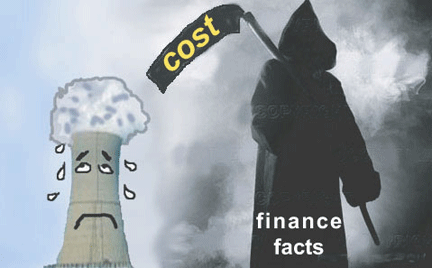
Obama, the Oracle of Omaha & Nuclear Power | Greenpeace USA, 24 Feb 2011, Last week, President Obama lauded those who have made an especially meritorious contribution to the United States, world peace and culture by bestowing upon them the Presidential Medal of Freedom. Among this years recipients was the “World’s Greatest Investor,” also one of the world’s greatest philanthropists Warren Buffett. Instead of merely lauding the Oracle of Omaha, President Obama should follow his lead and stop pursuing costly new nuclear power plants. Time and again, Buffett’s corporation MidAmerican has recognized the risks of investing in new nuclear power. Continue reading
France devising new nuclear marketing system
The new plan calls for France to create partnerships with China, accelerate the development of the 1100MW medium-sized Atmea-1 reactor, which is currently being developed by Areva in partnership with Mitsubishi Heavy Industries. The council is seeking participation from EDF and GDF Suez in this project.

France launches new nuclear strategy Industrial Fuels and Power, February 23rd, 2011 The French Nuclear Policy Council has drawn up a new strategy to boost the industry’s competitiveness on the international stage. Continue reading
Ethical, but very real, dilemma about nuclear power
in a nuclear context, total destruction of the target is assured and so, if one’s own annihilation is certain, is retaliation for its own sake a valid course of action?….is a reaction that wipes out the rest of humanity morally justifiable? Further, if one decides it is, what would the post-holocaust world look like and would it be worth living in for those who were not part of the original conflict?
This is just one of the dilemmas we face when considering the application of nuclear power,…..

Review: How the End Begins by Ron Rosenbaum | CultureMob, 24 Feb 2011, “………………. argues Ron Rosenbaum, author of the highly-acclaimed Explaining Hitler and The Shakespeare Wars, in his sensational new book How the End Begins: The Road to a Nuclear World War III . We are, and always have been, perilously close to nuclear war at any given time, and the threats are not just external. Glaring, to the point of grimly comical, flaws exist in our own nuclear response processes that make very real the possibility of a global inferno started by mistake. Continue reading

New climate research results should jolt governments into action
The Canadian/Oxford research is highly politically significant, because it will help to strip away the “stonewall”, do-nothing tactics that various governments have used to excuse themselves from dealing seriously with climate change. The studies will have particular relevance in Australia, where extreme weather events are all too evident, and where token gestures by government are the order of the day as far as climate change is concerned.
Greenhouse gas emissions linked to climate change, CPA – The Guardian, Peter Mac, 23 February 2011 In Australia the public’s attention has been firmly fixed on the havoc wrought by floods in the eastern states, cyclones in Queensland and the Northern Territory, and bushfires in Western Australia. However, extreme weather events are also occurring in many nations overseas.
Within the last few months the United States and much of Western Europe have been gripped by massive snowstorms, while hundreds of people have drowned in floods in Brazil and Pakistan.
Climate scientists have predicted for years that an increase in extreme weather events will result from a global increase in the emission of greenhouse gases, which change the wavelength of the sun’s rays entering the atmosphere, thereby preventing the reflection of the radiation back into space and boosting global temperatures. Since the beginning of the industrial revolution, human industry has caused a major increase in the overall level of global emissions.
Although the “greenhouse effect” results in an overall rise in global temperatures, in certain parts of the world extremely cold winters are likely, because of changes in the flow of the world’s ocean currents. In other areas an increase in rainfall levels is likely because the warmer air can contain more moisture.
Two critical new studies
There is widespread agreement among the world’s scientists about the link between climate change and extreme weather events in general. Nevertheless, decisive action to deal with climate change has been frustrated by claims from polluting industries and climate “sceptics” that there is no single extreme weather event that can be linked to human-induced greenhouse gas emissions, rather than normal weather variations. However, two new studies, one from Oxford University and another from Canada, have now done just that.
Their reports were published together recently in the scientific journal Nature. The research team from the Climate Research Division of Environment Canada examined daily records of rainfall taken in 6,000 northern hemisphere weather stations between 1951 and 1999. They found that the intensity of extreme rains increased by seven percent, confirming the predictions of climate model simulations.
Team member Xuebin Zhang commented, “Our research provides the first scientific evidence that human-induced greenhouse gas increases have contributed to the observed intensification of heavy precipitation events over large parts of the northern hemisphere.”
The research team conducting the Oxford study calculated the difference between actual rainfall figures and those that would have been expected in the absence of human greenhouse gas emissions under the climate model simulations, with particular regard to the record-breaking floods that hit England and Wales in 2000.
Pardeep Pall, lead author of the Oxford study, reported: “We found that emissions substantially increased the odds of floods occurring in … the record wet autumn of 2000, with a likely increase in odds of a doubling or more.”
False trails
The Canadian/Oxford research is highly politically significant, because it will help to strip away the “stonewall”, do-nothing tactics that various governments have used to excuse themselves from dealing seriously with climate change. The studies will have particular relevance in Australia, where extreme weather events are all too evident, and where token gestures by government are the order of the day as far as climate change is concerned.
1 This Month

of the week – Shut Down Drone Warfare!


Tell the Ukrainian Government to Drop Prosecution of Peace Activist Yurii Sheliazhenko

Petition to revoke the licensing of the Near Surface Nuclear Disposal Facility (NSDF) at Chalk River. https://www.ourcommons.ca/petitions/en/Petition/Details?Petition=e-7247
To see nuclear-related stories in greater depth and intensity – go to https://nuclearinformation.wordpress.com
-
Archives
- March 2026 (230)
- February 2026 (268)
- January 2026 (308)
- December 2025 (358)
- November 2025 (359)
- October 2025 (376)
- September 2025 (257)
- August 2025 (319)
- July 2025 (230)
- June 2025 (348)
- May 2025 (261)
- April 2025 (305)
-
Categories
- 1
- 1 NUCLEAR ISSUES
- business and costs
- climate change
- culture and arts
- ENERGY
- environment
- health
- history
- indigenous issues
- Legal
- marketing of nuclear
- media
- opposition to nuclear
- PERSONAL STORIES
- politics
- politics international
- Religion and ethics
- safety
- secrets,lies and civil liberties
- spinbuster
- technology
- Uranium
- wastes
- weapons and war
- Women
- 2 WORLD
- ACTION
- AFRICA
- Atrocities
- AUSTRALIA
- Christina's notes
- Christina's themes
- culture and arts
- Events
- Fuk 2022
- Fuk 2023
- Fukushima 2017
- Fukushima 2018
- fukushima 2019
- Fukushima 2020
- Fukushima 2021
- general
- global warming
- Humour (God we need it)
- Nuclear
- RARE EARTHS
- Reference
- resources – print
- Resources -audiovicual
- Weekly Newsletter
- World
- World Nuclear
- YouTube
-
RSS
Entries RSS
Comments RSS
 nuclear-news