Manmohan Singh helps France, but not India, in nuclear deal
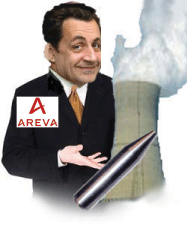
The deal between the Nuclear Power Corporation of India Limited (NPCIL) and Areva reflects a bonhomie between Indian prime minister Manmohan Singh and French president Nicolas Sarkozy at the cost of Indian people and the economy. Dr Singh actually came to the rescue of the problem-stricken French nuclear industry. Apart from the tariff structure, which is a very contentious issue, silence about the safety-related expenditure aggravates the suspicion.Transparency is, historically, a casualty in the nuclear energy arena.

Cost uncertainty dogs the Jaitapur nuclear project – Mumbai – DNA, Sankar Ray , February 3, 2011 Forget about the highly questionable technology for the proposed 1,650 megawatt nuclear power plant at Jaitapur in Ratnagiri district from the French power major Areva, or even the objections of the Finnish environmental watchdog body STUK for the Olkiluoto plant, which is being replicated at Jaitapur.The fact is that nothing can prevent time overruns and, therefore, cost escalation. To date, no nuclear power project has been implemented on schedule.
The last US nuclear plant, the Watts Bar-1 reactor, took 24 years for completion, 17 years behind schedule. Even China, with the ability to implement projects before schedule, had a two-year time overrun before commercial production commenced at its latest nuclear plant in 2007. That was too an Areva reactor. Gaps in quality of implementation were detected in the welds of the steel liner of it.

About the experience of infamous cost and time lags in the Indian nuclear power industry, the less said the better. And it is well-known that although India began atomic energy planning synergistically with France, nuclear power production has a share of 3% of total electricity generation.
The Jaitapur technology – a European pressurised reactor (EPR) — is an abandoned Finnish venture, whose original cost was estimated at €5.4 billion (Rs32,000 crore).
The time horizon was extended by over two years, due to a faulty foundation with flawed welds for the reactor’s steel liner, causing a cost escalation €1.5 billion, meaning 50% of the original production cost. Moreover, STUK recorded more than 3,000 safety and quality deficiencies at the construction of the Olkiluoto plant and pointed out that Areva chose cheap and incompetent subcontractors and overlooked safety-related problems.
The EPR design is yet to be tested and a joint letter from the French, Finnish, and United Kingdom nuclear regulators identified major design deficiencies pertaining to control and safety systems of the EPR…….
Much has been said about the choice of location, against which the local people have agitated with a solid rationale. A few months back, some 1,500 of them courted arrest to protest against the government ignoring their objections at the public hearing for the environmental impact assessment (EIA). The pity is that EIA for various projects have been more on commercial concerns rather than environmental. Jaitapur is no exception.
The deal between the Nuclear Power Corporation of India Limited (NPCIL) and Areva reflects a bonhomie between Indian prime minister Manmohan Singh and French president Nicolas Sarkozy at the cost of Indian people and the economy. Dr Singh actually came to the rescue of the problem-stricken French nuclear industry. Apart from the tariff structure, which is a very contentious issue, silence about the safety-related expenditure aggravates the suspicion.Transparency is, historically, a casualty in the nuclear energy arena.
Cost uncertainty dogs the Jaitapur nuclear project – Mumbai – DNA
No comments yet.
1 This Month


Tell the Ukrainian Government to Drop Prosecution of Peace Activist Yurii Sheliazhenko

Petition to revoke the licensing of the Near Surface Nuclear Disposal Facility (NSDF) at Chalk River. https://www.ourcommons.ca/petitions/en/Petition/Details?Petition=e-7247


of the week – STOP SMALL MODULAR REACTORS IN CANADA
To see nuclear-related stories in greater depth and intensity – go to https://nuclearinformation.wordpress.com
-
Archives
- March 2026 (212)
- February 2026 (268)
- January 2026 (308)
- December 2025 (358)
- November 2025 (359)
- October 2025 (376)
- September 2025 (258)
- August 2025 (319)
- July 2025 (230)
- June 2025 (348)
- May 2025 (261)
- April 2025 (305)
-
Categories
- 1
- 1 NUCLEAR ISSUES
- business and costs
- climate change
- culture and arts
- ENERGY
- environment
- health
- history
- indigenous issues
- Legal
- marketing of nuclear
- media
- opposition to nuclear
- PERSONAL STORIES
- politics
- politics international
- Religion and ethics
- safety
- secrets,lies and civil liberties
- spinbuster
- technology
- Uranium
- wastes
- weapons and war
- Women
- 2 WORLD
- ACTION
- AFRICA
- Atrocities
- AUSTRALIA
- Christina's notes
- Christina's themes
- culture and arts
- Events
- Fuk 2022
- Fuk 2023
- Fukushima 2017
- Fukushima 2018
- fukushima 2019
- Fukushima 2020
- Fukushima 2021
- general
- global warming
- Humour (God we need it)
- Nuclear
- RARE EARTHS
- Reference
- resources – print
- Resources -audiovicual
- Weekly Newsletter
- World
- World Nuclear
- YouTube
-
RSS
Entries RSS
Comments RSS
 nuclear-news
Leave a comment