World could run on renewable energy by 2030
“The actual footprint required by wind turbines to power half the world’s energy is less than the area of Manhattan,” said Jacobson.
Jacobson noted that most wind turbines could be placed offshore, and that others could be implemented on land already used for agriculture as is already the case with many large-scale land wind projects in the U.S.
By 2030, world can run on renewables, CNET News, by Candace Lombard 27 Jan 2011, Scientists from Stanford University and the University of California at Davis have crunched the numbers and come up with a plan for how the world might economically and feasibly make the move to renewable energy in the next 20 to 40 years.
In a two-part paper (Part 1 PDF, Part 2 PDF) published in the journal Energy Policy, Mark Z. Jacobson and Mark A. Delucchi show in great detail the who, what, where, and how of implementing a renewable energy-run world. It includes solutions to economic, material, and transport issues……..
The most interesting determination made as a result of the team’s due diligence to the world of energy creation and use was just how much energy the world wastes producing and transporting other energy.
The scientists estimated that the world could reduce its overall energy demand by as much as 30 percent just by transitioning away from combustion processes to more efficient electric processes for producing energy and hydrogen fuel cells.
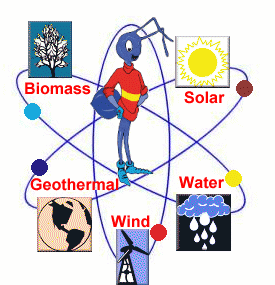
Jacobson and Delucchi claim that the world’s energy could be originated from 50 percent wind, 40 percent solar, 4 percent geothermal, 4 percent hydroelectric, and 2 percent wave and tidal power. They also agree that financial incentives and management systems aimed at conserving energy during peak demand times would be key.
Much of the plan revolves around the use of electricity and hydrogen fuel cells. That hydrogen would be produced by electricity which could be generated from wind and solar power.
The duo breaks down, step by step, which energy would be most efficient for a given use and how their idea of a world using renewable energy could work:
• Vehicles, train, and boats would run on electricity and hydrogen fuel cells.
• Airplanes would run on liquid hydrogen.
• Home heating and cooling systems would run on electricity.
• Hot water would be heated by solar.
• Commercial processes would run on a combination of electricity and hydrogen……….“The actual footprint required by wind turbines to power half the world’s energy is less than the area of Manhattan,” said Jacobson.
Jacobson noted that most wind turbines could be placed offshore, and that others could be implemented on land already used for agriculture as is already the case with many large-scale land wind projects in the U.S.
Jacobson and Delucchi have created an online interactive presentation that explains some of the details of their proposed plan, as well as several other detailed reports, presentations, and a spreadsheet detailing their calculations (Excel file). They can be found here.
Study: By 2030, world can run on renewables | Green Tech – CNET News
No comments yet.
1 This Month



Tell the Ukrainian Government to Drop Prosecution of Peace Activist Yurii Sheliazhenko

Petition to revoke the licensing of the Near Surface Nuclear Disposal Facility (NSDF) at Chalk River. https://www.ourcommons.ca/petitions/en/Petition/Details?Petition=e-7247


of the week – STOP SMALL MODULAR REACTORS IN CANADA
To see nuclear-related stories in greater depth and intensity – go to https://nuclearinformation.wordpress.com
-
Archives
- March 2026 (222)
- February 2026 (268)
- January 2026 (308)
- December 2025 (358)
- November 2025 (359)
- October 2025 (376)
- September 2025 (258)
- August 2025 (319)
- July 2025 (230)
- June 2025 (348)
- May 2025 (261)
- April 2025 (305)
-
Categories
- 1
- 1 NUCLEAR ISSUES
- business and costs
- climate change
- culture and arts
- ENERGY
- environment
- health
- history
- indigenous issues
- Legal
- marketing of nuclear
- media
- opposition to nuclear
- PERSONAL STORIES
- politics
- politics international
- Religion and ethics
- safety
- secrets,lies and civil liberties
- spinbuster
- technology
- Uranium
- wastes
- weapons and war
- Women
- 2 WORLD
- ACTION
- AFRICA
- Atrocities
- AUSTRALIA
- Christina's notes
- Christina's themes
- culture and arts
- Events
- Fuk 2022
- Fuk 2023
- Fukushima 2017
- Fukushima 2018
- fukushima 2019
- Fukushima 2020
- Fukushima 2021
- general
- global warming
- Humour (God we need it)
- Nuclear
- RARE EARTHS
- Reference
- resources – print
- Resources -audiovicual
- Weekly Newsletter
- World
- World Nuclear
- YouTube
-
RSS
Entries RSS
Comments RSS
 nuclear-news
Leave a comment