Safecast monitors Japan’s radiation levels, and sees it as a global issue
Despite the alarm inside Japan and abroad, specific information about radiation levels and its range are still mostly unavailable. This lack of information is what Safecast is trying to overcome…..
Global debate The Japanese government does not consider non-government readings to be authentic, and has urged the public to only rely on government data on radiation.
Bonner said: “Getting into this has showed us there is a lack of data everywhere.
“We’re going to start getting devices to people around the US and Europe. We’re going to set up fixed sensors and we’re making a device that we’ll sell to the public.
“We’re hoping to continue to get lots of data from lots of sources.”
Bonner’s ambitions appear timely against the backdrop of a revitalised global debate on the dangers of nuclear energy, especially in Japan.
“………..In the months since the catastrophe, the Japanese government, its nuclear watchdogs and Tokyo Electric Power Company (TEPCO), have provided differing, confusing, and at times contradictory, information on critical health issues.
Fed up with indefinite data, a group of 50 volunteers decided to take matters, and Geiger counters, into their own hands.
In April, an independent network of like-minded individuals in the Japan and United States banded together to formSafecast and began an ongoing crusade to record and publish accurate radiation levels around Japan. Continue reading
Fukushima city cleanup begins, with no long term solution in sight
Nor has Tokyo offered any long-term solution for the radioactive waste that is quickly accumulating around the prefecture
In Fukushima City, Decontamination Begins. But What to Do with the Radioactive Waste?, TIME, With reporting by Terrence Terashima, by Krista Mahr , August 9, 2011“…..Nearly five months after March 11, the physical process of cleaning up the world’s worst nuclear accident since Chernobyl has begun. Untold numbers of buildings, sidewalks, trees, gardens, parks, streets, school yards and gutters were dusted in radioactive particles after the earthquake and tsunami crippled the Fukushima Dai-ichi nuclear power plant. Though a circle within a 20-km radius of the plant and some other high-radiation spots remain evacuated, a much larger area is still home to tens of thousands of people who want those particles out of their lives as soon as possible. Continue reading
USA govt report – renewable energy outstrips nuclear
 Renewable Energy Consumption Passes Nuclear, Earth Techling, by Steve Duda, August 9th, 2011 Renewable energy consumption in the United States recently exceeded current and historical consumption levels for nuclear energy, a government study reports.
According to the U.S. Energy Information Administration, during the first quarter of this year a combination of nuclear outages related to plants shutting down for refueling and the start of the high water season for hydropower generation caused the shift in consumption. Seasonal variations in renewable energy, said the EIA, ”are dominated by the annual cycle of water availability for hydroelectric power production. Hydropower constitutes a significant yet highly variable portion of total renewable energy consumption, accounting for 31% of renewable energyconsumption in 2010.”
Joining this is a multi-year upward trend in renewable consumption driven by increasing consumption of biofuels and wind capacity additions. In the context of this study, renewable energy consumption is defined beyond electric power generation from hydro, wind, solar, and geothermalsources. Sources including biofuels for transportation (such as ethanol and biodiesel) and biomass (such as wood and wood wastes) for space heating and industrial steam production as well as for electric power generation are counted as renewable resources……http://www.earthtechling.com/2011/08/renewable-energy-consumption-passes-nuclear/
Musicians passionate for a non-nuclear future
The Winter of Nucler Energy, CleanTech blog , 11 Aug 11 On Sunday, August 7, a group of the world’s greatest musicians performed an inspiring benefit concert to support disaster relief in Japan. Crosby, Stills & Nash, Jackson Browne, Bonnie Raitt, Jason Mraz, The Doobie Brothers, Tom Morello, John Hall, Kitaro, Jonathan Wilson, and Sweet Honey in the Rock sang on behalf of Musicians United for Safe Energy (MUSE). Music video links and breaking news are available at NukeFree.Org….
Switching support to renewable energy? – Japan’s largest union wavers
Will Japan’s Largest Union Support Renewable Energy? In These Times, 11 Aug 11 By Akito Yoshikane, The Japanese Trade Union Confederation, also known as Rengo, said the country’s nuclear energy policy and the union’s support of it should bequestioned going forward. At an anti-nuclear gathering last Thursday in Hiroshima, the union’s secretary general told reporters, “We have to start discussions concerning nuclear energy from the beginning to decide what we should do in the future.”
That is a change from last August when the union promoted atomic power. …..
TEPCO nuclear company near financial disaster, even with government bailout
TEPCO teetering on financial edge, Chiaki Toyoda and Tadaaki Inoue / Yomiuri Shimbun Staff Writers, 11 Aug 11The harsh business environment facing Tokyo Electric Power Co. has been brought to the fore after the utility posted a record quarterly group net loss, logging a 571.7 billion yen deficit for the April-June period due to the crisis at its Fukushima No. 1nuclear power plant.
TEPCO will receive financial support from a new organization to be set up later this month by the government, which will be tasked with securing funds for the utility to pay compensation to people affected by radiation from the crippled plant.
Yet the utility’s business operations will be precarious, Continue reading
Nuclear Regulatory Commission more interested in its processes than in public safety
“the current commission’s preoccupation with process at the expense of nuclear safety policy.”
U.S. nuclear regulator tied up by process: chairman– By Roberta Rampton, WASHINGTON Aug 10, 2011 (Reuters) – The chairman of the U.S. nuclear regulator said his own commission is hamstrung by an inefficient, “flawed voting system” which distracts from its job of ensuring safety at the country’s power plants. Continue reading
Nuclear power has big carbon footprint, increases global warming
Nuclear Power Boosts Bills and Piles On Radioactive Waste, Kenric Ward, Sunshine State News, August 10, 2011“…..MEASURING CARBON FOOTPRINTS AND FUTURE BILLS
While Gov. Rick Scott and PSC Chairman Art Graham have expressed continued support for nuclear power in Florida, the industry faces high financial and technical hurdles.
“The NRC has yet to even certify the [proposed] AP1000 nuclear reactor design as being safe for construction and operation,” Saporito (Thomas Saporito, a West Palm Beach-based nuclear-power expert who has worked both in the industry and at the NRC) .said.
What’s more, environmentalists say nuclear plants are not as “green” as advertised.
“The carbon footprint made during the years and years of construction significantly contributes to global warming. Once the nuclear plants are operating, billions of BTUs are discharged into the environment. This is heat that was not in the environment prior to the operation of the nuclear power plants. So, these nuclear plants definitely increase global-warming concerns,” Saporito said.
According to the News Service of Florida, most of FPL’s rate request, about $172 million, is related to upgrading its four existing reactors at Turkey Point and St. Lucie. In a filing with state regulators, FPL President and CEO Armando Olivera said the projects would increase the company’s nuclear capacity about 15 percent.– http://www.sunshinestatenews.com/story/nuclear-power-boosts-bills-and-piles-radioactive-waste
Lower deman for uranium is forecast
Uranium One cuts demand forecast by 8%-10% TORONTO Mining Weekly, 9th August 2011 – Canada’s Uranium One has cut its demand growth projections for uranium for its namesake product by 8% to 10% over the next decade,…..
Last month, Australia-based Paladin Resources cut its 2012 uranium production guidance to 7.4-million pounds and 7.9-million pounds from the previous forecast of 8.2-million pounds, mainly because of delays to its stage-three expansion at the Langer Heinrich mine in Namibia.
This was followed by an August 4 announcement by uranium’s perennial under-performer, Rio Tinto’s Energy Resources of Australia, that it had nearly halved the reserves at its Ranger mine……
Yellow cake prices dropped to $49/lb from around $66/lb in the immediate wake of the Japanese disaster, and have since settled at about $52/lb.–
NRC needs to toughen up regulations on nuclear plant safety
The NRC has a deserved reputation of sometimes being too cozy with the industry it regulates. An Associated Press investigation recently showed that in relicensing power reactors the NRC depends largely on the assurances and information provided by plant operators.
Millstone scrutiny warranted, The Day.com 08/10/2011 “……The region should welcome the decision by the Nuclear Regulatory Commission to place the Millstone Power Station Unit 2 in Waterford under greater scrutiny. The additional oversight results from an incident earlier this year during which reactor operators made some troubling mistakes. Continue reading
USA to cut social welfare, health, but increase spending on nuclear weapons
 Some say Social Security and Medicare are under the gun, yet nobody’s talking about the $185 Billion increase to “modernize” America’s Nuclear arsenal and delivery systems…..
President ‘Nuclear Free World’ Obama and the Tea Party have resurrected policies that led to America’s First Great Depression.
The FY 2012 budget for the National Nuclear Security Administration includes 7.6 billion for nuclear weapons research and production.
66 Years of Nuclear Insanity and Real Change will do US good, Eileen Fleming Salem-News.com (CLERMONT, Fla.) 8 August 11, – This August 6th and 9th mark the 66th anniversaries of the most brutal acts of terrorism upon innocent people; America’s atomic bombings of Hiroshima and Nagasaki.
It has been spun ad’nauseum those actions “saved thousands of American lives” but the Pentagon and White House knew that Japan was ready to surrender and all they wanted was to “save face” and retain their emperor.
But the Manhattan Project was the steamroller for the Industrial Military Complex Continue reading
USA to spend $185 billion on nuclear weapons
How to Save a Quarter of a Trillion Dollars, HUFFINGTON POST, Lawrence Wittner, 8 Aug 11 In the midst of the current stampede to slash federal spending, Congress might want to take a look at two unnecessary (and dangerous) “national security” programs that, if cut, would save the United States over a quarter of a trillion dollars over the next decade.
The first of these is the Obama administration’s plan to spend at least $185 billion in the next ten years to “modernize” the U.S. government’s nuclear weapons arsenal. At present, the U.S. government possesses approximately 8,500 nuclear warheads, and it is hard to imagine that this country would be safer from attack if it built more nuclear weapons or “improved” those it already possesses. Indeed, President Barack Obama has declared — both on the 2008 campaign trail and as President – that he is committed to building a world without nuclear weapons. This seems like a perfectly sensible position — one favored by most nations and, as polls show, most people (including most people in the United States). Therefore, the administration should be working on securing further disarmament agreements — not on upgrading the U.S. nuclear arsenal in preparation for future nuclear confrontations and nuclear wars…….
by scrapping plans for nuclear weapons “modernization” and for national missile defense — programs that are both useless and provocative — the United States would save $271 billion (well over a quarter of a trillion dollars) in the next ten years. Whether used to balance the budget or to fund programs for jobs, healthcare, education, and the environment, this money would go a long way toward resolving some of the nation’s current problems.– …http://www.huffingtonpost.com/lawrence-wittner/budget-cuts-nuclear-missile_b_921157.html
UK and Japanese govts collude with nuclear industry to minimise Fukushima news
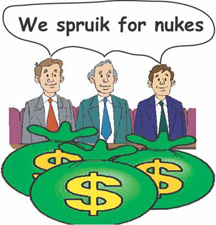 [the UK government] invited Westinghouse, Areva and EDF Energy, all pillars of nuclear power production, to contribute to government briefs and statements. “We need to all be working from the same material to get the message through to the media and the public,” ….Such spin and manipulation of information is likely to continue in the coming months as the industry struggles to recover.
(includes video)After Fukushima: the collusive nuclear industry fightback Independent Australia, 6 August 11, On the 66th anniversary of Hiroshima today, in a week whenrecord levels of radiation have been found at Fukushima, David McNeill looks at the way the nuclear industry has corruptly colluded with regulators in Japan and Britain to quieten valid public safety concerns about nuclear power. Continue reading
Solar energy becoming cheaper than coal
 it’s too bad our elected leaders see no value in spurring the next generation of energy technology rather than preserving tax cuts for oil and coal companies that are making record profits
5 breakthroughs that will make solar power cheaper than coal, Mother Nature Network, Karl Burkart, 8 Aug 11 Solar technology charges forward despite Washington’s backward march. Continue reading
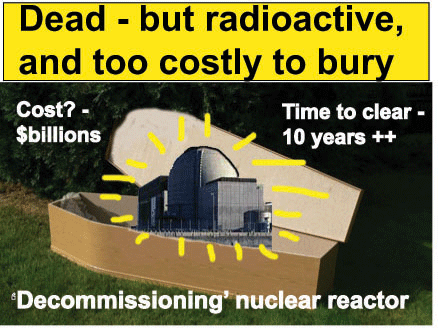
15 years later -work still continuing on getting rid of nuclear reactor
Visitors allowed into the decontamination workshop at Lubmin must wear radioactivity detectors and change into special protective clothing.
Working from inside containers, equipped with portholes, employees use high-pressure water, abrasive dust jets and acid baths to decontaminate the rooms one at a time.
“Don’t think radioactivity just disappears. It stays there as ground dust which has to be disposed of,” says Uwe Kopp, in charge of one of the workshops…..
Contaminated material from the plant is held in dozen of containers and barrels, awaiting a final government decision on a site for long-term storage.
1 This Month

of the week – Shut Down Drone Warfare!


Tell the Ukrainian Government to Drop Prosecution of Peace Activist Yurii Sheliazhenko

Petition to revoke the licensing of the Near Surface Nuclear Disposal Facility (NSDF) at Chalk River. https://www.ourcommons.ca/petitions/en/Petition/Details?Petition=e-7247
To see nuclear-related stories in greater depth and intensity – go to https://nuclearinformation.wordpress.com
-
Archives
- April 2026 (103)
- March 2026 (251)
- February 2026 (268)
- January 2026 (308)
- December 2025 (358)
- November 2025 (359)
- October 2025 (376)
- September 2025 (257)
- August 2025 (319)
- July 2025 (230)
- June 2025 (348)
- May 2025 (261)
-
Categories
- 1
- 1 NUCLEAR ISSUES
- business and costs
- climate change
- culture and arts
- ENERGY
- environment
- health
- history
- indigenous issues
- Legal
- marketing of nuclear
- media
- opposition to nuclear
- PERSONAL STORIES
- politics
- politics international
- Religion and ethics
- safety
- secrets,lies and civil liberties
- spinbuster
- technology
- Uranium
- wastes
- weapons and war
- Women
- 2 WORLD
- ACTION
- AFRICA
- Atrocities
- AUSTRALIA
- Christina's notes
- Christina's themes
- culture and arts
- Events
- Fuk 2022
- Fuk 2023
- Fukushima 2017
- Fukushima 2018
- fukushima 2019
- Fukushima 2020
- Fukushima 2021
- general
- global warming
- Humour (God we need it)
- Nuclear
- RARE EARTHS
- Reference
- resources – print
- Resources -audiovicual
- Weekly Newsletter
- World
- World Nuclear
- YouTube
-
RSS
Entries RSS
Comments RSS
 nuclear-news