Full body airport scanners that emit no radiation
 In July, Thruvision’s terahertz-scanning technology was tested at airports in Sydney and Melbourne, Australia, along with millimeter wave scanners from L3. Ron Frye, Thruvision’s Director of International Business Development, reports that the trials ended with positive results
Safer full-body scanners? SF Gate, 11 Aug 11, As controversy simmers surrounding the levels of radiation used in full body scanners, a small company based in the United Kingdom has developed a machine that emits no radiation at all. Continue reading
Australian soldiers to wear portable solar power
 Super slim solar cell a success, The Age, Ben Cubby August 12, 2011 ’A typical solar cell is about 0.2 millimetres thick, which is 200 micrometres thinner than a human hair or a sheet of paper, will soon be used by Australian soldiers on patrol in Afghanistan as a portable power source. The solar cells, invented by researchers at the Australian National University, can be used to cover helmets, tents or clothing and recharge electronic gear such as night vision goggles.
They also have extensive potential in civilian applications, including recharging phones and computers, because a square metre of lightweight solar panel can generate 140 watts of power and yet be rolled up into a ball afterwards. ’A typical solar cell is about 0.2 millimetres thick, which is 200 micrometres – that’s too thick to bend, it would shatter,” the project’s chief investigator, Andrew Blakers, said. ”But these cells are about 45 microns thick, so they are flexible and also about the same efficiency as commercial solar cells. By comparison, really fine quality merino wool is about 18 microns thick.” In practice, many square metres of panel could be unfurled from a box about the same size as a wine cask http://www.theage.com.au/national/super-slim-solar-cell-a-success-20110811-1iot3.html
Legal challenges to Nuclear Regulatory Commission’s approval for new reactor
On Thursday, 26 public interest and environmental groups filed challenges to the NRC safety evaluation report.
NRC clears AP1000 nuclear reactor design; environmental groups balk, Tampa bay.com By Ivan Penn, Aug 11, 2011 A Nuclear Regulatory Commission report cleared the AP1000 reactor Progress Energy plans to use for its new plant, but environmentalists want further public review before the agency gives the unit final approval. Continue reading
Centennial uranium project not likely to go ahead
 Powertech USA President Richard Clement said earlier this year that the Fukushima Daiichi nuclear power plant disaster in Japan shook the uranium market enough to give Powertech pause when considering the future of the Centennial Project.
Powertech writes off millions after uranium mine land deal collapses, Coloradoan.com. 11 Aug 11, Powertech Uranium Corp. has written off $2.3 million it lost when a Centennial Project land deal with two Northern Colorado landowners fell through in June. Continue reading
Third finding of radiation in shipment to Egypt, from Japan
 Egypt authorities find another case of radiation in Japanese shipment, Almasyry Alyoum, 9 Aug 11, — Egypt’s General Authority for Export and Import Control recently discovered radioactive cargo in two containers shipped from Japan to Ain Sokhna port, the Red Sea Ports Authority said.
This is the third radioactive shipment Egypt has discovered over the past month.
The radioactive material was found aboard ships carrying electric and mechanical instruments. A letter from Egypt’s atomic energy authorities confirmed the cargo had above-regulation radiation levels….http://www.almasryalyoum.com/en/node/485146
Parents bring lawsuit to challenge Japan’s handling of nuclear radiation crisis

 Japan Held Nuclear Data, Leaving Evacuees in Peril, NYT, Norimitsu Onishi reported from Fukushima, and Martin Fackler from Tokyo. Ken Belson and Kantaro Suzuki contributed reporting from Tokyo. 9 Aug 11, FUKUSHIMA, Japan —”……..In Koriyama, a city about 40 miles west of the nuclear plant, a group of parents said they had stopped believing in government reassurances and recently did something unthinkable in a conservative, rural area: they sued. Though their suit seeks to force Koriyama to relocate their children to a safer area, their real aim is to challenge the nation’s handling of evacuations and the public health crisis.
After the nuclear disaster, the government raised the legal exposure limit to radiation from one to 20 millisieverts a year for people, including children — effectively allowing them to continue living in communities from which they would have been barred under the old standard. The limit was later scaled back to one millisievert per year, but applied only to children while they were inside school buildings.
The plaintiffs’ lawyer, Toshio Yanagihara, said the authorities were withholding information to deflect attention from the nuclear accident’s health consequences, which will become clear only years later.
“Because the effects don’t emerge immediately, they can claim later on that cigarettes or coffee caused the cancer,” he said…..http://www.nytimes.com/2011/08/09/world/asia/09japan.html?_r=1&hp
USA’s radioactive nuclear waste piles up, with no plan in sight
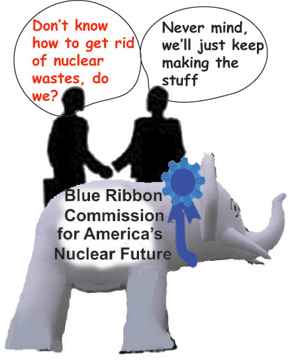 dispose of the waste, which remains radioactive for hundreds if not thousands of years. But legal fights, transportation concerns and a prevailing not-in-my-backyard mentality have blocked solutions.
In fact, no federal money is available anyway. The Wall Street Journal reported Tuesday that since the Balanced Budget and Emergency Deficit Control Act of 1985, Congress and successive administrations have funneled a $25 billion disposal fund into the government’s general coffers.
Because Washington failed to start taking spent fuel as promised beginning in 1998, utilities are suing it to cover their additional storage costs, the Journal reported. Legal fees are $16.2 billion and counting.
After spending billions to dig a dry-cask storage facility in the Nevada desert, Washington has, for now, scrapped that plan. Last month, the Blue Ribbon Commission on America’s Nuclear Future declared that the U.S. nuclear-waste disposal program has “all but broken down.” …
Something hidden in USA – India nuclear technology deal

 Government must clear mist about nuclear deal The New Indian Express, 11 Aug 11, “.…..S M Krishna’s latest statement in Parliament ….. His claim that new guidelines issued by the Nuclear Suppliers Group (NSG), banning transfer of nuclear enrichment and reprocessing (ENR) technologies to countries that do not sign Nuclear Proliferation Treaty do not negate NSG’s 2008 ‘clean waiver’ shows that the government continues to remain in a state of self-delusion. ……
As the gap between the prime minister’s assurances to Parliament before inking the nuclear deal and the reality keeps widening, it is clear that India was misled at the time of signing the deal. A bland, vague and simplistic statement from Krishna is not enough to dispel genuine concerns voiced by the Opposition as well as security experts that there was something hidden in the India-US civil nuclear deal. The government must now come out with a white paper on the subject and explain its position to Parliament and the people…http://expressbuzz.com/opinion/editorials/government-must-clear-mist-about-nuclear-deal/303299.html
19 legal challenges against relicensing of nuclear reactors
 The contentions filed with the NRC address reactors at nuclear facilities nationwide, including 11 plants in the South: the Tennessee Valley Authority’s Watts Bar plant in Rhea County, Tenn. and its Bellefonte plant in Hollywood, Ala.; SCE&G’s Summer plant near Jenkinsville, S.C.; NRG’s South Texas plant near Bay City; Luminant’s Comanche Peak plant southwest of Dallas; Southern Co./Georgia Power’s Vogtle plant in Burke County, Ga.; FP&L’s Turkey Point plant south of Miami; Progress Energy’s Levy County plant in Florida and its Shearon Harris plant in Wake County, N.C.; Dominion’s North Anna plant in Louisa County, Va.; and Duke Energy’s Lee plant in Cherokee County, S.C
Concerns grow over risk of U.S. nuclear projects post-Fukushima, Facing South, By Sue Sturgis on August 11, 2011 The disaster at the Fukushima Daiichi nuclear plant in Japan is still unfolding five months later, with multiple meltdowns and significant radiation releases contaminating communities and farms downwind from the facility. Some nuclear experts are calling it “the biggest industrial catastrophe in the history of mankind.”
The Fukushima accident is also raising questions about the U.S. nuclear industry’s current plans to build new reactors and re-license old ones.
Today, environmental and public-interest advocacy groups filed 19 legal challenges that ask the U.S. Nuclear Regulatory Commission to put the brakes on reactor licensing until it fully incorporates into its regulatory process the lessons learned from Fukushima. Continue reading
Nagasaki joins Hiroshima’s call to end nuclear energy
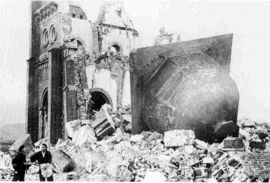 Nagasaki mayor calls for denuclearization, Asahi.com by Kenichi Ezaki and Yuji Endo. 10 Aug 11, NAGASAKI–The mayor of Nagasaki called for Japan to move away from nuclear power generation at a ceremony on Aug. 9 to commemorate the 66th anniversary of the dropping of the atomic bomb on Nagasaki. Continue reading
Japanese citizens exposed to radiation, as govt withheld information
In interviews and public statements, some current and former government officials have admitted that Japanese authorities engaged in a pattern of withholding damaging information and denying facts of the nuclear disaster — in order, some of them said, to limit the size of costly and disruptive evacuations in land-scarce Japan and to avoid public questioning of the politically powerful nuclear industry. As the nuclear plant continues to release radiation, some of which has slipped into the nation’s food supply, public anger is growing at what many here see as an official campaign to play down the scope of the accident and the potential health risks.
Japan Held Nuclear Data, Leaving Evacuees in Peril, NYT, Norimitsu Onishi reported from Fukushima, and Martin Fackler from Tokyo. Ken Belson and Kantaro Suzuki contributed reporting from Tokyo. 9 Aug 11, FUKUSHIMA, Japan — The day after a giant tsunami set off the continuing disaster at the Fukushima Daiichi nuclear plant, thousands of residents at the nearby town of Namie gathered to evacuate.
Given no guidance from Tokyo, town officials led the residents north, believing that winter winds would be blowing south and carrying away any radioactive emissions. For three nights, while hydrogen explosions at four of the reactors spewed radiation into the air, they stayed in a district called Tsushima where the children played outside and some parents used water from a mountain stream to prepare rice.
The winds, in fact, had been blowing directly toward Tsushima — and town officials would learn two months later that a government computer system designed to predict the spread of radioactive releases had been showing just that. Continue reading
U.S. taxpayers to pay nuclear build costs, and nuclear waste costs
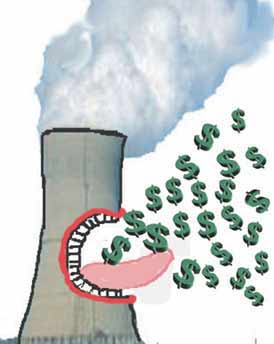 Nuclear Power Boosts Bills and Piles On Radioactive Waste, Florida PSC to consider more rate hikes for nuke projects at FPL and Progress Energy, Kenric Ward, Sunshine State News, August 10, 2011 For an energy source once touted as too cheap to meter, nuclear power bills sure are piling up. U.S. taxpayers are on the hook for a growing, multibillion-dollar tab to dispose of tons of radioactive waste and Florida’s two biggest utilities are seeking another round of rate increases to help pay for new reactors. Continue reading
TEPCO, Japan’s largest utility, likely to go broke
The March disaster at the Fukushima complex in northeast Japan spawned the world’s worst nuclear crisis since Chernobyl and has put the existence of Asia’s largest utility, known as TEPCO, in doubt.
Tepco said it has earmarked $5.1bn to compensate the victims of the crisis, who include about 80,000 people
evacuated from areas surrounding the Fukushima plant, 240km north of Tokyo.
Even before the pay-out began, Tepco posted a $15 billion net loss for the year to March 31, Japan’s biggest non-financial loss, according to Reuters news agency…..
Soothing propaganda promotes uranium mining in Virginia
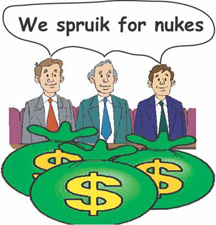 Uranium Safe to Eat With a Spoon!, OpEd News.com by David Swanson, 11 Aug 11, Carefully ignoring Fukushima, Los Alamos, Vermont, and Nebraska, a comforting new announcement informs us that “nuclear energy is safe.” A series of soothing television ads and videostells us that mining uranium in Virginia would produce jobs and protect us from scary foreigners.
Virginia newspapers carried an article from theAssociated Press this week that did not pretend to be anything but one-sided, reporting on the agenda of corporations that would profit from mining uranium while including no other views or any verified facts. The Washington Post did the very same thing. These articles are essentially press releases that have been tweaked. The online versions even include the videos.
We can expect even less actual news reporting than that (yes, less than nothing) to come through our televisions. But these ads hyping uranium mining as a job solution will be aired. And the television networks will consequently view the mining corporations as customers not to be needlessly offended or inconvenienced……
Thousands of years of danger, to provide what the uranium mining companies claim might be 65 years of uranium use. That seems like the kind of deal only a U.S. president could consider a bargain. Let’s hope Virginia still has more life left in it than Washington. http://www.opednews.com/articles/Uranium-Safe-to-Eat-With-a-by-David-Swanson-110809-895.html
USA Dept of Energy grants money to spin Nuclear as climate change solution
The goal is for the United States to use the nuclear industry to cut carbon emissions and create new green energy jobs……
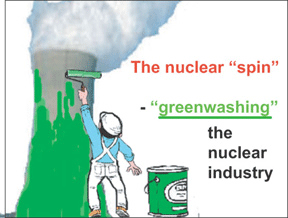
DOE awards $1.09M grant to CSU nuclear energy project, coloradoan.com 10 Aug 11, A Colorado State University statistics professor’s nuclear energy modeling project has been awarded a $1.09 million federal grant, part of a program aimed at developing nuclear energy technology at universities across the country. Continue reading
1 This Month

of the week – Shut Down Drone Warfare!


Tell the Ukrainian Government to Drop Prosecution of Peace Activist Yurii Sheliazhenko

Petition to revoke the licensing of the Near Surface Nuclear Disposal Facility (NSDF) at Chalk River. https://www.ourcommons.ca/petitions/en/Petition/Details?Petition=e-7247
To see nuclear-related stories in greater depth and intensity – go to https://nuclearinformation.wordpress.com
-
Archives
- April 2026 (103)
- March 2026 (251)
- February 2026 (268)
- January 2026 (308)
- December 2025 (358)
- November 2025 (359)
- October 2025 (376)
- September 2025 (257)
- August 2025 (319)
- July 2025 (230)
- June 2025 (348)
- May 2025 (261)
-
Categories
- 1
- 1 NUCLEAR ISSUES
- business and costs
- climate change
- culture and arts
- ENERGY
- environment
- health
- history
- indigenous issues
- Legal
- marketing of nuclear
- media
- opposition to nuclear
- PERSONAL STORIES
- politics
- politics international
- Religion and ethics
- safety
- secrets,lies and civil liberties
- spinbuster
- technology
- Uranium
- wastes
- weapons and war
- Women
- 2 WORLD
- ACTION
- AFRICA
- Atrocities
- AUSTRALIA
- Christina's notes
- Christina's themes
- culture and arts
- Events
- Fuk 2022
- Fuk 2023
- Fukushima 2017
- Fukushima 2018
- fukushima 2019
- Fukushima 2020
- Fukushima 2021
- general
- global warming
- Humour (God we need it)
- Nuclear
- RARE EARTHS
- Reference
- resources – print
- Resources -audiovicual
- Weekly Newsletter
- World
- World Nuclear
- YouTube
-
RSS
Entries RSS
Comments RSS
 nuclear-news