Nuclear company AREVA failing in nuclear and uranium sales

 Tough times for French nuclear giant Areva, Daily Press, Virginia, 27 Dec 11 These are difficult days for French nuclear giant Areva. The company announced earlier this month it would shed 1,500 jobs in Germany and suspend a controversial nuclear enrichment plant project in Idaho. It is trying to offset losses this year that could exceed $2 billion, the Associated Press reported.
Areva partnered with Newport News Shipbuilding to build a $363 million plant that would manufacture nuclear power plant components. Located off Huntington Avenue in Newport News, the plant is stalled indefinitely due to a lack of new nuclear projects in the U.S.
Another pertinent detail about Areva: the company said its earnings could be hurt by the drop in new reactors being built worldwide — fallout from the nuclear disaster in Japan. The company said this will also depress the price of uranium….. http://www.dailypress.com/news/science/dead-rise-blog/dp-tough-times-for-french-nuclear-giant-areva-20111227,0,2218239.story?track=rss
Australian Senator wants to stop uranium sales to India, on safety concerns
Australian senator slams India’s nuclear sector, Australia network news, 27 Dec 2011 An Australian Greens Senator has said India’s nuclear sector is set to become more irresponsible, and wants Australia to rethink its policy to sell uranium to the country. Senator Scott Ludlum made his comments after India announced plans to replace its independent nuclear regulator with a government-controlled body.
The decision comes just weeks after Australia announced it would begin selling uranium to India’s civilian nuclear program. Senator Ludlum told Connect Asia after Japan’s nuclear disaster in March this year, governments around the world were having second thoughts about how to regulate uranium.
“Because the technology is so unforgiving, and when things go wrong they go so seriously wrong, you need to have an exquisite safety culture to maintain this equipment,” the Western Australian Senator said.
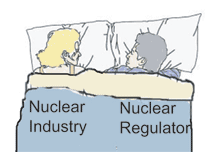 Corruption risk The Atomic Energy Regulatory Board will be replaced with a safety authority answerable to government ministers, which Senator Ludlum said could suffer from government interference. ”On a day to day basis they will actually have the ability, from the prime minister down, to direct the regulator, force it to investigate or not investigate certain kinds of activities and, I think, quite improper use of national interest tests to decide what the regulator should do.
“Not just in India, but everywhere around the world where this technology is used, you need to be completely at arms length and you need have a fiercely independent regulator to stick its nose in wherever it thinks it’s appropriate,” he said.
“The last thing you want is something that’s just a puppet of the top tiers of government and that’s what the Indian movement and Indian officials are telling us is occurring here,” the senator said. http://australianetworknews.com/stories/201112/3398569.htm?desktop
India’s Left parties want to tighten up Nuclear Liability Bill
The initial licence period is five years. But the Left argues that this “either or” provision is aimed at helping the foreign suppliers, and that the nuclear accidents can happen after the initial licence period which can still be the fault of the suppliers.


 Trouble for govt on nuclear liability rules Jayanth Jacob, Hindustan Times New Delhi,
  December 28, 2011 In a move that could bring fresh troubles for the government, the Left parties have moved amendments to the rules of the nuclear liability bill that deals with limiting of supplier liability.
The foreign suppliers have been maintaining that Indian liability law is not consistent with international norms owing to the stringent supplier liability of provisions. The amendments moved by the CPI(M) pertain to the rule 24 that deals with supplier liability.
The first amendment is for omitting the words “or the value of the contract itself, whichever is less” that aimed at limiting the compensation. Continue reading
Public unaware of serious risks in Virginia uranium mining experiment
Leave Virginia’s uranium mining ban in place, Washington Post, Joy M. Oakes, 27 Dec 11, Few people I’ve spoken with were aware of the threat uranium development poses to Virginia. This is a reflection of the would-be developers’ political savvy, and it’s deeply troubling, given the risky nature of this experimental development scheme by Virginia  Uranium. Plenty is at risk from operations on the proposed Pittsylvania County site, including potential contamination of drinking water that would affect more than a million residents of Hampton Roads and North Carolina communities; Virginia’s $18 billion tourism industry; and markets for local agricultural products, including wine, milk and the grass-fed beef raised in Pittsylvania County by my family, among others.
No one has identified successful uranium operations in wet, severe climates comparable to that of Southside Virginia. The National Academy of Sciences study on uranium mining at the site leaves too many unknowns. Gov. Robert F. McDonnell (R) and state legislators must reject this risky experiment with Virginia’s future and leave the state’s moratorium on uranium mining in place. http://www.washingtonpost.com/opinions/leave-virginias-uranium-mining-ban-in-place/2011/12/22/gIQAHWgHJP_story.html
Secrecy as Canada transports weapons grade uranium to USA

 Canada shipping bomb-grade uranium to U.S.: memo Andy Blatchford, The Canadian Press, 27 Dec 11 MONTREAL — Weapons-grade uranium is quietly being transported within Canada, and into the United States, in shipments the country’s nuclear watchdog wants to keep cloaked in secrecy. Continue reading
Jan’s govt suggests nationalising Tepco, at least temporarily
Tepco asked to consider temporary state control, BBC News 27 Dec 11 Tokyo Electric Power Company (Tepco), which operates Japan’s disaster-hit nuclear plant, has been asked to consider temporary state control. Energy minister Yukio Edano suggested it as one possible way to try to strengthen its financial position. Continue reading
Tepco asks Japan’s government for additional 6 billion pounds
Japan‘s biggest utility, known as Tepco, faces costs of trillions of yen for compensation and cleanup, and the Japanese government agreed only two months ago to provide £7bn through a bailout fund. Continue reading
Pakistani and Indian experts co-operate in nuclear weapons safety talks
 Pakistan, India Call for Extending Agreement on Preventing Nuclear Accidents Voice of America, December 27th, 2011 Pakistan and India say officials from both sides have called for
extending an agreement on reducing the risk of nuclear accidents relating to their countries’ atomic weapon stockpiles. Pakistani and Indian government experts discussed nuclear confidence-building measures in Islamabad on Tuesday, the second day of a two-day dialogue between the nuclear-armed rivals. The talks are part of a peace process that resumed in February following a two-year break.
In a joint statement, Pakistan and India said the experts agreed to advise their foreign ministries to prolong the existing agreement on preventing nuclear weapon-related accidents by five years. The statement described the talks as “cordial” and “constructive.”
In Monday’s talks, Pakistan proposed that both sides relocate their heavy weaponry at least 30 kilometers away from the Line of Control, a de facto border that divides Pakistani- and Indian-controlled Kashmir. India made no immediate public response to the idea of demilitarizing the Line of Control….. http://blogs.voanews.com/breaking-news/2011/12/27/pakistan-india-call-for-extending-agreement-on-preventing-nuclear-accidents/
Another safety problem shuts down Pilgrim nuclear power plant
Pilgrim nuclear plant shut down because of safety relief valve leak By Carolyn Y. Johnson, Boston Globe , 27 Dec 11 The Pilgrim Nuclear Power Station in Plymouth was shut down early this morning because of a leak detected in one of four safety relief valve systems. The steam leak was slightly radioactive and contained inside the plant. It posed no threat to the public or to plant workers, according to a spokesman for the Nuclear Regulatory Commission….. Last spring, safety issues and an emergency shutdown at Pilgrim occurred. In November, the NRC officially required a yearlong review of safety procedures because of the problems, which occurred as control room operators as were restarting the reactor after it had been refueled. …. http://www.boston.com/Boston/metrodesk/2011/12/pilgrim-nuclear-plant-shut-down-because-safety-relief-valve-leak/iGrt6XDLKSsJAem1djJ3aJ/index.html
The hypocrisy and lies of the global nuclear lobby

Christina Macpherson's websites & blogs
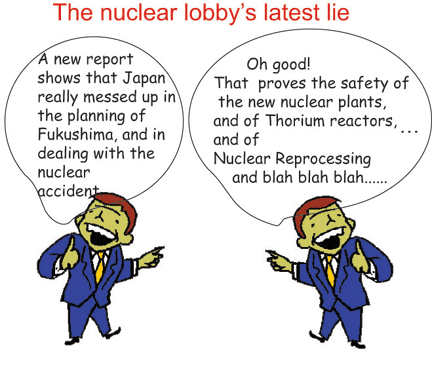
Has anyone noticed that Japan well and truly stuffed up in its planning and setting up of the Fukushima nuclear power plant – and yet is now preaching to India on the unsafety of India’s nuclear plants?
That strikes me as a dazzling bit of arrogance and hypocrisy. Yet Japan’s Prime Minister has the gall to tell India that because of Japan’s nuclear disaster, Japan is now an expert on nuclear safety!
And anyway, as if the Japanese government cared about India’s safety, anyway! What they care about is making money selling their nuclear. technology.
But now – I’m here getting a bit ahead of the worldwide nuclear lobby. The comprehensive international report on the Fukushima nuclear disaster will not be completed until about June 2012. However, the initial part of the report recounts all the errors made by the Japanese regarding the planning and setting up of the Fukushima Daiichi nuclear plant, and in dealing with the catastrophe.
I’m predicting that the nuclear lobby will come out with a whole lot of guff about how much safer nuclear technology is now. How much they’ve learned from the disaster, so we can all rest assured that the nuclear industry is now safe! – Christina Macpherson, 27 Dec 11
New report on the continuing nuclear disaster at Fukushima
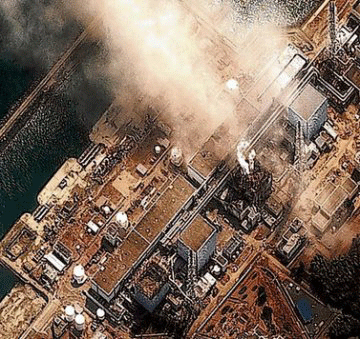 Nuclear disaster response failed: report 9 News Dec 26 2011 Yuri Kageyama Japan’s response to the nuclear crisis that followed the March 11 tsunami was confused and riddled with problems, a report revealed on Monday. The response included an erroneous assumption that an emergency cooling system was working and a delay in disclosing dangerous radiation leaks.
The disturbing picture of harried and bumbling workers and government officials scrambling to respond to the problems at Fukushima Dai-ichi nuclear power plant was depicted in the report detailing a government investigation……
Sadder still was how the government dallied in relaying information to the public, such as using evasive language to avoid admitting serious meltdowns at the reactors, the report said.
The government also delayed disclosure of radiation data in the area, unnecessarily exposing entire towns to radiation when they could have evacuated, the report found.
The government recommended changes so utilities will respond properly to serious accidents.
It recommended separating the nuclear regulators from the unit that promotes atomic energy, echoing frequent criticism since the disaster, which left 20,000 people dead or missing.
Japan’s nuclear regulators were in the same ministry that promotes the industry, but they will be moved to the environment ministry next year to ensure more independence.
The report acknowledged people were still living in fear of radiation spewed into the air and water, as well as radiation in the food they eat. Thousands have been forced to evacuate and have suffered monetary damage from radiation contamination, it said.
“The nuclear disaster is far from over,” the report said.
http://news.ninemsn.com.au/world/8395190/japan-probe-finds-nuclear-disaster-respons
The continuing human cost of Fukushima’s continuing radiation
Enduring the nuclear winter, Irish Times, 26 Dec 11“……..More than 100,000 people have been displaced due to radiation around Fukushima Prefecture, home to the crippled Daiichi nuclear plant. Those who stay keep children indoors for much of the day. Others, such as single mother Kanako Nishitaka from Fukushima City, have fled in an attempt to find normality in a different part of the country.
“My daughter is smaller and closer to the ground, so she absorbed more radiation,” she says. “They found caesium in her body. I was told it was about the same amount as people exposed to nuclear bomb tests. When I told my son we were moving, he cried his eyes out because he
didn’t want to leave his friends.”
Many doubt the immediate area around the plant will ever again be habitable. The Daiichi plant will become an unwanted monument to Japan’s nuclear ambitions for years to come, while the cost of dismantling its reactors and supporting its victims will haunt future
governments…….” http://www.irishtimes.com/newspaper/features/2011/1227/1224309514995.html
Stiff opposition in South Korea to new nuclear power plants

 New nuclear plants face public backlash, Korea Herald, By Shin Hyon-hee, 27 Dec 11 2011 Civic groups, environmentalists, residents stage protests, voicing safety concerns The government’s plan to install new nuclear reactors in the country’s eastern shore faces stiff opposition from residents, stoking safety concerns in the aftermath of a Japanese disaster.
Last week, the government picked two candidate sites for nuclear power plants –Yeongdeok in North Gyeongsang Province and Samcheok in Gangwon Province. The decision will be finalized by late next year after on-site inspections and environmental surveys.
On Monday, civic groups, religious organizations, environmentalists and residents staged a mass rally in downtown Seoul and the two regions, calling to scrap the country’s atomic energy policy.
“The government’s latest site selection completely neglects a global anti-nuclear trend that has been reigning supreme since the Fukushima meltdown in March,” Green Korea United, one of the country’s major environmental groups, said in a statement. In Samcheok, Gangwon
Province Gov. Choi Moon-soon added fuel to the flame by expressing his regret over the announcement. “It’s hard to understand the government is pushing ahead with its nuclear expansion program at a time when there is no national consensus and public understanding of the safety of the plan,” he said. ..
..Among the imminent issues is the storage of spent radioactive fuel rods that will run of space in 2016. The ministry plans to host a public forum in the first half of next year to discuss how to take care of such obsolete equipment, Hong said….http://www.koreaherald.com/business/Detail.jsp?newsMLId=20111226000732
78% of Japanese do not believe that Fukushima nuclear plant crisis is over
78 percent of poll participants did not accept Noda’s announcement this month of the effective end of the accident at the Fukushima Daiichi nuclear plant,
 Japan PM’s public support plunges Channel Asia News 26 December 2011 TOKYO: Support for Japan’s primeminister plunged in December as voters lost faith in his leadership, amid party turmoil and criticism over his handling of the nuclear crisis, a poll said Monday. Continue reading
Japan taking a moral position about the unsafety of India’s nuclear plants!
Japan likely to speak out on N-plants’ safety during talks with India The Pioneer, 22 DECEMBER 2011 SANDHYA SHARMA | NEW DELHI Japan will voice concerns over the safety of nuclear plants with India as two Prime Ministers Manmohan Singh and his Japanese counterpart Yoshihiko Noda are set to meet in New Delhi next week for the 6th Annual Summit between the two leaders.
The two sides will enhance the cooperation in nuclear sector despite the Fukushima disaster that rocked Tokyo last year….. even less than a year to the Fukushima Daiichi nuclear accident, Japan is recommencing steps it hopes will lead to exports of commercial nuclear technology to counties like India and Vietnam. This resumption comes even as Japan itself is scaling back the use of nuclear energy
at home.
Japan’s ruling Democratic Party is promoting nuclear technology exports as a pillar of its economic growth strategy. The earthquake in March with ensuing accident at the Fukushima Daiichi power plant led to a suspension of negotiations with India toward accords on the
transfer of nuclear energy technology.
New Delhi on the other hand is facing the flack from the locals over the commencement of the Kudankulam nuclear plant which is a joint Indo-Russian collaboration project following the Fukushima disaster….http://dailypioneer.com/nation/29789-japan-likely-to-speak-out-on-n-plants-safety-during-talks-with-india.html
1 This Month

of the week – Shut Down Drone Warfare!


Tell the Ukrainian Government to Drop Prosecution of Peace Activist Yurii Sheliazhenko

Petition to revoke the licensing of the Near Surface Nuclear Disposal Facility (NSDF) at Chalk River. https://www.ourcommons.ca/petitions/en/Petition/Details?Petition=e-7247
To see nuclear-related stories in greater depth and intensity – go to https://nuclearinformation.wordpress.com
-
Archives
- March 2026 (230)
- February 2026 (268)
- January 2026 (308)
- December 2025 (358)
- November 2025 (359)
- October 2025 (376)
- September 2025 (257)
- August 2025 (319)
- July 2025 (230)
- June 2025 (348)
- May 2025 (261)
- April 2025 (305)
-
Categories
- 1
- 1 NUCLEAR ISSUES
- business and costs
- climate change
- culture and arts
- ENERGY
- environment
- health
- history
- indigenous issues
- Legal
- marketing of nuclear
- media
- opposition to nuclear
- PERSONAL STORIES
- politics
- politics international
- Religion and ethics
- safety
- secrets,lies and civil liberties
- spinbuster
- technology
- Uranium
- wastes
- weapons and war
- Women
- 2 WORLD
- ACTION
- AFRICA
- Atrocities
- AUSTRALIA
- Christina's notes
- Christina's themes
- culture and arts
- Events
- Fuk 2022
- Fuk 2023
- Fukushima 2017
- Fukushima 2018
- fukushima 2019
- Fukushima 2020
- Fukushima 2021
- general
- global warming
- Humour (God we need it)
- Nuclear
- RARE EARTHS
- Reference
- resources – print
- Resources -audiovicual
- Weekly Newsletter
- World
- World Nuclear
- YouTube
-
RSS
Entries RSS
Comments RSS
 nuclear-news