UK’s legacy of radiation from World War 2
Former RAF base at Little Rissington named by MoD as contaminated Cotswold Journal, 29th December 2011 THE former Red Arrows site at Little Rissington has been revealed by the MoD as one of 15 places in the UK to be contaminated by radioactivity from the Second World War.
A dozen such sites, which have not been made public by the ministry before, were revealed after a parliamentary question was asked of MP Andrew Robathan earlier this month…… Building work has already started on a raft of other amenities including a primary school, health centre and shops, and leisure facilities are planned for the site.
Lionel Teague, chairman of the Little Rissington Parish Council, said the council was unaware of the contamination…… The contamination comes from radium used to coat the dials of aircraft and other equipment to illuminate them in the dark. The radium comes from scrap
that was burned and dumped in the 1940s and 50s….. http://www.cotswoldjournal.co.uk/news/9441673.Ex_RAF_base_radiation_alert/
China continues research on Fukushima radiation in Pacific Ocean
China conducts second radiation monitor in Pacific Ocean By Yu Jianbin (People’s Daily Overseas Edition), December 29, 2011 Edited and translated by People’s Daily Online A marine monitoring team dispatched by China’s State Oceanic Administration accomplished the mission of monitoring radiation in the western Pacific Ocean for the second time, and returned to Xiamen on Dec. 27 aboard the Xiangyanghong 09 scientific exploration ship.
The monitoring team sailed about 6,100 nautical miles in 30 days, and monitored radiation in the air over and water in the western Pacific Ocean as well as radiation-sensitive sea creatures, chemistry and dynamic environments.
This is the second time that China has monitored radiation in international waters in the western Pacific Ocean.
The aim of the mission is to gain a deeper understanding of the impact of Japan’s Fukushima Daiichi nuclear disaster on the western Pacific Ocean and China’s marine environment, and to help build a western Pacific marine environmental monitoring and early warning system.
http://english.peopledaily.com.cn/202936/7691886.html
America’s out-dated Cold War nuclear strategy

 The Cold War Is Long Gone, but the Nuclear Threat Is Still Here The Atlantic, Dec 20 2011, America’s nuclear strategy hasn’t changed much since the Soviet Union fell, but the world’s nuclear dangers have. In the two decades since the fall of the Soviet Union and the end of the Cold War, the nuclear challenges facing the United States have changed radically. American nuclear strategy has not.
American nuclear forces are largely designed to deter a superpower that no longer exists. Continue reading
Talks between USA and Israel about bombing Iran’s nuclear facilities
U.S., Israel Discuss Triggers for Bombing Iran’s Nuclear Infrastructure, The Daily Beast, Eli Lake, Dec 28, 2011 The Obama administration is trying to assure Israel privately that it would strike Iran militarily if Tehran’s nuclear program crosses certain “red lines”—while attempting to dissuade the Israelis from acting unilaterally. Eli Lake reports Continue reading
Threat to cut off oil exports- Iran – if there are more sanctions over its nuclear development
Iran threatens to cut off oil exports if sanctions imposed over nuclear activity Reuters Dec 27, 2011 By Ramin Mostafavi TEHRAN — Iran threatened on Tuesday to stop the flow of oil through the Strait of Hormuz if foreign sanctions were imposed on its crude exports over its nuclear ambitions, a move that could trigger military conflict with economies dependent on Gulf oil.
Western tensions with Iran have increased since a November 8 report by the UN nuclear watchdog saying Tehran appears to have worked on designing an atomic bomb and may still be pursuing research to that end. Iran strongly denies this and says it is developing nuclear energy for peaceful purposes.
Iran has defiantly expanded nuclear activity despite four rounds of UN sanctions meted out since 2006 over its refusal to suspend sensitive uranium enrichment and open up to UN nuclear inspectors and investigators…..
Countries in the 27-member European Union take 450,000 barrels per day of Iranian oil, about 18 percent of the Islamic Republic’s exports, much of which go to China and India. EU officials declined to comment on Tuesday….. http://news.nationalpost.com/2011/12/27/iran-threatens-to-cut-off-oil-exports-if-sanctions-imposed-over-nuclear-activity/
In 2012 nuclear power more costly, more problematic
 Experts: Even Higher Costs and More Headaches Ahead for Nuclear Power in 2012 Market Watch, WASHINGTON, Dec. 28, 2011 – Given Long-Term Uncontrollable Costs and Short-Term Pressure from Needed Post-Fukushima Safety Regulations, Nuclear Reactors Even Less Able to Take on Natural Gas, Other Alternatives
With the Fukushima disaster, earthquake-related reactor shutdowns, further reactor project cost escalation, infighting at the Nuclear Regulatory Commission (NRC), and cheap natural gas, 2011 was a year the nuclear power industry would prefer to get behind it as quickly as possible. But, looking ahead to 2012, experts see continuing challenges that will make it extremely difficult for the nuclear power industry to expand in the U.S. beyond a small handful of reactor projects that government agencies decide to subsidize by forcing taxpayers to assume the risk for the reactors and mandating that
ratepayers pay for construction in advance.
A new paper presented by Mark Cooper, senior fellow for economic analysis, Institute for Energy and the Environment, Vermont Law School, suggests that the cost of nuclear power, which already had risen sharply in 2010 and 2011 before the Fukushima disaster, could climb another 50 percent due to tighter safety oversight and regulatory delays in the wake of the reactor calamity in Japan. The Cooper paper is available online at
http://www.markcooperresearch.com/Nuclear-Safety-and-Nuclear-Economics-Post-Fukushima.pdf ….
Florida consumers being hit with costs for imaginary nuclear power plants
consumers are getting hit with costs for “imaginary nuclear plants” and that the Public Service Commission is not properly carrying out a 2006 law.”It’s a scam,’’ ….. “It’s an absolute scam of monumental proportions.’’
attorneys for the Southern Alliance for Clean Energy, consumers and major power users questioned whether the utilities will ever build the multibillion-dollar nuclear plants.
 Clean energy group to challenge PSC decision on nuke funding, Miami Herald, By Jim Saunders, 29 Dec 11 An advocacy grouup notified the state Public Service Commission that it is taking the unusual step of appealing an order that allows utilities to collect money for work on future or existing nuclear plants. By Jim Saunders The News Service of Florida TALLAHASSEE —
An advocacy group will ask the state Supreme Court to reject a regulatory decision that would allow Florida Power & Light and Progress Energy Florida to collect about $282 million from
customers next year for nuclear-power projects.The Southern Alliance for Clean Energy notified the state Public Service Commission last week that it is taking the unusual step of appealing an order that allows the utilities to collect money for work on future or existing
nuclear plants. Continue reading
USA’s ‘nuclear renaissance’ is just not going to happen
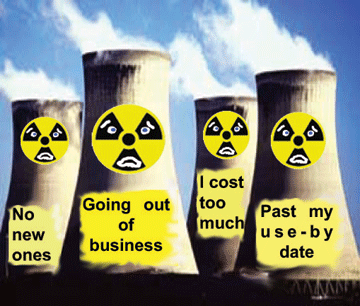 Report: U.S. nuclear renaissance unlikely after Fukushima Los Angeles Times, December 28, 2011 A new study released Wednesday said that the regulatory fallout from the Fukushima power plant disaster in Japan in March will short-circuit the U.S. nuclear renaissance of new power plant construction.
The report, “Nuclear Safety and Nuclear Economics,” was written and presented by Mark Cooper, a frequent critic of the nuclear power industry. The report can be found here. Cooper is a senior fellow for economic analysis at the Institute for Energy and the Environment at the Vermont Law School.
Cooper said that past nuclear disasters, such as the one at the Three Mile Island power plant in Pennsylvania in 1979, have tended to greatly raise regulatory barriers and have also severely multiplied the cost of reactor construction. After Three Mile Island, for example, the report said, the cost of nuclear power plant construction doubled in most cases and trebled or quadrupled in some rare instances.
“This is an important moment to compare what is really likely to happen over the next 10 years with the industry’s expectations” of a nuclear renaissance, Cooper said. “When that comparison is performed properly, it becomes clear that we are witnessing not a revival but a collapse in expectations for new reactor construction.”
The report comes just days after a panel appointed by the Japanese government released a scathing assessment of the reponse to the disaster, which was caused when a huge earthquake generated a tsunami that struck the facility….
A recently updated online report by the World Nuclear Assn. said that as few as four of the 26 new nuclear facilities that have been proposed or planned in the U.S. will be finished by 2020. But it did not mention Fukushima and instead said the primary reason was the fact that a boom in domestic natural gas production has “put the economic viability of some of these projects in doubt.” http://latimesblogs.latimes.com/money_co/2011/12/a-new-study-released-today-said-that-theregulatory-fallout-from-the-fukushima-power-plantdisaster-in-japan-last-marchwill-pro.html
25 history making events in green energy in 2011
Top 25 Alternative Energy Moves of 2011
Earth 911 by Mary Mazzoni12/28/11 Despite controversies surrounding biofuel and the collapse of several high-profile alternative energy companies, 2011 was a big year for renewables. Profits from the alternative energy industry skyrocketed, making headlines worldwide. As the year comes to a close, let’s take a look at some history-making milestones in green energy…… http://earth911.com/news/2011/12/28/top-25-alternative-energy-moves-of-2011/
Clean energy highlights of 2011
Top 10 clean energy stories of 2011, Grist, BY STEPHEN LACEY 29 Dec 11 What an odd year. While businesses around the world were making record-level investments in renewables and efficiency, a growing number of conservative politicians and members of the American media punditry — lead by the outrageously ignorant “reporting” by Fox News — have been foolishly projecting (even cheering on) the demise of the sector.
However, in order to cut through some of the recent political attacks, here are stories on the positive trends in clean energy. These are some of our favorites from the last year (with some of our best clean energy charts of the year):
1. Clean energy stunner: Renewable power tops fossil fuels for the first time.
Even with a severe financial crisis in Europe and the continued malaise in the U.S., renewable energy surpassed fossil fuels for the first time in new power-plant investments in 2011.
2. Solar is ready now: “Ferocious cost reductions” make solar PV competitive.
This great series of charts shows just how cost-competitive solar photovoltaics have become with new coal and nuclear plants in the U.S…..
10. Polling reveals that being anti-clean energy is bad politics.
Anyone watching the presidential primaries has seen an astonishing reversal from candidates on climate science and support of clean energy. It turns out that negative rhetoric can actually havenegative consequences for candidates. http://www.grist.org/renewable-energy/2011-12-28-top-10-clean-energy-stories-of-2011
2012 will be an even worse year for the nuclear power industry
Experts: Even Higher Costs and More Headaches Ahead for Nuclear Power in 2012 Market Watch, WASHINGTON, Dec. 28, 2011 – “………Highlights of the new Cooper paper include the following: Fukushima has stimulated vigorous reviews around the world, in part because of the severity of the accident, in part because it is the worst accident affecting a nuclear reactor in a market economy and in part because it occurred in a nation that was assumed to have a high standard of safety and superb technical expertise.
The challenges perceived by those responsible for nuclear safety around the world in the wake of the Fukushima accident are quite substantial. Continue reading
Uranium mining harmful to Tanzania, benefits only foreign investors
companies mining uranium had never solved problems associated with extraction of the minerals and also they had never employed good way of settling remains of the minerals after the mining activity is complete.
that mining activities benefited more investors than Tanzanians.
“Take an example of Niger, they are now suffering from the impacts of uranium extraction, including high levels of environmental degradation,”
PP Media 28 Dec 11, “………The Legal and Human Rights Centre Legal Officer in-charge of Corporate and Environment Flaviana Charles says the metal posses dangers not only to human beings but to animals and environment.
Already companies including Mantra (T) and Uranex (T) limited are exploring the minerals in various parts including Namtumbo (Mkuju River Project) Bahi and Manyoni, a move which has been criticised by majority of the members of public including legislators.
“We have decided to take the initiative to raise awareness to the public on this new mineral expected to start being mined in the country,” says Charles. Continue reading
India boosts its nuclear weaponry
India to get Russian nuclear attack sub in days: Report , Economic Times, 28 DEC, 2011,MOSCOW: Indian Navy is set to receive a major boost when the much-awaited Russian ’Nerpa’ nuclear attack submarine would join its fleet “in the next few days” on a 10-year lease worth USD 920 million. …. The Akula-II class submarines are equipped with 28 nuclear-capable cruise missiles with a striking range of 3,000 km. The Indian version is reportedly expected to be armed with the 300-km Club nuclear-capable missiles. ………http://economictimes.indiatimes.com/news/politics/nation/india-to-get-russian-nuclear-attack-sub-in-days-report/articleshow/11280048.cms
The political realities of Iran and the nuclear issue
Concerns built around the fiery anti-western and anti-Israeli rhetoric of Ahmadinejad and his clerical contemporaries again seem to be purposefully ignoring the realities of political theatre,
US troops have been deployed along two of its major borders for more than a decade. Perhaps it is because, despite assisting coalition forces against the Taliban in 2001, Iran was singled out as one of the major targets of George W Bush’s infamous 2002 ‘Axis of Evil’ speech. Perhaps, with an unrivalled number of American-backed and led regime changes in the Middle East, Central Asia and North Africa over the past 10 years, Tehran is getting even more wary of the impact of US exceptionalism in the region. Perhaps Tehran knows that, had Saddam actually possessed nuclear weapons in 2003 there is no way in hell the US would have pulled a blitzkrieg on Baghdad.
Iran’s pursuit of a nuclear arsenal makes perfect sense from a defensive and deterrence standpoint.
 Stop worrying and learn to love the Iranian bomb, The Drum, Ben Rich 28 Dec 11, Prominent figures within the Israeli and US governments are beating the war drum over the issue of Iran’s progress towards nuclearisation. Regardless of whether or not Iran will actually seek to weaponise its nuclear program, the chances of it utilising WMDs for anything more than posturing remain next to zero.
Critics of Iran’s nuclear program loudly contend that Tehran is irrational and will not operate within the accepted nuclear paradigm of modern states. This claim is at best, obtuse conjecture, and in all likelihood, purposeful disinformation.
Iranian foreign policy has traditionally been cautious, and post-revolutionary Iran has never initiated a conventional conflict. Claims that Tehran’s willingness to engage in clandestine operations demonstrate an inherent irrationality and hold little credibility when held up against the plethora of other states, many of them Western, who engage in the same activities and are still considered wholly rational. Continue reading
The disaster that is Japan’s Fukushima area
No-man’s land attests to Japan’s nuclear nightmare NewsDay, December 27, 2011 By The Associated Press DAVID GUTTENFELDER , ERIC TALMADGE “……In the ghost towns around Fukushima Dai-ichi, vines have overtaken streets, feral cows and owner-less dogs roam the fields. Dead chickens rot in their coops.
The tens of thousands of people who once lived around the plant have fled. They are now huddling in gymnasiums, elementary school classrooms, bunking with friends, sometimes just sleeping in their cars, moving from place to place as they search for alternatives.
For those who lived on the perimeter of the Fukushima Dai-ichi nuclear plant, fliers used to come in the mail every so often explaining that someday this might happen. Most recipients saw them as junk mail, and threw them away without a second glance. For those who did read them, the fliers were always worded to be reassuring — suggesting that although a catastrophic nuclear accident was extremely unlikely, it could require evacuating the area.
Never was it even hinted that the evacuation could last years, or decades.
At most of the shelters, food is doled out military-style, at set times. Personal space is extremely limited, often just big enough to fit a futon and the collective snoring at night makes sleep fitful, at best. Baths are public, cramped, dark.
The total amount of radiation released from the plant is still unknown, and the impact of chronic low-dose radiation exposures in and around Fukushima is a matter of scientific debate.
Recent studies also suggest Japan continues to significantly underestimate the scale of the disaster — which could have health and safety implications far into the future.
According to a study led by Andreas Stohl the Norwegian Institute for Air Research, twice as much radioactive cesium-137 — a cancer-causing agent — was pumped into the atmosphere than Japan had announced, reaching 40 percent of the total from Chernobyl. The French Institute for Radiological Protection and Nuclear Safety found 30 times more cesium-137 was released into the Pacific than the plant’s owner has acknowledged.
Under a detailed roadmap, plant operator Tokyo Electric Power Co. will remove the melted nuclear fuel, most of which is believed to have fallen to the bottom of the core or even down to the bottom of the larger, beaker-shaped containment vessel, a process that is expected to begin in 10 years. http://www.newsday.com/news/nation/no-man-s-land-attests-to-japan-s-nuclear-nightmare-1.3413018
1 This Month


10 March A LIVE WEBINAR THE REAL EFFECTS OF NUCLEAR POWER
What the Industry Isn’t Telling Us
1:00 PM Mountain, 2 pm Central, 3 pm Eastern. Live on the Keepers of the Water Facebook page

18 March Webinar @ 1 PM EST: An Assessment of SMR Projects: The Case of Canada
register for the zoom:
https://us02web.zoom.us/webinar/register/WN_o8BIIOUvQ2ONJR1nta65DQ#/registration


of the week – STOP SMALL MODULAR REACTORS IN CANADA
To see nuclear-related stories in greater depth and intensity – go to https://nuclearinformation.wordpress.com
-
Archives
- March 2026 (62)
- February 2026 (268)
- January 2026 (308)
- December 2025 (358)
- November 2025 (359)
- October 2025 (376)
- September 2025 (258)
- August 2025 (319)
- July 2025 (230)
- June 2025 (348)
- May 2025 (261)
- April 2025 (305)
-
Categories
- 1
- 1 NUCLEAR ISSUES
- business and costs
- climate change
- culture and arts
- ENERGY
- environment
- health
- history
- indigenous issues
- Legal
- marketing of nuclear
- media
- opposition to nuclear
- PERSONAL STORIES
- politics
- politics international
- Religion and ethics
- safety
- secrets,lies and civil liberties
- spinbuster
- technology
- Uranium
- wastes
- weapons and war
- Women
- 2 WORLD
- ACTION
- AFRICA
- Atrocities
- AUSTRALIA
- Christina's notes
- Christina's themes
- culture and arts
- Events
- Fuk 2022
- Fuk 2023
- Fukushima 2017
- Fukushima 2018
- fukushima 2019
- Fukushima 2020
- Fukushima 2021
- general
- global warming
- Humour (God we need it)
- Nuclear
- RARE EARTHS
- Reference
- resources – print
- Resources -audiovicual
- Weekly Newsletter
- World
- World Nuclear
- YouTube
-
RSS
Entries RSS
Comments RSS
 nuclear-news