Japanese government pays up big to keep TEPCO nuclear utility afloat
TEPCO gets 120 bil. yen as government insurance over nuclear crisis Mainichi Daily News, 23 Nov 11 TOKYO (Kyodo) — Tokyo Electric Power Co., operator of the crisis-stricken Fukushima Daiichi power plant, said Tuesday it has received 120 billion yen from the government under an existing insurance program for nuclear accidents.
The funds will be used by the company to pay massive compensation to people and companies affected by the world’s worst nuclear accident in 25 years. The utility, known as TEPCO, has separately received 558.7 billion yen from a state-backed funding entity.
TEPCO submitted a request on Oct. 24 for the payment of 120 billion yen, the maximum compensation amount set by a contract between the government and TEPCO for an accident at one nuclear power plant…. http://mdn.mainichi.jp/mdnnews/news/20111123p2g00m0bu031000c.html
South Africa’s huge nuclear power tender, but will there be graft?

 R1tn nuclear tender raises graft fears, Times Live South
 Africa, ANNA MAJAVU | 24 November, 2011 Concern is mounting about the government’s planned R1-trillion nuclear power station tender, with opposition parties demanding reassurances from Deputy President Kgalema Motlanthe that the tender will not be “mired in corruption” like the R70-billion arms deal.
It will be the biggest tender ever issued in South Africa . “The multibillion-rand arms deal, which was just a fraction of this cost, was mired in corruption,” said DA parliamentary leader Lindiwe Mazibuko. “There are reports that the government is being strongly lobbied about this tender by companies such as Areva and Westinghouse who are desperate to get in on the action.”….
African Christian Democratic Party MP Cheryllyn Dudley asked if the government had budgeted money for handling nuclear waste, which remains hazardous for more than 200000 years…. The cabinet approved a 20-year energy plan for South Africa in March. It stipulates that 23% of the energy supply be derived from nuclear power.
Parliament’s portfolio committee on energy visited France last year and met representatives of nuclear energy corporation Areva. They told the MPs that their company was ready to build six nuclear power plants in South Africa. http://www.timeslive.co.za/politics/2011/11/24/r1tn-nuclear-tender-raises-graft-fears
Nuclear power’s not doing too well on Earth, but then, there’s always Mars
The Competition Between Solar and Nuclear Energy Moves to Mars, NYT By MATTHEW L. WALD, 23 Nov 11 NASA’s last two Mars rovers, Spirit and Opportunity, launched in 2003
and carried solar panels, but the new Mars rover that the space agency is scheduled to launch on Saturday morning from Cape Canaveral uses nuclear power, a fact that did not escape the partisans of nuclear power here on Earth. Continue reading
A site specific report on uranium mining, milling, in Pittsylvania County,

 Uranium mining, milling threatens water, report claims, By TIM DAVIS/Star-Tribune , November 22, 2011 “………Moran’s study is one of the few reports on the potential impact of uranium mining not funded by the mining industry,…
Moran’s site-specific findings include:
Virginia Uranium has failed to present any sort of detailed project proposal in writing.
The verbally described plans have changed constantly, depending on the audience.
Hence, the public has no way of reliably knowing the details of the proposed mining and mineral processing methods or the related impacts.
The project as proposed may generate at least 28 million tons of solid uranium mill tailings and roughly the same amount of liquid waste.
The solid wastes would remain on site forever, requiring maintenance forever.
Uranium mill tailings would contain radionuclides, heavy metals, and other toxic elements.
Undiluted tailings liquids may contain 1,160 to 1,460 times the existing Safe Drinking Water Act standard for uranium.
The confirmed presence of sulfides in the Coles Hill rock raises the possibility that long-term, active water treatment may be required, in perpetuity.
Numerous factors combine to provide long-term pathways for the migration of contaminants into local waters.
As proposed, the Coles Hill project would require over 5 billion gallons of water. During the start-up period, the project would use at least 525.6 million gallons per year.
It has been estimated that at least 136 million gallons of groundwater would flow into the open pit per year.
This water would become contaminated with numerous radioactive and non-radioactive contaminants.
To allow mining, this contaminated water must be pumped out of the open pit and discharged to some undefined location.
The Coles Hill project may use over 2,030 tons of explosives per year, releasing potentially toxic concentrations of nitrate, ammonia, and other organic compounds into the environment.
Such a project would cause long-term, chronic degradation of water quality and increase wate competition in the region.
Statistically adequate baseline data (water quality, quantity, etc.) have never been collected, compiled, and interpreted, or released to the public.
Thus, the public has no reliable “yardstick” against which to demonstrate that changes have occurred or not.
There is no credible evidence to indicate that either the federal or state regulatory agencies have sufficient staff, budgets, or political clout to adequately oversee and enforce the appropriate regulations…. http://www.wpcva.com/articles/2011/11/23/chatham/news/news43.txt
French activists try to stop nuclear waste train
The shipment from the French nuclear giant Areva’s reprocessing plant at La Hague is the last planned to Germany. Germany has stopped sending nuclear waste for reprocessing in France, as it winds down its nuclear power plants. Chancellor Angela Merkel said this year that all plants would be shut down by 2022.Wednesday’s train left more than an hour late as a result of the disturbances, which were frequently violent, correspondents report…. The demonstrators managed to remove a rail and destroy electric junction boxes before the train left, according to France’s AFP news agency.
‘Radical opposition’ Further protests are expected when the train enters Germany on its way to the nuclear waste facility at Gorleben. Protesters say the shipment presents an environmental hazard but Areva insists the rail shipment is perfectly safe.”Beyond the danger that this waste poses, we’re demonstrating our radical opposition to a means of production that means we’ll always need more power,” said one Parisian protester, Anna, 24. “We’re against endless growth.” http://www.bbc.co.uk/news/world-europe-15861761
Radioactive caesium on nearly 10% of Japan’s land
 Nearly a tenth of Japan contaminated Almost eight per cent of Japan’s land area has been covered by radioactive caesium from the disaster at the Fukushima Daiichi nuclear plant. ABC Nes 22 Nov 2011 Mark Willacy, North Asia correspondent Japan’s Science Ministry says nearly 10 per cent of the country’s land has been contaminated by radiation from the crippled Fukushima nuclear plant.
It says more than 30,000km², or eight per cent of the country’s land area, has been blanketed by radioactive caesium.
The Ministry says most of the contamination was caused by four large plumes of radiation spewed out by the Fukushima nuclear plant in the first two weeks after meltdowns after the March earthquake and tsunami.
The Japanese Government says some of the radioactive material fell with rain and snow, leaving the affected areas with accumulations of more than 10,000 becquerels of caesium per square metre. http://abcasiapacificnews.com/stories/201111/3373127.htm
Continuing crisis of Fukushima, and of the global nuclear industry
 In particular, scientists believe the accident resulted in the atmospheric release of over 35,000 terabecquerels’ worth of caesium-137 – or some 42 percent of what was released during the 1986 catastrophe at Chernobyl. Caesium-137 is a radioactive isotope that has a half-life decay period of around 30 years and is capable of causing gene damage after prolonged exposure…..
Also contrary to government claims, researchers believe that a great amount of caesium-137 was discharged from the spent nuclear fuel storage ponds, which were in significant distress during the crisis as the cooling systems failed to supply water to the ponds, leading to heat accumulation and exposure of the fuel rods.
 A chronicle of nuclear decay: Over half a year later, what have we learnt from Fukushima? MOSCOW – Eight months since the fateful March of 2011, one of the world’s worst nuclear catastrophes that enflamed Japan’s Fukushima Daiichi Nuclear Power Plant has ceased to be the stuff of front-page frenzy. We will likely still see radioactive goods and food products popping up on the store shelves around the world, reminding us of the terrors of nuclear energy, but for many, the panic caused by the threat of contamination spreading silently in a far-off country has become yesterday’s news. But does it mean that the problems of Fukushima – and, indeed, of the global nuclear power industry – are soon to be over? Not by a long shot.
Bellona, Vladimir Slivyak, 22/11-2011 – Translated by Maria Kaminskaya
Clearly, even a cursory look at the latest developments will tell us it will be a very long time before the tragedy in Japan is safely forgotten. Continue reading
Does USA really need to spend $700 billion on nuclear weapons?
there are serious questions about whether all of these programs are necessary. Do we need to keep almost 5000 warheads in the active stockpile? Do we need to replicate the entire existing fleet of missiles, planes and subs for another 50 years, as the Pentagon now proposes?

 Nuclear Turkeys, Huffington Post, Joe Cirincione , 22 Nov 11 Washington is planning to spend over $700 billion on nuclear weapons and related programs over the next ten years. Some programs are necessary, some are questionable and some are simply turkeys gobbling up defense dollars.
With the failure of the Supercommittee almost certain, pressure to cut military spending will increase. These nuclear turkeys offer lawmakers a way to reduce spending without any harm to national security. Continue reading
Japanese seismologist predicted nuclear earthquake disaster
Disregard for the science extended to a government panel started in 2001 to revise seismic engineering standards for Japan’s nuclear plants, said Ishibashi. He quit the panel after five years of debate that he called rigged and unscientific…..
an article on Hamaoka published in the October 1997 issue of Japan’s Science Journal that reads like a post-mortem of the Fukushima disaster: A major quake could knock out external power to the plant’s reactors and unleash a tsunami that could overrun its 6-meter
defenses, swamping backup diesel generators and leading to loss of cooling and meltdowns.
 Vindicated Seismologist Says Japan Still Underestimates Threat to Reactors, Bloomberg, By Jason Clenfield – Nov 21, 2011, Dismissed as a “nobody” by Japan’s nuclear industry, seismologist Katsuhiko Ishibashi spent two decades watching his predictions of disaster come true: First in the 1995 Kobe earthquake and then at Fukushima. He says the
government still doesn’t get it….
Haruki Madarame, now head of Japan’s Nuclear Safety Commission, from dismissing Ishibashi as an amateur when he warned of a “nuclear earthquake disaster,” a phrase the Kobe University professor coined in 1997. Ishibashi says Japan still underestimates the risk of operating reactors in a country that has about 10 percent of the world’s quakes. Continue reading
Iran is not racing toward a nuclear weapon
“We know what’s going on in (the monitored sites) now, and what’s going on in them now is not indicative of an Iran that’s racing toward a nuclear weapon,”
 Analysis: Iran’s nuclear showdown with West still short of war, msnbc.com 11/22/2011 LONDON — Iran’s nuclear standoff with the West has led to much harsher
words and new economic sanctions, but Tehran has yet to cross the red lines that would prompt Israel or the United States to contemplate military action…..
For now at least, experts say there was nothing in the IAEA report that makes military action more likely. If anything, it points to the limits of the effectiveness of a military campaign, which would have to be weighed against the risk of starting a potentially catastrophic
regional war. Continue reading
Nuclear Suppliers discriminated in favour of India, in order to sell USA nuclear reactors
 India is now in the privileged position of being the only known country with nuclear weapons which is not a party to the Nuclear Non Proliferation Treaty but is permitted to carry on nuclear commerce with the rest of the world. The discrimination is in India’s favour, not against it..

 Nuclear policy and process dumped at the drop of a hat, The Drum, Paul Barratt, 21 Nov 11 “………India is not a party to the NPT, has never been, has developed a nuclear weapons capability as a non-member of the Treaty, and accordingly, is in an entirely different position from China vis a vis Australian uranium export policy.
As part of a deal to enable India to gain access to US and other nuclear technologies, President Manmohan Singh and then President George W. Bush issued a joint statement in July 2005 to the effect that India would separate its civil and military nuclear activities and place all its civil facilities under IAEA safeguards, in return for which the United States would work toward full civil nuclear cooperation with India. An IAEA Safeguards agreement was signed in 2008, and India was granted an exemption by the Nuclear Suppliers Group, an export control group that had been established mainly inresponse to India’s first nuclear test in 1974. Continue reading
Nuclear waste safety problems, retaliation against whistleblowers
The agency “seems to be more interested in paying contractor fees than in paying attention to safety concerns or to those who are disciplined for raising them,”
Hanford Nuclear-Waste Safety May Not Be Assured, Markey Says, By Brian Wingfield Nov. 22 (Bloomberg) –– The U.S. Energy Department may not have adequately responded to safety questions and allegations of retaliation against whistle-blowers at a nuclear-waste treatment plant in Washington state, Representative Edward Markey said. Continue reading
Nuclear power falling behind, as China grows its wind power
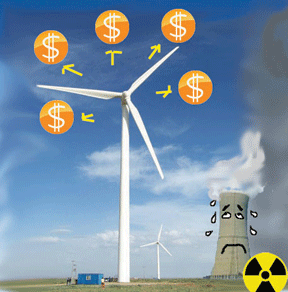 In China, and globally, wind power will stay well ahead of nuclear for decades and replace it altogether…..
 China’s path to renewable superpower, Climate Spectator, Matthew Wright, 23 Nov 11 Comparing China’s wind and nuclear power sectors reveal much about the fortunes of new and old energy technologies.
Wind power in China is growing at a blinding pace. China commenced construction of its first wind turbines in 2005 and in just six years has installed 58GW worth of wind power, which now contributes 128TWh to its grid. …
What’s remarkable about China’s wind sector is the speed and scale of its expansion. Wind generators are up and operating within nine months of breaking ground. Continue reading
Uranium spill ship leaves Vancouver, as legal wrangles continue
North Vancouver bids adieu to uranium ship By James Weldon, North Shore News November 22, 2011 A boat that sparked concern among some residents of North Vancouver’s waterfront for its connection to a radioactive spill has left its anchorage in Indian Arm………
The Altona became contaminated in the final week of 2010 when an unspecified amount of powdered uranium concentrate — commonly called yellow cake — spilled out of toppled containers and into the hold when the ship hit rough seas en route to China.
The boat returned to Port Metro Vancouver for cleanup, a process that took weeks because of the chemical’s radioactivity and toxicity. The Canadian Nuclear Safety Commission and Transport Canada declared the Altona clean and safe in early May, at which point it was moved to Indian Arm while the legal battles got underway.
The owner of the cargo, Saskatchewan’s Cameco Corporation, claimed the ship’s owners were responsible for the mishap, which Cameco said cost it close to $20 million. Facing the potentially costly lawsuit, the ship’s owners — a company called MS MCP Altona GMBH — went bankrupt, and the ship was put up for sale. That sale is now being finalized, according to the port.
Undeterred, Cameco went after other associated companies and companies involved in loading the cargo to get its money back. The case was expected to take some time to resolve. Proceeds from the sale of the Altona will go to the defunct owner’s creditors. It remains to be seen how much, if any, of that money will go to Cameco.http://www.vancouversun.com/North+Vancouver+bids+adieu+uranium+ship/5749809/story.html
Media blacking out the full and continuing rate of radiation from Fukushima
Fukushima: 27 Hiroshimas per day, China Syndrome inevitable, Abused Islanders, Deborah Dupre , Human Rights Examiner November 21, 2011 Fukushima nuclear energy ecocide, ongoing Big Energy human rights abuses Eight months after 311, a human right to health violation with media blacking out the public health hazards of the Fukushima nuclear catastrophe, the highest radiation to date, the silence was broken Sunday with news that 1600 millisievert per hour at Unit No. 3 reported on Tokyo Broadcasting System, shocking news that the nuclear event is equivalent to 27 Hiroshimas per day. Uehara Harua, architect of Fukushima’s Reactor #3 warned that China Syndrome is inevitable and tons of radioactive contaminated debris is hitting shores of Least Developing Pacific Island nation, Marshall Islands where its Indigenous People’s rights have been gravely violated for years by American scientists studying nuclear weapons on them.
1 This Month

of the week – Shut Down Drone Warfare!


Tell the Ukrainian Government to Drop Prosecution of Peace Activist Yurii Sheliazhenko

Petition to revoke the licensing of the Near Surface Nuclear Disposal Facility (NSDF) at Chalk River. https://www.ourcommons.ca/petitions/en/Petition/Details?Petition=e-7247
To see nuclear-related stories in greater depth and intensity – go to https://nuclearinformation.wordpress.com
-
Archives
- March 2026 (237)
- February 2026 (268)
- January 2026 (308)
- December 2025 (358)
- November 2025 (359)
- October 2025 (376)
- September 2025 (257)
- August 2025 (319)
- July 2025 (230)
- June 2025 (348)
- May 2025 (261)
- April 2025 (305)
-
Categories
- 1
- 1 NUCLEAR ISSUES
- business and costs
- climate change
- culture and arts
- ENERGY
- environment
- health
- history
- indigenous issues
- Legal
- marketing of nuclear
- media
- opposition to nuclear
- PERSONAL STORIES
- politics
- politics international
- Religion and ethics
- safety
- secrets,lies and civil liberties
- spinbuster
- technology
- Uranium
- wastes
- weapons and war
- Women
- 2 WORLD
- ACTION
- AFRICA
- Atrocities
- AUSTRALIA
- Christina's notes
- Christina's themes
- culture and arts
- Events
- Fuk 2022
- Fuk 2023
- Fukushima 2017
- Fukushima 2018
- fukushima 2019
- Fukushima 2020
- Fukushima 2021
- general
- global warming
- Humour (God we need it)
- Nuclear
- RARE EARTHS
- Reference
- resources – print
- Resources -audiovicual
- Weekly Newsletter
- World
- World Nuclear
- YouTube
-
RSS
Entries RSS
Comments RSS
 nuclear-news