India’s confused nuclear weapons policy
Nuclear weapons have limited, not augmented, India’s strategic options, BY:RAMESH THAKUR , THE AUSTRALIAN . November 29, 2011 “….India’s nuclear weapons policy remains confused. ……..Under prime minister Jawaharlal Nehru’s formative influence, India’s nuclear policy used to be that of a disarmament champion informed by a strategic vision. By contrast, its policy as a nuclear-armed state since 1998 has been ad hoc and episodic.
……Before 1998, India refused to let interests come in the way of principles. Since 1998, India has defined national security so narrowly that values are not allowed to “infect” interests. ……..Recent decades have involved a flexing of muscle devoid of value-promoting notions of good governance.
India is the proud possessor of nuclear weapons, but projects little sophisticated sense of how to use them for deterrence, defence or compellence guided by strategic doctrines. Pakistan has concluded that India’s non-response to serial terrorist provocations is the product of nuclear stalemate in the subcontinent, meaning that, far from augmenting, nuclear weapons have further limited India’s strategic options.
In the meantime, the poverty of India’s moral leadership is reflected in the near-total lack of nuclear disarmament leadership. India needs to bestir itself to make the transition to a norm entrepreneur once again.
Does India seek nuclear abolition? Does it wish to join the NPT-licit powers in converting the NPT from a de jure nuclear prohibition into a de facto non-proliferation regime? Or would it be happiest with the early collapse of the NPT regime and relaxed at proliferation?
Without these answers, India’s nuclear policy will remain ad hoc, reactive and hostage to events and forces outside its control.. http://www.theaustralian.com.au/news/world/nuclear-weapons-have-limited-not-augmented-indias-strategic-options/story-e6frg6ux-1226208508350
Australia breaking international law if selling uranium to India
PLANS to sell uranium to India could hit a legal snag because of an anti-nuclear treaty Australia helped create. Herald Sun, 29 Nov 11Australian National University treaty law expert Don Rothwell says the South Pacific Nuclear Free Zone treaty, known as the Rarotonga treaty, stops Australia trading the nuclear material with India.
Prof Rothwell, who questioned the legality of the Malaysian solution before it was rejected by the High Court, has provided advice to the International Campaign to Abolish Nuclear Weapons.
“If India does not agree to Article III.1 Non-Proliferation Treaty safeguards and Australia were to export uranium to India, Australia would be in violation of its Treaty of Rarotonga obligations,” the legal advice says.
This could lead to a challenge from other countries that are part of the treaty.
Prime Minister Julia Gillard wants the ALP to agree to change its platform to allow sales of uranium to India, which she has said would create jobs in Australia and would still have safeguards attached.
A vote will be put to members at the party’s national conference this weekend.
The Coalition already has a policy to allow uranium sales to India.
Tim Wright, the Australian director of ICAN, said the Prime Minister had failed to consult her lawyers. “Not only is the sale of uranium to India illegal, it is also highly dangerous given that India is rapidly bolstering its nuclear forces,” Mr Wright said….http://www.heraldsun.com.au/news/more-news/rarotonga-treaty-may-prevent-sale-of-uranium-to-india/story-fn7x8me2-1226208772517
France’s politics making the nuclear industry anxious
Uranium And The French Threat FN Arena News – Greg Peel – 29 Nov… TradeTech did not publish its usual weekly update on uranium spot market … impact on European CO2 pricing (which might be interesting for Australia). …
|
Drug use among nuclear plant workers – eleven sacked
Nuclear plant workers fired over alleged drug use, KAREN HOWLETT TORONTO Globe and Mail, Nov. 28, 2011 Eleven employees at a nuclear power station in Ontario have been dismissed with cause for allegedly using drugs on the job.
Ontario Power Generation issued a statement Monday evening, saying it took prompt action to ensure that neither the safety nor security of the nuclear plant was compromised after allegations of the drug-related activity were made…. http://www.theglobeandmail.com/news/national/nuclear-plant-workers-fired-over-alleged-drug-use/article2252432/
Nuclear waste train delayed by huge anti nuclear protest

 Thousands block nuke train in Germany ABC 702 Sydney, 28 Nov 11, German police battled thousands of anti-nuclear protesters trying to block a train carrying nuclear waste in the north of the country. The convoy taking the German waste is now nearing the end of its 1,200-kilometre journey from a reprocessing centre in north-western France to a storage facility in the northern German city of Dannenberg.
After stopping for 18 hours, including overnight, amid mass demonstrations, the train only covered about 30 kilometres in four hours. Thousands of activists swarmed the tracks along the route near Dannenberg and boasted that the train’s journey had now topped the 92-hour record set during a shipment one year ago. Continue reading
British Ministry of Defence’s secrecy on nuclear weapons spending
Details of the MoD’s investments have been unveiled for the first time.
 The figures have been released by the defence minister Peter Luff inanswer to a parliamentary question by the Green MP Caroline Lucas. Although a few were known from freedom of information requests or other sources, the bulk had previously been kept confidential.
“By spending billions of pounds now, the MoD is trying to force the hands of future governments into developing a new nuclear warhead, regardless of whether it will be necessary or affordable,”
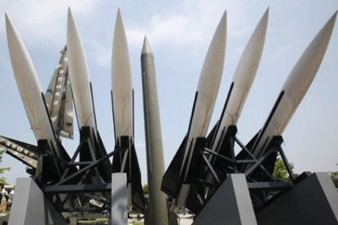 MoD spends £2bn on nuclear weapons ahead of Trident renewal decision Ministry accused of pre-empting parliament’s decision on Trident and attempting to force the hand of future governments Rob Edwards, guardian.co.uk, 27 November 2011

 The Ministry of Defence is spending £2bn on new nuclear weaponsplants before a formal decision has been taken over whether to replaceTrident warheads, according to ministers. The revelation has prompted fierce attacks on the MoD for making “a complete mockery” of the democratic process by pre-empting a decision and so attempting to force the hands of future governments. Continue reading
People’s Movement Against Nuclear Energy details faults in Kudankulam report
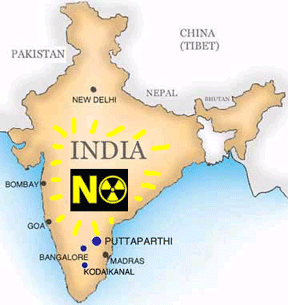 Activists dub report on Kudankulam as flawed, THE HINDU 27 Nov 11 Rebuttal by People’s Movement Against Nuclear Energy soon The People’s Movement Against Nuclear Energy (PMANE) on Sunday slammed the report of the Government-appointed expert committee on Kudankulam as being extremely flawed, premised on obsolete demographic data and opaque on the risks from sub-volcanic activity near the site or health impact on the local population.
The PMANE also released a letter to Chief Minister Jayalalithaa seeking her intervention in scrapping the project.
In the letter to the Chief Minister–copies of which were circulated to media – PMANE leaders flayed the Expert Group for ignoring valid questions on liability and declining to give specific or scientific information on nuclear waste or the fresh water needs of the KKNPP. The Expert Group had not talked to any section of the public nor tried to allay the fears and concerns of the people.
“Campaign of canards” The letter also took exception to the Central government’s “campaign of canards” about the anti-nuke activists receiving foreign funds, support and guidance to drive a wedge in the movement and sought to reassure the Chief Minister that there was not an iota of truth in these charges. Continue reading
Millions of fishermen and farmers would be affected by India’s nuclear power plans
 Both areas support millions of subsistence fishing and farming families who, faced with the forced acquisition of their land and loss of livelihoods, pose a formidable opposition to a government sensitive to the loss of a core constituency.
Dr (Anil) Kakodkar projected that India would be generating 650,000MW of nuclear power by 2050. That’s 650 1000MW nuclear reactors,” he says. “You would almost need to evict the entire fishermen population of India.”……..
 Heat rises beyond the smog in India AMANDA HODGE, SOUTH ASIA CORRESPONDENT : The Australian November 26, 2011 “….. In India, where its nuclear capability has traditionally stirred great national pride, Fukushima gave meaning and pictures to environmentalists’ warnings. “People are realising that if something like this can happen in Japan, where everything runs on time, it can definitely happen here,” Greenpeace India nuclear spokeswoman Karuna Raina says.
India’s anti-nuclear fervour is centred on two huge atomic energy projects: one built and ready to go in Koodankulam in southern Tamil Nadu, the other mooted for Jaitapur on the fertile coast of Maharashtra. Continue reading
Secrecy in Japan’s radiation studies
 Will the Government of Japan’s radiation studies on the
 people exposed to radiation include removing tissue and bone samples after they have died? Will they inform the public or keep it a secret? dedicated to the mystery surrounding the 2 tsunami dogs 26 Nov 11
The citizens that were exposed to radiation from the Fukushima Prefecture have a surprise coming to them. It won’t matter to them, actually, because this will happen to them after they die. It is justwhat has been happening with the animals that have been killed andtheir bodies examined for cesium levels. Don’t think that it won’t happen to the Fukushima citizens that have been exposed to radiation.
Those same scientists that are examining the animals will want to examine the people also. This is where the Government of Japan will either tell people or keep it a secret and just take the samples and hope that no one will notice. The scientists that are like vultures
waiting, will want those samples to see what the levels of cesium are in those people.
If they think that their participation of the research being done by the Government of Japan on their exposure to the radiation is limited to just being monitored, it is not. Continue reading
Japanese anti nuclear activists ignored by media
activists say they are being ignored by the domestic media and threatened by ultra-nationalist groups.
“The Japanese newspapers and TV stations all take so much advertising money from the power companies that they won’t report on the strength of the anti-nuclear movement or cover our protests,”
Anti-nuclear protesters have an unlikely ally in Masayoshi Son, Japan’s richest man.
 Japan’s anti-nuclear protesters find the going tough, despite Fukushima disaster Polls show the public turning against nuclear energy after Japan’s Fukushima disaster. But low coverage of protests and powerful business and political interests have complicated efforts to promote change. Christian Science Monitor, By Gavin Blair, Correspondent / November 23, 2011 Continue reading
Iran warns it will retaliate on NATO bases if attacked by U.S. or Israel
Iran threatens to bomb Turkey if U.S. or Israel attacks its nuclear installations, By DAILY MAIL REPORTER, 28th November 2011 Iran will bomb Turkey if the U.S. or Israel tries to destroy its nuclear installations, a senior military commander warned today. Continue reading
World’s nuclear waste problem becoming ever more urgent
 A New Urgency to the Problem of Storing Nuclear Waste, NYT By KATE GALBRAITH, November 27, 2011 AUSTIN, TEXAS — The nuclear disaster in Fukushima, Japan, earlier this year caused many countries to rethink their appetite for nuclear power. It is also, in subtler ways, altering the fraught discussion of what to do with nuclear plants’ wastes.
A prime example is Germany, which decided to shut down all its nuclear power plants by 2022 after the partial reactor meltdowns at Fukushima. That decision is making it easier for Germans to have a calm and focused discussion about a permanent disposal site for the plants’
wastes, analysts say.
Previously, opponents of nuclear power worried that backing a permanent solution for the wastes would make it easier for nuclear power plants to continue to exist, according to Michael Sailer, the chief executive at the Öko-Institut in Berlin, a research and consulting group focused on sustainability.
Anti-nuclear politicians, he said, felt that if they came out in favor of a permanent disposal site, “they support pro-nuclear people because they solve the waste problem.”….
Germany is now moving forward on the waste issue. Continue reading
Claim that Pakistan’s nuclear program is unsafe
Pakistan’s nuclear program unsafe in Zardari’s hands, says Qureshi, By AZHAR MASOOD, Arab News Nov 27, 2011 ISLAMABAD: Pakistan’s former Foreign Minister Shah Mahmood Qureshi Sunday claimed that the country’s nuclear program was in “unsafe
hands.” Qureshi, who joined Imran Khan’s Tehreek-e-Insaaf party at a rally in Ghotki on Sunday, said, “Pakistan’s nuclear program is unsafe as long Asif Ali Zardari was at the helm of affairs.”
Qureshi alleged, “Zardari has turned the Pakistan Peoples Party (PPP) a backyard of the CIA.” Qureshi added, “I will make more disclosures in this regard before Pakistan Tehreek-e-Insaf’s rally in Karachi on Dec. 25.” http://arabnews.com/world/article539536.ece
Feed-in Tariffs – the renewable energy way to go
 Feed-in Tariffs the Way Forward for Renewable Energy, Peter Lynch with an introduction by Andrew DeWit, 28 Nov 11 Peter Lynch, an expert on the renewable energy sector, offers a concise introduction to the central role of feed-in tariffs (FITs) in fostering the ongoing transition from conventional, carbon-laden sources of generating electricity to renewables such as solar, wind and geothermal. As the author points out, FITs guarantee markets and prices for renewable power, and drive down their cost through deployment and the encouragement of yet more technical advance. FITs thus offer much hope to a world that seems unable to reach any sort of global agreement on cutting emissions which have continued to spiral since the 1997 Kyoto Protocol.
Last year, according to figures from Bloomberg New Energy Finance (link), investment in new generation capacity from renewable energy sources (excluding hydro) totaled USD 187 billion, outpacing the USD 157 billion new investment in natural gas, oil, and coal-fired generating capacity. This rapid ramping up of deployment of existing technologies is key for renewables, as Bloomberg notes. For example, since the mid-1980s each doubling of wind generation capacity has led to a 14% reduction in cost through technical improvements in production, better materials, learning by doing, and the like. Advances have come so rapidly that the Bloomberg New Energy Finance researchers “expect wind to become fully competitive with energy produced from combined-cycle gas turbines by 2016 in most regions offering fair wind conditions.”
The article highlights the role of the German FIT in driving this energy revolution. It notes that a decade ago Germany targeted a 12.5% share of electricity from renewables for 2010, but blew through the target in 2007 to achieve a 15.1% share……..
Feed-in Tariffs: The Proven Road NOT Taken…Why?
Peter Lynch……. http://japanfocus.org/-Peter-Lynch/3654
Japan’s new nuclear watchdog – an unknown quantity
“Concrete steps will be taken only after actual health problems have come to light, and if such damage could be recognized as a pollution-caused disease like Minamata disease, the sources said.”
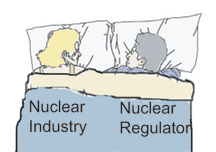 This item is a bit of a worry. Nothing in here to say that those made ill from radiation will get any help. And the suggestion is that it will be hard for them to prove it – so don’t expect any help? – Christina Macpherson
N-watchdog gets health role / New agency to handle residents’ well-being, not just reactors, The Yomiuri Shimbun, 25 Nov 11 A new nuclear safety agency to be established in April will deal with health problems caused by radioactive materials released from the Fukushima No. 1 nuclear power plant, it has been learned. Continue reading
1 This Month

of the week – Shut Down Drone Warfare!


Tell the Ukrainian Government to Drop Prosecution of Peace Activist Yurii Sheliazhenko

Petition to revoke the licensing of the Near Surface Nuclear Disposal Facility (NSDF) at Chalk River. https://www.ourcommons.ca/petitions/en/Petition/Details?Petition=e-7247
To see nuclear-related stories in greater depth and intensity – go to https://nuclearinformation.wordpress.com
-
Archives
- March 2026 (237)
- February 2026 (268)
- January 2026 (308)
- December 2025 (358)
- November 2025 (359)
- October 2025 (376)
- September 2025 (257)
- August 2025 (319)
- July 2025 (230)
- June 2025 (348)
- May 2025 (261)
- April 2025 (305)
-
Categories
- 1
- 1 NUCLEAR ISSUES
- business and costs
- climate change
- culture and arts
- ENERGY
- environment
- health
- history
- indigenous issues
- Legal
- marketing of nuclear
- media
- opposition to nuclear
- PERSONAL STORIES
- politics
- politics international
- Religion and ethics
- safety
- secrets,lies and civil liberties
- spinbuster
- technology
- Uranium
- wastes
- weapons and war
- Women
- 2 WORLD
- ACTION
- AFRICA
- Atrocities
- AUSTRALIA
- Christina's notes
- Christina's themes
- culture and arts
- Events
- Fuk 2022
- Fuk 2023
- Fukushima 2017
- Fukushima 2018
- fukushima 2019
- Fukushima 2020
- Fukushima 2021
- general
- global warming
- Humour (God we need it)
- Nuclear
- RARE EARTHS
- Reference
- resources – print
- Resources -audiovicual
- Weekly Newsletter
- World
- World Nuclear
- YouTube
-
RSS
Entries RSS
Comments RSS
 nuclear-news