Shares in uranium likely to be doomed
Even more ominous in this new environment is the fact that storage pools for spent uranium rods are now recognized as a threat. Every reactor has one of these glowing pools, specifically because the world has not found a way to dispose of nuclear waste…..
the developed world will eventually turn very sharply away from nuclear energy and towards cheap and abundant natural gas…….
Is Uranium A Buy Again? Beware of These Radioactive Stocks ETF DAILY NEWS, byn George Wolff, 27 March 11, “………The industry’s future is “red hot” according to CBS Business News writer David Phillips. Cameco and other uranium miners are already spending heavily on the construction of new mines and processing facilities. They’re still scrambling in anticipation of the global nuclear boom which seemed so inevitable before the Japanese disaster……
But, in the wake of the Japanese crisis, I believe that the optimists touting a rebound in the nuclear industry are premature at best. At worst, they may be flogging a dead horse. Continue reading
Should earthquake prone Japan have nuclear reactors?
 Fear grows near another nuclear plant in Japan – The Globe and Mail, 27 March 11, “……..The Fukushima disaster has raised the volume of a decades-old debate over whether Japan, a country crisscrossed and surrounded by some 2,000 major and minor fault lines, should have 55 nuclear plants on its soil. Some 300 Japanese demonstrators – some of them wearing gas masks – marched past TEPCO’s Tokyo headquarters on Sunday chanting “We don’t need nuclear plants!”…….Fear grows near another nuclear plant in Japan – The Globe and Mail
Radioactive iodine and thyroid cancer
 RADIATION RISKS TO HEALTH A Joint Statement from the American Association of Clinical Endocrinologists, the American Thyroid Association, The Endocrine Society, & the Society of Nuclear Medicine March 18, 2011 The recent nuclear reactor accident in Japan due to the earthquake and tsunami has raised fears of radiation exposure to populations in North America from the potential plume of radioactivity crossing the Pacific Ocean. The principal radiation source of concern is radioactive iodine including iodine-131, a radioactive isotope that presents a special risk to health because iodine is concentrated in the thyroid gland and exposure of the thyroid to high levels of radioactive iodine may lead to development of thyroid nodules and thyroid cancer years later. Continue reading
Little hope now of resuscitating the nuclear industry
little hope for development of new nuclear generation methods, the proponents of which believe they solve some of the intractable problems of today’s fission reactors. Chief among fission’s shortcomings is the risk of a reactor core meltdown and release of large amounts of highly toxic radiation, and the disposal of radioactive waste.
Nuclear power likely casualty in tide of change, NZ Herald News, By Anthony Doesburg y Mar 28, 2011 Nuclear power can be all but written off in the wake of Japan’s reactor emergency, believes the director of energy studies at Otago University.
“I would have thought that Japan will pretty much spell the end of the nuclear industry,” Continue reading
George Monbiot does not understand the public health effects of nuclear radiation
workers have received high doses and it’s anyone’s guess how many thousands (or millions) of people have received very small doses. Monbiot seems not to understand that the weight of scientific opinion holds that there is no safe dose of radiation.For a tiny, unlucky percentage of the many people who have received small radiation doses as a result of Fukushima, that radiation exposure will prove to be fatal.
George Monbiot’s nuclear mistakes | Green Left Weekly, Jim Green, 26 March 11, Prominent British columnist George Monbiot announced in the British Guardian on March 21 that he now supports nuclear power………….Monbiot is understating the radiological impacts of Fukushima and ignoring the other impacts. Continue reading
Nuclear power a public health danger even without earthquakes
A study by the Radiation and Public Health Project (RPHP) found that the incidence of thyroid cancer in three counties near the Indian Point nuclear plant in New York state were about twice the U.S. rate.
It’s time to say ‘no’ to nuclear power – The Holland Sentine, lLaketown Township, MI, 27 march 11 —The crisis in Japan is making many of us think twice about nuclear power, and with good reason. In many ways, we cannot afford nuclear power. According to a report from the Union of Concerned Scientists, the cost of subsidizing nuclear power exceeds the value of the power produced. No wonder the private sector doesn’t want to finance new nuclear power plants. Continue reading
Claim that US using depleted uranium weapons in Libya
‘US drops uranium bombs on Libya’ PressTV , 27 march 11, The Stop the War Coalition says the bombs and missiles that the US-led military alliance has dropped on several Libyan cities contain depleted uranium (DU). The report recently published on the Coalition’s website said that in the first 24 hours of the war on Libya, dozens of bombs and cruise missiles were launched by US, British, and French forces — all with depleted uranium warheads. Continue reading
Russian nuclear czar – selling $6 billion enriched uranium to USA?
 Rosatom Signs $2.8 Billion Contract to Enrich Uranium for U.S. Bloomberg, By Ilya Khrennikov – Mar 26, 2011 Rosatom Corp., Russia’s government- owned nuclear holding company, agreed a contract valued at about $2.8 billion to supply enriched uranium to the U.S., Russian state-run newspaper Rossiyskaya Gazeta said, citing the company.The accord includes an option to double supplies, possibly boosting the value of the deal to $6 billion, Kommersant said in a separate report, citing Rosatom Chief Executive Officer Sergei Kirienko.….Rosatom Signs $2.8 Billion Contract to Enrich Uranium for U.S. – Bloomberg
2.000 Taiwanese protest against nuclear power
DPP Taipei City Councilwoman Hsu Chia-ching told IPS that “no one is advocating an immediate cessation of generation, but a gradual and balanced phase-out”.
In response to questions as to whether refusing to allow the new facility to operate would be a waste of money, Tsai said that “allowing Nuclear Four to operate and generate more radioactive spent fuel and waste would create a greater tragedy.”
TAIWAN Opposition Urges Nuclear Phase-out By 2025, IPS ipsnews.net, By Dennis Engbarth, 28 March 11, Over 2,000 protestors participated in a “We Love Taiwan, We Don’t Want Nuclear Disaster” march in Taipei City. Opposition Democratic Progressive Party (DPP) Chairwoman and former Vice Premier Tsai Ing-wen has announced a proposal for a “2025 Non-Nuclear Home Plan” that will allow Taiwan to eliminate reliance on nuclear power by the end of 2025….
……. DPP Taipei City Councilwoman Hsu Chia-ching told IPS that “no one is advocating an immediate cessation of generation, but a gradual and balanced phase-out”.
In response to questions as to whether refusing to allow the new facility to operate would be a waste of money, Tsai said that “allowing Nuclear Four to operate and generate more radioactive spent fuel and waste would create a greater tragedy.”
“The damage to Japan’s society and economy, including tourism, agriculture, fishing and industry, is simply too huge, not to mention the costs of rebuilding,” National Taiwan University Professor of Atmospheric Sciences Hsu Kuang-jung told IPS, stressing that “the Fukushima incident is not yet over”.
“Nuclear power is the most expensive and risky method of power generation and if we don’t absolutely need it, why should we create so much danger and cause our people to live in fear?” asked Hsu. “The Taiwan people have never had a chance to directly express their will on whether to accept the risk of nuclear power.”
Over 2,000 residents near the fourth plant, environmentalists and opposition politicians participated in a rally last week with the theme “We Love Taiwan, We Don’t Want Nuclear Disasters”. …….
TAIWAN: Opposition Urges Nuclear Phase-out By 2025 – IPS ipsnews.net
Russian scientist estimate 100s of thousands of Chernobyl fallout deaths
Russian scientists recently reviewed the impacts of Chernobyl’s 1986 meltdown, and concluded: “The calculations suggest that the Chernobyl catastrophe has already killed several hundred thousand human beings in a population of several hundred million that was unfortunate enough to live in territories affected by the fallout. The number of Chernobyl victims will continue to grow over many future generations.”
Unsafe at any remove? Nuclear energy: time for a closer look SFGate, Steve Heilig : 27 March 11, Is atomic energy safe? Proponents say it is. Then doubters point to a near-disaster. Following this, safeguards against that particular accident are engineered into the system and proponents say ‘See? It’s safe now!’ and the dance goes on. The dialectic sounds like a broken record.” – Garrett Hardin, 1976
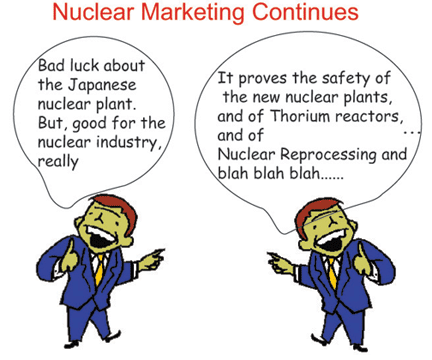
The US Nuclear Regulatory Commission has just affirmed that no real changes are being considered for US reactors following the Japan earthquake. President Obama and energy secretary Chu likewise continue to support nuclear power as an important part of American energy policy. But perhaps officials there, and President Obama, who has been a supporter of nuclear energy, need to take a closer look. Given the stakes, a much closer look.. Continue reading
87 percent chance of big earthquake near Hamaoka nuclear plant
The possibility of an imminent magnitude 8-plus earthquake in the Tokai region near the Hamaoka plant was brought to the public’s attention by geologist Ishibashi Katsuhiko in the 1970s and a government report has estimated there is an 87 percent chance of such an earthquake within the next 30 years……
Japan activist warns another ‘nuclear quake’ looms | Reuters, 27 march 11,“ “……….except for the location -Hirose had predicted an imminent megaquake and nuclear accident at the Hamaoka plant 200 km southwest of Tokyo, not the Fukushima Daiichi plant 240 km northeast — the scenario depicted in his first book on nuclear power in 15 years has proved eerily prescient. Continue reading
How many $trillions is the nuclear industry going to cost?
No insurance company would — or will, or can — insure such risks. So who insures them? You do. Canada’s Nuclear Liability Act, proclaimed in 1976, caps the liability of nuclear operators at $75 million. Beyond that, the taxpayer pays.
Nuclear power is the worst option, TheChronicleHerald.ca, By SILVER DONALD CAMERONSun, Mar 27 – “…….The first major unknown cost is insurance. Nobody knows what a catastrophic nuclear accident might cost. If the crippled Japanese reactors suffer meltdowns, how many lives will be lost, how many people will be injured, how much property will be rendered unusable? In 1996, informed observers speculated that the cost of a catastrophic accident at Darlington, Ont., could reach $1 trillion. Continue reading
George Monbiot fails to see the impact of nuclear power on indigenous peoples
George Monbiot’s nuclear mistakes | Green Left Weekly, Jim Green, 26 March 11,”……… Monbiot takes offence at ill-informed, moralistic objections to nuclear power. Fair enough. Yet two of the greatest objections to nuclear power both have a moral dimension — one because of its particularity, the other because of its generality.The particular moral problem concerns the disproportionate impacts the nuclear industry has on indigenous peoples. The industry’s racism is grotesque. Continue reading
Dr Helen Caldicott on the health issues in nuclear radiation
|
Nuclear power: A costly gamble Lake Oswego Review See the introduction and chapters 1, 2 and 3 of Helen Caldicott’s well-documented book about all aspects of nuclear power, namely “Nuclear Power Is Not The Answer.” Also see www.beyondnuclear.org/. Manufacturers of nuclear power plants and electric … Anti-nuclear campaigner attacks expansion of Darlington Toronto Star Veteran anti-nuclear campaigner Dr. Helen Caldicott launches a scathing attack Thursday on nuclear energy and its advocates before a panel, weighing a proposal for two new nuclear reactors at Darlington Nuclear Generating Station. …
Dr. Caldicott says Japanese nuclear crisis far from overLaval News – Matin C. Barry – 27 march 11Anti-nuke activist Dr. Helen Caldicott is predicting that the nuclear crisis overwhelming Japan following that … Thompson, Caldicott address new Darlington plant review panel – Northumberland Today
|
| Nuclear radiation ‘the greatest public health hazard’ 27 March 11 (CNN) — When she was an adolescent, Helen Caldicott says, she read the nuclear apocalypse novel “On the Beach.” The story was set in the aftermath of an …
|
| Helen Caldicott The Sag Harbor Express – Claire Walla -26 march 11 Nobel Peace Prize nominee and former East Hampton resident Dr. Helen Caldicott explains why the threat of nuclear radiation might not be as …
|
|
| Dr. Helen Caldicott Boston Globe – Peter S. Canellos – 22 March 11FOR BOSTONIANS of the late ’70s and early ’80s, a lecture by Dr. Helen Caldicott was a bracing, and often viscerally painful, ..
|
| Nuclear power is always unsafe, says Greenpeace Herald Sun – 13 Mar 2011 Anti-nuclear campaigner Helen Caldicott said the release of radioactive caesium 137 and iodine 131 into the atmosphere from the Fukushima plant posed grave …
|
| Caldicott: Japan may spell end of nuclear industry worldwide Center for Research on Globalization – 16 Mar 2011 Anti-nuclear campaigner Dr Helen Caldicott says it could spell the end of the nuclear industry worldwide. David Donovan reports. There appears to be massive … |
|
| Press Conference and Public Conference – Helen Caldicott – THE … Canada NewsWire (press release) – 17 Mar 2011 MONTREAL, March 17 /CNW Telbec/ – Helen Caldicott, distinguished author, physician and co-founder of Physicians for Social Responsibility, will give a press …
|
| Dr. Helen Caldicott Fukushima statement: ‘Destroyer of Worlds’ Examiner.com – Deborah Dupre – 18 Mar 2011On March 16, five days after onset of the Fukushima earthquake-nuclear catastrophe, Dr. Helen Caldicott released the statement below. … |
| Nuclear power: A costly gamble Lake Oswego Review – Bob Thomas – 26 March 11 See the introduction and chapters 1, 2 and 3 of Helen Caldicott’s well-documented book about all aspects of nuclear power, namely “Nuclear Power Is Not The …
|
| MIT, Harvard experts divided on Turkish nuclear plans Hurriyet Daily News – Samuel Doveri – 24 March… former Harvard physicist and anti-nuclear activist Dr. Helen Caldicott expresses serious concerns about leukaemia and nuclear energy This photo shows .. |
Earth Hour – a challenge to the consumer society

Christina Macpherson's websites & blogs
 Some environmentalists dismiss Earth Hour as pretty much irrelevant to the global warming crisis, and to the issue of nuclear energy.
But I think that they are wrong. Earth Hour in itself might mean just a temporary drop in energy use, worldwide. But during Earth Hour, people realise how they can manage quite well, using less energy.
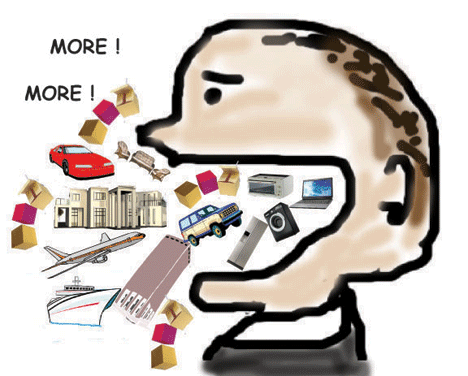
This is a subversive message – for it contradicts the whole “philosophy” behind society’s present rampant consumerism,
and ever-growing need to use more energy.
If the Consumer Society were to change to a Conserver Society, then the planet and its atmosphere would be treated with respect. Greenhouse gas emissions would diminish, and it would be obvious that nuclear energy is not needed. The nuclear lobby thrives on ever-growing consumption of energy and material “goods” – Christina Macpherson
1 This Month
Chernobyl: The Lost Tapes – A good documentary on Chernobyl on SBS available On Demand for the next 3 weeks– https://www.sbs.com.au/ondemand/tv-program/chernobyl-the-lost-tapes/2352741955560

of the week–London Campaign for Nuclear Disarmament

Tell the Ukrainian Government to Drop Prosecution of Peace Activist Yurii Sheliazhenko
To see nuclear-related stories in greater depth and intensity – go to https://nuclearinformation.wordpress.com
-
Archives
- April 2026 (152)
- March 2026 (251)
- February 2026 (268)
- January 2026 (308)
- December 2025 (358)
- November 2025 (359)
- October 2025 (376)
- September 2025 (257)
- August 2025 (319)
- July 2025 (230)
- June 2025 (348)
- May 2025 (261)
-
Categories
- 1
- 1 NUCLEAR ISSUES
- business and costs
- climate change
- culture and arts
- ENERGY
- environment
- health
- history
- indigenous issues
- Legal
- marketing of nuclear
- media
- opposition to nuclear
- PERSONAL STORIES
- politics
- politics international
- Religion and ethics
- safety
- secrets,lies and civil liberties
- spinbuster
- technology
- Uranium
- wastes
- weapons and war
- Women
- 2 WORLD
- ACTION
- AFRICA
- Atrocities
- AUSTRALIA
- Christina's notes
- Christina's themes
- culture and arts
- Events
- Fuk 2022
- Fuk 2023
- Fukushima 2017
- Fukushima 2018
- fukushima 2019
- Fukushima 2020
- Fukushima 2021
- general
- global warming
- Humour (God we need it)
- Nuclear
- RARE EARTHS
- Reference
- resources – print
- Resources -audiovicual
- Weekly Newsletter
- World
- World Nuclear
- YouTube
-
RSS
Entries RSS
Comments RSS
 nuclear-news
