Will the Nuclear Regulatory Commission relicense dangerous Pilgrim Nuclear Plant?
 the Nuclear Regulatory Commission (NRC) considers the Pilgrim plant the second most dangerous of America’s 104 ancient reactors…..Pilgrim has been cited for violations numerous times by the NRC, but usually just gets a slap on the wrist…….The NRC has relicensed over 50 old nuclear plants, and turned none down. So is Pilgrim’s application just a pro forma exercise
The Plymoushima Nuclear Plant, Cape Cod Today, Richard C. Bartlett, 3 April 11, The Pilgrim Nuclear Generating Station in Plymouth will be up for license renewal next year, 40 years after its 1972 start-up. It’s the same GE Mark I design as two of the Fukushima Dai-ichi nukes we have been reading about for nearly a month. Japan is far more vulnerable to earthquakes than we are, but Chernobyl and Three Mile Island remind us disasters are not dependent on shifting tectonic plates. Continue reading
India’s Parliament and people kept in the dark, as USA sells nuclear to India
 Among the US objectives were the desire ……to revive the moribund US nuclear industry by selling US-design nuclear reactors to India……US and Indian corporate sectors and their federations interested in profiteering from the Indian nuclear power business,….This collective also successfully kept Parliament and the people of India deliberately in the dark throughout this decision-making process. And all this is still continuing under cover of the Official Secrets Act, which is unnecessarily being applied to this civilian nuclear power sector, mainly to hush up the irrational policy decisions and the questionable financial deals between the government and corporate business houses.
 Abandon the import of nuclear reactors: DNA , Dr A Gopalakrishnan Former chairman of the Atomic Energy Regulatory Board , Apr 4, 2011, Mumbai : The decision taken by the government to import about 40,000 MWe of Light Water Reactors (LWRs) within the next two decades, has no justifiable technical or economic basis. Continue reading
The taxpayers’ bill for nuclear wastes continues to rise
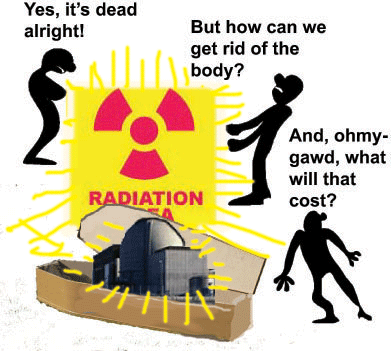 Regional plants have a bleak history of underestimating plant decommissioning costs by hundreds of millions, sometimes loading those unanticipated costs onto taxpayers and ratepayers far into the future……
“If a nuclear renaissance were to take place — if it were not just a figment or wishful thinking — we would need another Yucca Mountain every few years,”….”Independent analysis suggests that new nuclear power is more expensive than nearly every other energy source, including solar, wind, biomass and geothermal energy,” …… “Given that reality, I cannot understand why we would continue to pour massive taxpayer subsidies into nuclear power.”.
Taxpayers, utility ratepayers face mounting nuclear bills, Maggie Mulvihill, Shay Totten and Matt Porter, New England Center for Investigative Reporting, April 2, 2011Over three decades, New England’s electricity consumers and nuclear plant owners have poured close to $1 billion into a federal nuclear-waste storage fund, holding up their end of a 1982 deal with the federal government to finance the permanent storage of thousands of tons of spent fuel from the region’s reactors. Continue reading
Chernobyl’s radioactive poisoning continuing in Ukraine
Cs-137 “represents a long-term threat to the public’s health particularly for people who consume this food on a daily basis,” Greenpeace scientist Iryna Labunska told a briefing.
The Greenpeace report was especially critical of the Ukrainian government for suspending regular monitoring of food contamination from Chernobyl two years ago.
 Greenpeace finds milk, berries still contaminated from Chernobyl , Sustainable Ecosystems and Community News Reuters, Kiev April 3, 2011 Greenpeace finds milk, berries still contaminated from Chernobyl Milk and other staples like mushrooms and berries are still contaminated in parts of Ukraine by radioactive fallout from Chernobyl, 25 years after the world’s worst nuclear disaster, Greenpeace said on Sunday. Continue reading
Europe’s nuclear plant owners face big obstacles
Pressure rising on Europe’s nuclear plant owners Reuters Apr 3, 2011
Some reactors likely to fail stress test – EU’s Oettinger
* EU plans crackdown on low insurance costs – magazine
* Germany can do without nuclear power before 2020 -Greens
By Christiaan Hetzner BERLIN, April 3 (Reuters) – Some of Europe’s 143 nuclear reactors are likely to fail a test simulating terrorist attacks, an EU Commissioner said, and others will likely see insurance bills soar as politicians try to tighten regulations. Continue reading
Kenyan Adnan Z. Ameen first Director General of IRENA
 Irena elects Kenyan as first director general, gulfnews , 4 April 11, Adnan Z. Ameen won two thirds of the votes in an election at a meeting Dubai: Adnan Z. Ameen will become the first permanent director-general of International Renewable Energy Agency (Irena),Ihas learnt.
Ameen, a Kenyan national, won two thirds of the votes in an election at a meeting held on Sunday night in the capital, the diplomats who attended the meeting told Gulf News….. gulfnews : Irena elects Kenyan as first director general
New York protest for closure of Indian Point Nuclear plant
NYC protest over Indian Point Nuclear Plant | 7online.com, 3 April 11 UNION SQUARE (WABC) –– In a show of solidarity with the victims in Japan, dozens of people rallied on Saturday in Union Square.In the wake of the problems with Japan’s nuclear power plants, anti-nuclear protestors are calling for the closure of the Indian Point Nuclear Power Plant here. New York City is just 24 miles downwind of Indian Point and in the event of a nuclear accident protestors say it is impossible to evacuate 10 million people. The demonstrators believe nuclear power is inherently unsafe and should be replaced with renewable sources of energy.
NYC protest over Indian Point Nuclear Plant | 7online.com
Fukushima facility “awash with radioactive saltwater”
The battle to cool overheated reactors and avoid dangerous meltdowns of the highly radioactive fuel rods has seen workers hose saltwater into reactors, but this has left the facility awash with contaminated saltwater, preventing workers getting closer to the reactors……
Japan says it may take months to end radiation leaks, Daily Times, 4 April 11, TOKYO: Japan’s government warned on Sunday it may take months to stop radiation leaking from a nuclear plant crippled by a huge earthquake and tsunami, three weeks ago, as more bodies were recovered in devastated areas of northeast Japan. Continue reading
Is USA using depleted uranium in weapons in Libya?
Mounting alarm over US use of depleted uranium arms in Libya, Herald Scotland , By Rob Edwards 3 Apr 2011 THE countries involved in air strikes on Colonel Gaddafi’s forces in Libya are coming under pressure to ban the use of toxic depleted uranium (DU) weapons because of the dangers they could pose to civilians……
critics say that the US has sometimes been economical with the truth about the use of DU weapons. “We continue to seek a cast-iron guarantee that depleted uranium has not been used and will not be used in Libya,” said Kate Hudson, the general secretary of the Campaign for Nuclear Disarmament. “The US has a long history of only admitting to deploying this radioactive material months or years after it has been used.” DU is a radioactive and chemically toxic heavy metal which has been used by UK and US military forces in armour-piercing shells fired in the Gulf, Balkans and Iraq wars, and is thought to be in use by around 18 other countries. When DU weapons burn, they release a hazardous dust.
Mounting alarm over US use of depleted uranium arms in Libya – Herald Scotland | News | Home News
Amti uranium concerns in Nanavut
(Canada) Japan’s reactor disaster raises Nunavut nuclear fears ,The Canadian Press Apr. 3, 2011 The hall in the tiny Nunavut community of Baker Lake was packed last Thursday and the debate lasted all night and into the morning.The crowd of about 150 people — nearly 10 per cent of hamlet’s entire population — didn’t stop talking until 1:30 a.m.They were talking about uranium, a familiar subject in the community where French nuclear giant Areva has proposed a $1.5-billion mine for the radioactive metal.But this forum, one of several organized by the territorial government, was different than so many previous community meetings on the topic. About halfway through, an elderly Inuit man stood and asked the question that underlined why.
“His question was, if it’s so safe, why are people in Japan asked to leave their homes and not to come back?” recalled Sandra Inutiq, a member of a Nunavut anti-nuclear group. “If it’s so safe, why are people in Japan so scared?”
Nunavummiut have been asking whether they want uranium mining on their land for years……..Japan’s reactor disaster raises Nunavut nuclear fears – CTV News
Fukushima now causing a rethink in Iran, about nuclear power
The risks of a nuclear meltdown and the release of radioactive material are not limited to Iran. Bushehr is closer in proximity to Kuwait, Bahrain, and Saudi Arabia’s oil rich eastern province than it is to Tehran.
Will Fukushima Force Iran to Reconsider Nuclear Program? The Atlantic, By Karim Sadjadpour, Ali Vaez & Fariborz Ghadar, Apr 1 2011, The country’s rogue energy program isn’t worth the humanitarian danger, the economic cost, or whatever scant power it might provide
While Japan’s unfolding nuclear and humanitarian crisis resurrected longstanding fears in the West about the safety of nuclear power and the potential vulnerabilities of the world’s over 400 operational nuclear power plants, among Iranians it seems to have inaugurated a long overdue debate. Continue reading
Germns protest against nuclear power
Thousands of Germans protest against nuclear power Bloomberg 2 April 11, BERLIN Several thousand Germans demanding an end to the use of nuclear energy have taken part in nationwide demonstrations, including a rally outside of energy company RWE’s headquarters.Police said about 3,000 people protested Saturday outside of RWE’s headquarters in Essen, according to the DAPD news agency.
On Friday, RWE filed a lawsuit demanding two of its nuclear reactors that are to be taken off the grid in the wake of Japan’s Fukushima disaster be allowed to remain operational.
About 7,000 people took part in anti-nuclear protests in Bremen. Other smaller rallies were held elsewhere.Chancellor Angela Merkel hastily announced the shut down of seven of the nation’s nuclear power plants in the wake of the Japan nuclear crisis…..Thousands of Germans protest against nuclear power – BusinessWeek
Workers still trying to stop Fukushima radioactive water leak
Bodies found as nuclear plant leak poisons ocean | The Australian, 4 April 11, “……..Plant workers yesterday attempted to inject water-absorbent polymer into a 20cm crack in a pit beneath the No 2 reactor that has been blamed for radioactive leaks into the ocean. Earlier attempts to fill the crack with concrete failed.”We are hoping the polymers will absorb water and fill in the pipe to prevent water from flowing,” said the deputy director-general of Japan’s Nuclear and Industrial Safety Agency, Hidehiko Nishiyama.TEPCO said radiation readings in the air above the pit had hit 1000 millisieverts per hour – more than four times the allowable annual total for workers at the plant. Continue reading
Decades until Fukushima nuclear plant closed down
 Experts: Scrapping Fukushima plant could take decades, asahi.com(朝日新聞社)2 April 11, – Regaining control of the four stricken reactors at the Fukushima No. 1 nuclear power plant could take months or years, according to nuclear experts. And, even if the reactor cores can be cooled below 100 degrees, known as the “cold shutdown” stage, decommissioning will take several decades……. Continue reading
A floating radioactive waste pool? Hope there’s no more tsunamis!
 Pontoon to hold Japan nuke plant water | Herald Sun April 02, 2011 THE operator of Japan’s disaster-stricken nuclear power plant plans to use a huge steel floating structure to contain radioactive water it releases.The pontoon-type structure which can hold a maximum of 18,000 tonnes of water will be handed over to Tokyo Electric Power Co (TEPCO) by its owner which has been using it as a floating park for anglers, officials said yesterday.Called a “Mega-Float”, it measures 136 metres long, 46 metres wide and three metres high and can hold up to 10,000 tonnes of water without sinking….. Pontoon to hold Japan nuke plant water | Herald Sun
1 This Month
Chernobyl: The Lost Tapes – A good documentary on Chernobyl on SBS available On Demand for the next 3 weeks– https://www.sbs.com.au/ondemand/tv-program/chernobyl-the-lost-tapes/2352741955560

of the week–London Campaign for Nuclear Disarmament

Tell the Ukrainian Government to Drop Prosecution of Peace Activist Yurii Sheliazhenko
To see nuclear-related stories in greater depth and intensity – go to https://nuclearinformation.wordpress.com
-
Archives
- April 2026 (114)
- March 2026 (251)
- February 2026 (268)
- January 2026 (308)
- December 2025 (358)
- November 2025 (359)
- October 2025 (376)
- September 2025 (257)
- August 2025 (319)
- July 2025 (230)
- June 2025 (348)
- May 2025 (261)
-
Categories
- 1
- 1 NUCLEAR ISSUES
- business and costs
- climate change
- culture and arts
- ENERGY
- environment
- health
- history
- indigenous issues
- Legal
- marketing of nuclear
- media
- opposition to nuclear
- PERSONAL STORIES
- politics
- politics international
- Religion and ethics
- safety
- secrets,lies and civil liberties
- spinbuster
- technology
- Uranium
- wastes
- weapons and war
- Women
- 2 WORLD
- ACTION
- AFRICA
- Atrocities
- AUSTRALIA
- Christina's notes
- Christina's themes
- culture and arts
- Events
- Fuk 2022
- Fuk 2023
- Fukushima 2017
- Fukushima 2018
- fukushima 2019
- Fukushima 2020
- Fukushima 2021
- general
- global warming
- Humour (God we need it)
- Nuclear
- RARE EARTHS
- Reference
- resources – print
- Resources -audiovicual
- Weekly Newsletter
- World
- World Nuclear
- YouTube
-
RSS
Entries RSS
Comments RSS
 nuclear-news