Not all nuclear accidents have been rated on the scale
Some of the events on this list predate the scale and do not appear to have been rated. They are listed by Mr. Cochran in chronological order.
Keeping Score on Nuclear Accidents – NYTimes.com, Matthew Wald 12 April 11, Now that Japan has raised its assessment of the Fukushima accident to a 7 on the International Atomic Energy Agency’s scale, equal to the 1986 accident at Chernobyl, it may be time to review past accidents. Thomas B. Cochran, a physicist at the Natural Resources Defense Council, just did that in preparing to testify on Tuesday afternoon before the Senate Environment and Public Works Committee. Continue reading
Volcanoes, earthquakes, corruption, but Indonesia still wants nuclear power
 concerns over Indonesia’s geological vulnerability – such as its ill-fated position atop the “ring of fire” – in addition to Indonesia’s history of inefficiently coordinated responses to disaster…..
Then there’s the pervasive culture of corruption in Indonesia.
Fukushima crisis fails to dampen Indonesia’s nuclear ambitions guardian.co.uk, 13 April 11, Gillian Terzis “……The government is talking up the country’s nuclear future…….the reverberations of the crises at Fukushima have scarcely cast a ripple in Indonesia‘s political quarters. Two weeks after Japan’s nuclear crisis, the Indonesian government stated that it will continue to pursue an ambitious nuclear power programme of its own that will triple the country’s electricity output by 2025…… Continue reading
Japan’s government and Tepco have been “economical” with the truth
the patient people of Japan are getting angry. They feel – not for the first time – that their government and Tepco, the power company, have been economical with the truth.
The oil leak in the Gulf was terrifying because of its relentless filthy incontinence. The leak of radiation is terrifying because it remains unseen and is in part dependent on the whim of the wind.
As radiation leaks, truth is slow to follow BBC Matt Frei , 12 April 2011 As radiation leaks, truth is slow to follow. I t is cruelly ironic that as we approach the first anniversary of the BP oil spill in the Gulf of Mexico, the world should once again be transfixed by the inability of humans to plug a poisonous leak created by our need for energy.
Last year it was the spewing orifice at the bottom of the sea brought to us 24/7 courtesy of the dozen or so “spillcams” that became a fixture in the corner of just about every cable news TV screen.
This year we have the unseen wafts, leaks and seepages of radiation from the Fukushima Daichi nuclear power plant in Japan. The fact that the threat level of this crisis has now been raised – one month later – to seven – the highest possible – is alarming.
The fact that Japanese authorities insist the radiation level is still one-tenth that of Chernobyl – the only other nuclear disaster that has earned a seven – is puzzling.
The leaking information has made the leaking radiation all the more perplexing. Not surprisingly, the patient people of Japan are getting angry. They feel – not for the first time – that their government and Tepco, the power company, have been economical with the truth.
The oil leak in the Gulf was terrifying because of its relentless filthy incontinence. The leak of radiation is terrifying because it remains unseen and is in part dependent on the whim of the wind…
BBC – American Frei: As radiation leaks, truth is slow to follow
The importance of the nuclear accident rating of Fukushima
The assessed INES level reflects negative impacts on health and the environment. It will be important to carefully monitor the incidence of leukemia and cancer as well as soil contamination. The crisis also could strongly affect the international image of Japan.
Effect of nuclear crisis on health, environment The Yomiuri Shimbun/Asia News Network, Apr 13, 2011 By Kyoichi SasazawaFor an incident to be rated on the International Nuclear and Radiological Event Scale (INES), it is assessed by the nuclear supervisory authorities in the nation where it occurred and is then reported to the International Atomic Energy Agency (IAEA). Continue reading
Video on the nuclear accident scale
 VIDEO A Look at the Nuclear Accident Scale – NYTimes.com A Look at the Nuclear Accident Scale – NYTimes.comapan has raised its assessment of the accident at the crippled Fukushima Daiichi nuclear power plant to the worst rating on an international scale, putting the disaster on par with the 1986 Chernobyl explosion.”
America keeps building up nuclear trash
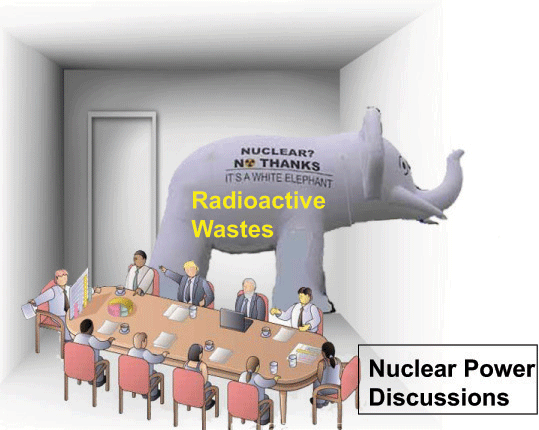 What is to be done with the country’s 70,000 tons of commercial spent nuclear fuel and the 3,000 additional tons per year that the nation will produce?
What to do with United States’ nuclear trash? – This Just In – CNN.com Blogs 13 April 11″……The Japan incident has American politicians advocating to move the United States’ nuclear waste, often stored in pools and casks on the grounds of nuclear power plants, away from highly populated areas. Continue reading
Two Koreas may meet for nuclear negotiations
Chief Nuclear Negotiators from Both Koreas ‘May Meet, The Chosun Ilbo , 12 April 11, ‘South Korea is likely to accept a proposal from China for a three-stage process to revive the stalled six-party talks that would start with an inter-Korean meeting between chief nuclear negotiators as a lead up to North Korea-U.S. talks and the resumption of six-party talks. Continue reading
Japan’s nuclear industry’s future looking gloomy
The Japanese government last June highlighted exports of nuclear-power plants as a pillar of its economic growth strategy….All that now is in doubt. Interest in the companies’ hardware—and nuclear power in general—has fallen sharply as a result of the Fukushima disaster.
Japan’s Nuclear-Reactor Industry Faces Challenge – WSJ.com, Chester Dawson, 12 April 11, As Japanese manufacturers consider moving some operations offshore, another industry is facing yet another challenge……. Before the March 11 earthquake and tsunami, Japanese companies had hoped to export ¥20 trillion, or about $230 billion, a year in nuclear plants and other infrastructure-related business, according to the Japan Bank for International Cooperation. Continue reading
At least seven nuclear cores or spent fuel pools in trouble at Fukushima
It has been obvious all along this was a 7. There are three reactors that are not being cooled (No. 1, 2 &3) and four fuel pools too (No. 1, 2, 3, and especially 4)…there were at least seven cores or pools that had been in difficulty. He noted that at Chernobyl it was only one reactor that created the problem.
Fire at Japan’s crippled nuclear plant, more aftershocks | Reuters By Shinichi Saoshiro and Kazunori Takada TOKYO Apr 11, 2011 – Engineers were fighting a fire at Japan’s crippled nuclear plant on Tuesday as another major aftershock rocked eastern Japan, swaying buildings in central Tokyo and closing Narita airport runways…… Continue reading
Fukushima nuclear crisis now rated at maximum level 7
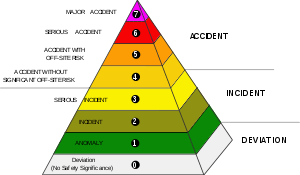 Japan’s reactor crisis hits maximum level, equal to Chernobyl Rick Wallace, Tokyo corresponden The Australian * April 12, 2011 JAPAN will upgrade the rating of the Fukushima nuclear crisis to the same level as the 1986 Chernobyl disaster in the former Soviet Union.
News of the re-rating of the nuclear crisis came as Japan’s main island, Honshu, was battered by another series of strong aftershocks today.
Japan’s chief cabinet secretary Yukio Edano confirmed this morning that the crisis at the Fukushima Daiichi plant would be upgraded from a level 5 to a level 7, which is the maximum, on the international scale…..Japan’s reactor crisis hits maximum level, equal to Chernobyl | The Australian
The difference between radiation emitters – external and internal
The grave effects of internal emitters are of the most profound concern at Fukushima. It is inaccurate and misleading to use the term “acceptable levels of external radiation” in assessing internal radiation exposures. To do so, as Monbiot has done, is to propagate inaccuracies and to mislead the public worldwide (not to mention other journalists) who are seeking the truth about radiation’s hazards.
 How nuclear apologists mislead the world over radiation George Monbiot and others at best misinform and at worst distort evidence of the dangers of atomic energy Helen Caldicott * guardian.co.uk, 11 April 2011
1) Mr Monbiot, who is a journalist not a scientist, appears unaware of the difference between external and internal radiation Continue reading
Off Japan’s coast, radioactive fish found
Radioactive fish found off Japan’s coast Australian Broadcasting CorporationBroadcast: 06/04/2011 Reporter:The Fukushima nuclear emergency in Japan has now led to radiation monitoring in 1,400 schools and a fishing suspension. TONY JONES, PRESENTER: Radiation monitoring has begun at 1,400 schools in Japan because of the Fukushima nuclear emergency.
In seawater close to the facility, the plant’s operator has detected radioactive iodine at 7.5 million times the legal limit. And off Japan’s east coast, radioactive traces have now been found in popular small fish known as young lance. Ten fishing co-operatives in the affected zone have now banned or suspended fishing for that delicacy.
Lateline – 06/04/2011: Radioactive fish found off Japans coast
Radioactive Cesium in Hawaii and other USA locations
 AUDIO Japan Nuclear Radiation In Hawaii Milk At LEAST 600% Above Federal Drinking Water Limits : The Intel Hub By Alexander Higgins – Contributing Writer April 12, 2011 Title of article now represents the minimum percentage that the radiation found in Hawaii is over EPA standards.
New EPA milk samples in Hawaii show radiation in milk at 800% above limits for Cs-134, 633% above limits for Cs-137 and 600% above EPA maximum for I-131 for a total of 2033%, or 20.33 times, above the federal drinking water limits.
New readings have also been posted for Phoenix AZ with milk being above the federal limit and Los Angeles with milk being slightly below the limit for Iodine.
Montpelier VT milk has tested positive for radioactive CS-137, above about 2/3rds the EPA maximum and Spokane WA milk testing less than half the limit for i-131….Japan Nuclear Radiation In Hawaii Milk At LEAST 600% Above Federal Drinking Water Limits :
Dangerously high levels of radiation in northwestern Fukushima Prefecture,
 Radiologist Jan van de Putte told the same news conference that areas with high levels of radioactivity were concentrated in northwestern Fukushima Prefecture, especially in areas between the villages of Iitate and Tsushima, which registered 48 microsieverts per hour.
“This is really dangerous and a very high level,” van de Putte said.
High radiation well past no-go zone: Greenpeace, The Japan Times Online, 12 April 11By JUN HONGO, Staff writer Radiology experts from Greenpeace urged the government to revise their evacuation protocol Monday after they found high levels of radiation around the greater Fukushima area and in the region’s fresh produce.
Nuclear ‘renaissance’ turning into nuclear stillbirth
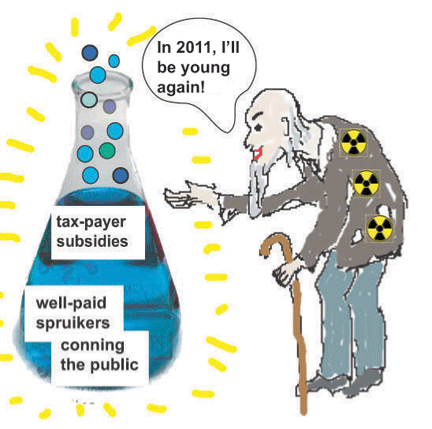 Before Fukushima, a “nuclear renaissance” — as it was termed in the press — seemed well underway, except for this point: Nuclear power, as a total of world energy supply, has been in steady decline for the past decade.
Japan: The ‘nuclear renaissance’ that wasn’t | Finance Business News, CNN) 11 April 11, — A month after a devastating earthquake sent a wall of water across the Japanese landscape, the global terrain of the atomic power industry has been forever altered.The ongoing drama at the power plant in Fukushima — a name now ranked alongside Three Mile Island and Chernobyl as history’s worst nuclear accidents — has erased the momentum the nuclear industry has seen in recent years……
Before Fukushima, a “nuclear renaissance” — as it was termed in the press — seemed well underway, except for this point: Nuclear power, as a total of world energy supply, has been in steady decline for the past decade.
From 2000 to 2008, nuclear energy dropped from 16.7% to 13.5% of global energy production, according to the World Nuclear Industry Status Report 2009. The 2010-11 preliminary report, expected to be released Wednesday, will show the downward trend has continued, according to study author Mycle Schneider. While nuclear energy production has steadily increased, its piece of the global electricity pie is shrinking compared to traditional sources such as coal and alternatives like wind and solar power…
Japan: The ‘nuclear renaissance’ that wasn’t | Finance Business News
1 This Month

of the week – Shut Down Drone Warfare!


Tell the Ukrainian Government to Drop Prosecution of Peace Activist Yurii Sheliazhenko

Petition to revoke the licensing of the Near Surface Nuclear Disposal Facility (NSDF) at Chalk River. https://www.ourcommons.ca/petitions/en/Petition/Details?Petition=e-7247
To see nuclear-related stories in greater depth and intensity – go to https://nuclearinformation.wordpress.com
-
Archives
- April 2026 (114)
- March 2026 (251)
- February 2026 (268)
- January 2026 (308)
- December 2025 (358)
- November 2025 (359)
- October 2025 (376)
- September 2025 (257)
- August 2025 (319)
- July 2025 (230)
- June 2025 (348)
- May 2025 (261)
-
Categories
- 1
- 1 NUCLEAR ISSUES
- business and costs
- climate change
- culture and arts
- ENERGY
- environment
- health
- history
- indigenous issues
- Legal
- marketing of nuclear
- media
- opposition to nuclear
- PERSONAL STORIES
- politics
- politics international
- Religion and ethics
- safety
- secrets,lies and civil liberties
- spinbuster
- technology
- Uranium
- wastes
- weapons and war
- Women
- 2 WORLD
- ACTION
- AFRICA
- Atrocities
- AUSTRALIA
- Christina's notes
- Christina's themes
- culture and arts
- Events
- Fuk 2022
- Fuk 2023
- Fukushima 2017
- Fukushima 2018
- fukushima 2019
- Fukushima 2020
- Fukushima 2021
- general
- global warming
- Humour (God we need it)
- Nuclear
- RARE EARTHS
- Reference
- resources – print
- Resources -audiovicual
- Weekly Newsletter
- World
- World Nuclear
- YouTube
-
RSS
Entries RSS
Comments RSS
 nuclear-news