UK nuclear companies protected from financial risks
Nuclear risks , The Guardian, Donald Power 15 April 2011 An estimate of the cost of compensation to Fukushima victims of $133bn has been reported by Reuters (Japan raises nuclear alert, 12 April). The UK has nuclear sites closer to major cities than Fukushima is to Tokyo, so costs could be even greater here. So it’s scandalous that nuclear operators are being allowed to cap their liability at €0.7bn or at most €1.3bn – barely 1% of the possible Fukushima compensation. No other industry is allowed to do this: BP has a $20bn fund for compensation to victims of last year’s oil spill. Why should nuclear be let off?
- The industry says the public have a poor perception of risk. That although a nuclear accident could be catastrophic and cause us to lose our homes and towns, the chances of it happening are so small that we should not worry about it. How strange then that their shareholders are not willing to accept the same small risk that they might lose their money.A more suitable measure would be to remove the protection of limited liability from the owners and directors of these companies in the event of a major accident. If we are to lose our homes, they should too, not walk away with bonuses and pensions intact as the bankers did. Readers may like to make their own views known to the Department of Energy and Climate Change nuclear third party liability consultation, which ends on 28 April. ..Letters: Nuclear risks | Environment | The Guardian
Huge and unprecedented problems in Fukushima nuclear cleanup
The scale and complexity of the challenge is unprecedented. No nuclear reactor has ever been fully decommissioned in Japan, let alone the four certain to be dismantled at Fukushima
Nuclear Cleanup Plans Hinge on Unknowns, NYTimes.com, By HIROKO TABUCHI April 14, 2011 “…..he widely divergent outlooks underscore the basic uncertainties clouding any forecast for Fukushima: when cooling stems will be restored and radiation emission halted; how soon workers can access some parts of the plant; and how bad the damage to the reactors, their fuel, and nearby stored fuel turns out to be. Continue reading
Giant Siemens company may be the first to dump nuclear projects
The second thoughts at Siemens show how swiftly the accident at the tsunami-stricken Fukushima Daiichi plant in Japan has upended the nuclear-energy revival that the company and its rivals had expected
Siemens Rethinks Nuclear Ambitions – WSJ.com* APRIL 15, 2011 By VANESSA FUHRMANS German engineering giant Siemens AG is considering whether to abandon its goal of becoming a major player in the atomic-power industry, according to people familiar with the matter, as Japan’s nuclear crisis continues to unfold. Continue reading
Uncertain future for Japan’s nuclear refugees
Japan’s “nuclear refugees” face the unknown – World Watch – CBS News 14 April TOKYO – There are still 139,000 people living in shelters across Japan. While most of those displaced by the earthquake and tsunami in the Miyagi and Iwate prefectures (states) can expect to eventually return home, the fate of Fukushima’s 47,000 “nuclear refugees” is murky…
Japan’s “nuclear refugees” face the unknown – World Watch – CBS News
Nuclear Regulatory Commission was all too cosy with Davis Besse Nuclear Power Station
The inspector general concluded that a conflict between the NRC’s twin goals of inspecting the plant to protect public safety and a desire to “reduce unnecessary regulatory burden” on the owner led to the delay in finding the gaping hole.
U.S. Nuclear Regulator Lets Industry Help With the Fine Print by John Sullivan, Special to ProPublica April 13, 2011, In the fall of 2001, inspectors with the Nuclear Regulatory Commission were so concerned about possible corrosion at Ohio’s Davis Besse Nuclear Power Station [1] that they prepared an emergency order to shut it down for inspection. But, according to a report [2] from the NRC inspector general, senior officials at the agency held off – in part because they did not want to hurt the plant’s bottom line. Continue reading
Fukushima nuclear plant on a disaster tightrope
“The slightest disturbance could set off a full-scale meltdown at three nuclear power stations, far beyond what we saw at Chernobyl… you’re looking at basically a ticking time bomb.”……now you have these Japanese samurai warriors. They know that this is potentially a suicide mission.
Fukushima Daiichi Is a ‘Ticking Time Bomb’ HUFFINGTON POST, 04/14/11 “……”Radiation is continuing to leak out of the reactors. The situation is not stable at all,” says Dr. Michio Kaku, professor of theoretical physics at the City University of New York and the City College of New York, in an interview with Democracy Now! April 13. Continue reading
Rescuers risk radiation to save Fukushima dogs
Dog-lovers brave Fukushima nuclear danger zone to save abandoned pets | Mail Online, By Daily Mail Reporter 14th April 2011 Rescuers have been risking their lives in the nuclear swamp around tsunami-hit Japan’s stricken power plant – to save abandoned dogs.Thousands of animals have starved to death or been abandoned by their owners after the earthquake and tsunami shattered Japan on March 11.
A 20km exclusion zone was put in place around the damaged Fukushima nuclear power plant as deadly radiation spilled into the atmosphere…..In the early hours of Sunday morning, seven volunteers left Tokyo and drove over broken roads and past demolished houses to meet three other volunteers in the ghost town which Minami Soma has become. Some had prepared radiation suits and others wore simple vinyl raincoats…..Japan nuclear crisis: Dog-lovers brave Fukushima danger zone to save abandoned pets | Mail Online
Europe having a big rethink about nuclear power
The March accident at Japan’s Fukushima Daiichi nuclear power plant has rekindled a long simmering debate in Europe over whether nuclear power – with its expense, its waste and especially its risk – is worth it…..”The first lesson that Europe should learn from the Fukushima accident is the fact that safe nuclear does not exist and that an accident can happen everywhere around the world – on any reactor.”
Europe’s Nuclear Debate at Forefront After Japan Disaster, Voice of America,|Lisa Bryant | Paris April 14, 2011 European concerns about the safety of nuclear power were notched up this week after Japan raised its assessment of the crisis at its Fukushima Daiichi nuclear power plant to the highest level….. Continue reading
New USA standards will allow higher levels of radiation
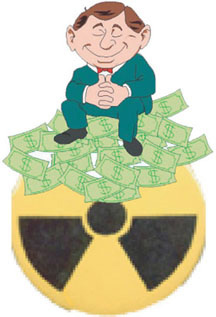 This is being accomplished, of course, to protect the nuclear lobby and its stakeholders from threats to its financial health.
Radiation Spreads Worldwide. The Poisoning of Mother Earth, Global Reseach Ca, by Freedom Against Censorship Thailand (FACT), 14 April 11,“…….However, what we’re seeing, according to the American NGO Public Employees for Environmental Responsibility is the application of new standards which will drastically raise the levels of radiation allowed in food, water, air and the general environment. Access to internal US Environmental Protection Agency communications has revealed a 1,000% increase for exposure to Strontium-90; a 3,000-100,000% rise for Iodine-131; a 25,000% rise for Nickel-63 in drinking water. Continue reading
New surge of radiation above Fukushima reactor No 4
 Tepco said the fuel rods in the Unit 4 pool had released cesium-134 and -137 in the process of being damaged. Cesium-137 has a half-life of 30 years. “Contaminated water leaked From the Unit 2 may have gathered as a lump and drifted offshore,”
Radiation surges above 4’s fuel pool The Japan Times Online By KANAKO TAKAHARA STAFF WRITER, 14 April 11, Radiation has risen to high levels above the spent-fuel pool at reactor No. 4 and its temperature is rising, the nuclear safety agency said Wednesday, indicating the fuel rods have been further damaged and are emitting radioactive substances. Continue reading
Using up USA’s depleted uranium – for weapons in Libya
given the amount of depleted uranium in the hands of the US—one of the few countries that has refused to sign on to the UN’s Human Rights Commission’ ban on the element—we’re going to only further saturate foreign battlefields with the toxic metal in years to come.
 NATO using depleted uranium in Libya RT, 13 April, 2011, Conn Hallinan is a columnist with Foreign Policy in Focus and says that, after examining the impact wounds left on tanks in Libya, he is almost certain that depleted uranium is being utilized. “Politically, it’s a bad idea. Medically, it’s an extremely bad idea. It’s just one of those things that’s an effective weapon that you have to step away from,” says Hallinan, who attests that, while the element is both affordable and powerful, “It’s just a very, very bad idea.” Continue reading
Public pays for “rare event” of a nuclear disaster
If TEPCO were to be held fully responsible for the entire long term costs of the disaster, they would probably go insolvent. In a capitalist system, this ought to happen, otherwise we perpetuate the endemic problem of short-term and sociopathic behaviour on the part of corporations who operate in the knowledge that they’ll never really be held accountable for the negative consequences of their operations…..
Probability and responsibility at Fukushima, Crikey, April 14, 2011 – , by John Hepburn In the long run, the least likely event will occur. Such is the nature of probability, and the nature of risk. Continue reading
Nuclear financial disaster – even without Fukushima
 Energy policy professor Steve Thomas points out that the scale of problems at newbuild reactors in Finland and France has taken even sceptics by surprise. Originally priced at €3bn, the Finnish reactor’s cost is estimated to be at least €5.7bn, and the French reactor is doing just as badly. Britain’s nuclear waste bill is still growing too: liability estimates have grown from £50bn in the mid-2000s to as much as £80bn at present.
Who to trust on nuclear? | Paul Dorfman The Guardian 14 April 11, Even without Fukushima sceptics might wonder why Britain ignores the German lead on energy In the continuing disaster at Fukushima, Japan’s nuclear safety agency has now raised the crisis level to seven: the highest category of nuclear accident. The government is widening the evacuation zone. The unpalatable truth is that the legacy of Fukushima will be with us for a long time to come.
The numbers are staggering. Latest information from nuclear consulting engineer John Large tells us the six reactor cores held 487 tonnes of uranium (of which 95 tonnes includes 230kg of plutonium, an even nastier substance, from the Mox assemblies), with a further 1,838 tonnes of stored spent fuel, including 1,097 tonnes in the central pool store. There is no question there have been very significant and “ongoing” releases of this radioactive inventory.
But even away from this disaster, facts about the industry’s cost and scope to meet Europe’s energy needs should be enough to give nuclear supporters pause. For instance, government figures state that a very ambitious new nuclear-build programme will give us only 4% of the energy we need. Electricity provides only 20% of our energy, and at its peak nuclear only provided 20% of electricity.
Energy policy professor Steve Thomas points out that the scale of problems at newbuild reactors in Finland and France has taken even sceptics by surprise. Originally priced at €3bn, the Finnish reactor’s cost is estimated to be at least €5.7bn, and the French reactor is doing just as badly. Britain’s nuclear waste bill is still growing too: liability estimates have grown from £50bn in the mid-2000s to as much as £80bn at present.
In stark contrast to the “measured exit” from nuclear power of Angela Merkel, the German chancellor, the chief executive of EDF insists that new UK reactors “will have to go ahead” – maybe something to do with the £12.4bn they’ve already spent on buying UK nuclear sites. And when Nick Clegg suggested that the next generation of nuclear power stations may never be built because the recommended higher and more costly safety standards would make them too expensive, Chris Huhne launched an astonishing attack on his party leader, accusing him of behaving like a “headless chicken” on the issue.
Who to trust on nuclear? | Paul Dorfman | Comment is free | The Guardian
Three aspects of Fukushima nuclear crisis
 VIDEO Arnie Gundersen: Three Things You Should Know About Fukushima –– Forbes, Osha Gray Davidson , 13 April 11– Nuclear engineer Arnie Gundersen has plenty of experience with nuclear “events.” He was an expert witness during the investigation of the 1979 Three Mile Island accident and has studied the catastrophic failure at Chernobyl in 1986. He has critics aplenty — primarily from inside the nuclear industry who see him as a turncoat.Still, he’s one of the more knowledgeable sources you can find on nuclear power.In the video below, Gunderson discusses three aspects of the disaster at Fukushima that are worth considering.
Arnie Gundersen: Three Things You Should Know About Fukushima – Osha Gray Davidson – Edison 2.0 – Forbes
Climate change and earthquakes
Earthquakes linked to climate change, The Age, 13 April 11, Long-term climate change could be responsible for moving the Earth’s tectonic plates.A team of scientists based in Australia, France and Germany has established a link between monsoons in India over the past 10 million years and the motion of the Indian plate.The scientists have found that, as monsoons in the area increased, the plate moved by almost one centimetre a year.
The researchers say it’s the first time climate change has been recognised as having the potential to influence the motion of tectonic plates.
“It is known that certain geologic events caused by plate motions have the ability to influence climate patterns over a period of a million years,” Dr Giampiero Iaffaldano from the Australian National University said in a statement. “Now we know that the opposite holds as well…… Earthquakes linked to climate change
1 This Month

of the week – Shut Down Drone Warfare!


Tell the Ukrainian Government to Drop Prosecution of Peace Activist Yurii Sheliazhenko

Petition to revoke the licensing of the Near Surface Nuclear Disposal Facility (NSDF) at Chalk River. https://www.ourcommons.ca/petitions/en/Petition/Details?Petition=e-7247
To see nuclear-related stories in greater depth and intensity – go to https://nuclearinformation.wordpress.com
-
Archives
- April 2026 (114)
- March 2026 (251)
- February 2026 (268)
- January 2026 (308)
- December 2025 (358)
- November 2025 (359)
- October 2025 (376)
- September 2025 (257)
- August 2025 (319)
- July 2025 (230)
- June 2025 (348)
- May 2025 (261)
-
Categories
- 1
- 1 NUCLEAR ISSUES
- business and costs
- climate change
- culture and arts
- ENERGY
- environment
- health
- history
- indigenous issues
- Legal
- marketing of nuclear
- media
- opposition to nuclear
- PERSONAL STORIES
- politics
- politics international
- Religion and ethics
- safety
- secrets,lies and civil liberties
- spinbuster
- technology
- Uranium
- wastes
- weapons and war
- Women
- 2 WORLD
- ACTION
- AFRICA
- Atrocities
- AUSTRALIA
- Christina's notes
- Christina's themes
- culture and arts
- Events
- Fuk 2022
- Fuk 2023
- Fukushima 2017
- Fukushima 2018
- fukushima 2019
- Fukushima 2020
- Fukushima 2021
- general
- global warming
- Humour (God we need it)
- Nuclear
- RARE EARTHS
- Reference
- resources – print
- Resources -audiovicual
- Weekly Newsletter
- World
- World Nuclear
- YouTube
-
RSS
Entries RSS
Comments RSS
 nuclear-news