Worried about their nuclear export sales, Russia promotes safety
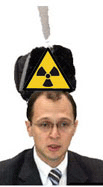 Vast commercial interests are tied up in the continued adoption of nuclear power and development of reactors, particularly in emerging markets, which are the primary customers of Russia’s nuclear exports….Some of that market is already drying up (at left, Sergei Kiriyenko, Russia’s top nuclear salesman)
Russia Proposes Stricter Rules for Nuclear Safety, New York Times, By ANDREW E. KRAMER, April 28, 2011, MOSCOW —”…..Russian officials have announced details of what is emerging as their main response to the disaster in Japan: a proposal to create an international regulatory framework for nuclear power….. Continue reading
Japan stopping Greenpeace from monitoring seawater radiation
 Greenpeace says Japan restricting its radiation , Straits Times, 29 April 11, TOKYO – GREENPEACE said on Thursday Japan had blocked it from testing seawater and marine life for radiation from a stricken nuclear plant in territorial waters that extend 20km offshore. Continue reading
Safety violations at US nuclear plants
 News 2 investigates violations at SC nuclear power plants, News 2, 29 April 11, “……..Since 1990, the Catawba Nuclear Station in York, SC has 8 Severity Level 3 violations, resulting in a total of $250,000 in fines.
The Oconee Nuclear Station in Seneca had 9 Severity Level 3 violations, and 2 Severity Level 2 violations totaling $765,000.
The H.B. Robinson plant in Hartsville had 10 Severity Level 3 violations and 1 Severity Level 2 violation totaling $443,000.
The V.C. Summer plant in Jenkensville had 3 Severity Level 3 violations, with no associated fines.
When it comes to violations and fines, Knight says that not all issues are associated with the danger ofradiation exposure to employees or the public, but “Many such violations, points to a culture of maybe a lack of concern and that’s where I say vigilance and having that safety culture is so critical.”
A further study of the Severity Level 2 violations shows that in 1997 at the Oconee plant there was problem with a 2 pumps over-heating for failing to correctly measure water levels.
In 1998 Oconee had a second Severity Level 2 violation due to faulty instrument calibration which the NRCcalled “a very significant regulatory concern.”….http://www2.counton2.com/news/2011/apr/28/6/news-2-investigates-violations-sc-nuclear-power-pl-ar-1775561/
USA politicians pledge tax-payer funds, but nuclear industry still failing
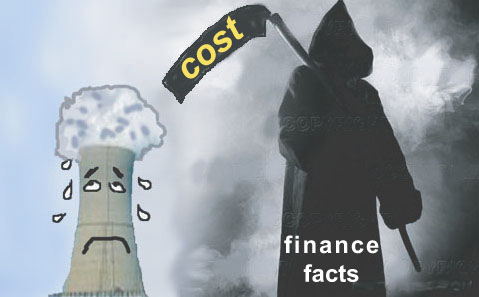 Even supporters of the technology doubt that new projects will surface any time soon to replace those that have been all but abandoned…If the builders default, as happened on some nuclear construction projects in the 1980s, the taxpayer liabilities could run into the billions of dollars……
Despite Bipartisan Support, Nuclear Projects Falter, New York Times, By MATTHEW L. WALD, April 28, 2011, WASHINGTON — In an effort to encourage nuclear power, Congress voted in 2005 to authorize $17.5 billion in loan guarantees for new reactors. Now, six years later, with the industry stalled by poor market conditions and the Fukushima disaster, nearly half of the fund remains unclaimed. And yet Congress, at the request of the Obama administration, is preparing to add $36 billion in nuclear loan guarantees to next year’s budget. Continue reading
Corruption of nuclear power regulators
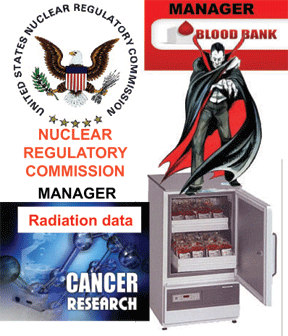 Japan Nuclear Update, Clean Energy.org, April 28th, 2011 “….Much is being made of the corruption of nuclear regulators in Japan, with the New York Times reporting the existence of a culture of complicity that sounds similar to recent charges that the U.S. Nuclear Regulatory Commission (NRC) suffers from regulatory capture. As we reported last week, Wikileaksobtained cables that prove there is a conflict of interest in the NRC’s role to regulate, which is being compromised by their apparent double role as diplomats extolling the benefits of American nuclear technology. This is completely unacceptable considering the NRC’s stated mission, “to ensure adequate protection of public health and safety, to promote the common defense and security, and to protect the environment.” How can regulators objectively regulate when a large portion of their budget comes from the industry? The problem is further compounded by the regulatory “revolving door” which clearly affects decision-making. We don’t need to look far here in the Southeast to see instances of “regulatory capture.” Former NRC Chair Dale Klein joined Southern Company’s board of directors just months after leaving the NRC and just as the utility giant and its partners accepted the first conditional nuclear loan guarantee of $8.3 billion for the two new proposed reactors at Plant Vogtle in Georgia….. http://blog.cleanenergy.org/2011/04/28/april-28-japan-nuclear-update/
Washington region gets new Renewable Energy Economic Development Alliance
| Renewable Energy Economic Development Alliance Formed In Washington North American Windpower 28 April 2011, The Port of Walla Walla and the Southeast Washington Economic Development Association have formed a partnership aimed at promoting the region’s renewable energy resources in the five counties (Asotin, Columbia, Garfield, Walla Walla and Whitman) represented by the two organizations. Continue reading |
Centennial Project – uranium mining’s poor prospects
(USA) Powertech pauses uranium mine Company: Nuke disaster hurt industry, Centennial Project, Coloradoan.com , Apr. 27, 2011“…..The March 11 Tohoku earthquake in Japan and nuclear meltdown at the Fukushima Dai-ichi nuclear power plant that followed sent uranium prices plummeting….. “This is about as bad a story as you can imagine for the U.S. nuclear power industry,” said Charles Mason, True Chair of energy economics in the economics and finance department at the University of Wyoming, who is writing a book about uranium exploration and its impacts. “It certainly is bad news.”
Once it became clear the quake would lead to prolonged nuclear disaster, nuclear industry forecasters started to predict unhappy consequences for uranium prices….. Powertech’s current financial state could cast even more doubt on the future of the Centennial Project, according to the filing. Powertech said in its report that to maintain “a portion” of its interest in the Centennial Project, the company is required to make “significant” option payments in June.
Plutonium danger in Los Alamos nuclear plan
 In the event of an earthquake and inadequate safety features, highly carcinogenic plutonium smoke could escape the building, rendering the land beneath the plume too contaminated for use.
“It would be like a dirty bomb,” Mello said.
Nuclear watchdog groups slam New Mexico plan, By Zelie Pollon, Santa Fe, New Mexico | Wed Apr 27, 2011 (Reuters) – The U.S. government should rethink plans for a multi-billion dollar plutonium complex at Los Alamos after the recent nuclear catastrophe in Japan and the discovery of increased seismic risk in New Mexico, nuclear watchdog groups said. Continue reading
Highest radiation readings now at Fukushima No 1 nuclear reactor
| Radiation Readings at TEPCO Plant Rise to Highest Arirang, 28 April 11The operator of the crippled Fukushima nuclear power plant says the level of radiation is the highest at the number one reactor showing readings of 1,120 milisieverts per hour. This is the highest level detected since the March 11th earthquake and tsunami that hit the country and led to the ongoing nuclear crisis there. That’s also more than four times the annual dose of radiation allowed for the plant’s workers. http://www.arirang.co.kr/News/News_View.asp?nseq=115402&code=Ne2&category=2 |
Latest information on Fukushima’s nuclear power plant
 What’s going on at Japan’s damaged nuclear power plant?, Reuters, 27 April 11, “…… WILL THE SITE BECOME A NO-MAN’S LAND?
Most likely, yes. Even after a cold shutdown there are tonnes of nuclear waste sitting at the site of the nuclear reactors.
Entombing the reactors in concrete would make them safe to work and live a few kilometres away from the site, but is not a long-term solution for the disposal of spent fuel, which will decay and emit radiation over several thousand years.
The spent nuclear fuel in Fukushima has been damaged by sea water, so recycling it is probably not an option, while transporting it elsewhere is unlikely because of the opposition that proposal would bring.
Experts say the clean-up will take decades. (Additional reporting by Shinichi Saoshiro and Yoko Kubota; Editing by Alex Richardson) MORE AT….http://www.reuters.com/article/2011/04/27/japan-plant-idUSL3E7FR2IV20110427
Japan makes convenient new rules on “acceptable” nuclear radiation
it has the effect of legalizing illness and deaths from nuclear radiation, or at least the state’s responsibility for them…..the state’s concern appears to be less the health of employees and more the cost of caring for nuclear victims.
 Dying for TEPCO? Fukushima’s Nuclear Contract Workers, The Asia Pacific Journal , Paul Jobin 28 April 11“……On March 14th, the Ministry of Health and Labor raised the maximum dose for workers to 250 mSv a year, where previously it was set at 100 mSv over 5 years (either 20 mSv a year for five years or 50 mSv for 2 years, which is in itself a strange interpretation of the recommendations of the International Commission on Radiological Protection’s guideline stipulating a maximum of 20 mSv a year. Continue reading
USA Nuclear Regulatory Commission accused of lying on safety
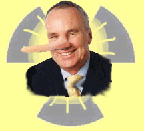 “Key elements of what the NRC chief told Congress were ‘a baldfaced lie.'”…The NRC, America’s nuclear watchdog, is essentially captive to the profit-driven industry it’s charged to regulate.
America’s Nuclear Nightmare: ‘A Dozen Fukushima’s Waiting to Happen’, Rolling Stone, By JULIAN BROOKES, 27 April 11, Shortly after an earthquake and tsunami struck Japan, in March, triggering the worst nuclear disaster since Chernobyl, America’s leading nuclear regulator trekked up to Capitol Hill to assure jumpy lawmkers that, no way, it couldn’t happen here. Continue reading
Stuxnet computer worm paralysing Iran’s nuclear program
 Russian experts and officials have been warning for several months that the Bushehr power plant has become too dangerous to operate because of the Stuxnet infection
…..Iran was forced to shut down its uranium enrichment plant at Natanz last November and removed nearly 1,000 centrifuges because of malfunctions caused by Stuxnet.
Computer Worm Wreaking Havoc on Iran’s Nuclear Capabilities, NewsMax.com, 27 Apr 2011 , By Ken Timmerman, An internal report by a special intelligence unit in Iran has concluded that the Stuxnet malware computer virus that has infected Iran’s nuclear facilities is so dangerous it could shut down the entire national power grid. Continue reading
Warren Buffett sees the nuclear industry as dead
 Mr. Buffett asserted to CNBC that nuclear facility construction in the U.S. will be “dead for a long, long time.”….“It would be unconscionable for Mr. Buffett’s company to swindle Iowans into investing in a project that he himself has apparently written off…
Watchdog Group Charges Buffett With Swinding Iowans Over New Nuclear Reactor, eNews Park Forest, 27 April OMAHA, Neb – As shareholders began arriving for Berkshire Hathaway’s annual meeting, Friends of the Earth placed an advertisement in the Omaha World-Herald challenging Warren Buffett to halt an attempt by one of his companies to force Iowa ratepayers to invest in a new nuclear reactor. Continue reading
Resistance growing to Jaitapur nuclear plan in seismic area
Former nuclear safety regulator Dr A. Gopalkrishnan revealed that he had been told in 1995 by American nuclear authorities that India would be well advised to close the reactors.
Fears rise in India of Fukushima-style nuclear disaster, By Julian O’Halloran, BBC News, 27 April 2011 Jaitapur, India A leading campaigner against a massive nuclear power plant in India has pledged that villagers are ready to sacrifice their lives in order to prevent a repeat of Japan’s nuclear disaster. Continue reading
1 This Month

of the week – Shut Down Drone Warfare!


Tell the Ukrainian Government to Drop Prosecution of Peace Activist Yurii Sheliazhenko

Petition to revoke the licensing of the Near Surface Nuclear Disposal Facility (NSDF) at Chalk River. https://www.ourcommons.ca/petitions/en/Petition/Details?Petition=e-7247
To see nuclear-related stories in greater depth and intensity – go to https://nuclearinformation.wordpress.com
-
Archives
- April 2026 (103)
- March 2026 (251)
- February 2026 (268)
- January 2026 (308)
- December 2025 (358)
- November 2025 (359)
- October 2025 (376)
- September 2025 (257)
- August 2025 (319)
- July 2025 (230)
- June 2025 (348)
- May 2025 (261)
-
Categories
- 1
- 1 NUCLEAR ISSUES
- business and costs
- climate change
- culture and arts
- ENERGY
- environment
- health
- history
- indigenous issues
- Legal
- marketing of nuclear
- media
- opposition to nuclear
- PERSONAL STORIES
- politics
- politics international
- Religion and ethics
- safety
- secrets,lies and civil liberties
- spinbuster
- technology
- Uranium
- wastes
- weapons and war
- Women
- 2 WORLD
- ACTION
- AFRICA
- Atrocities
- AUSTRALIA
- Christina's notes
- Christina's themes
- culture and arts
- Events
- Fuk 2022
- Fuk 2023
- Fukushima 2017
- Fukushima 2018
- fukushima 2019
- Fukushima 2020
- Fukushima 2021
- general
- global warming
- Humour (God we need it)
- Nuclear
- RARE EARTHS
- Reference
- resources – print
- Resources -audiovicual
- Weekly Newsletter
- World
- World Nuclear
- YouTube
-
RSS
Entries RSS
Comments RSS
 nuclear-news