Japan’s nuclear clique, the “nuclear village” fighting to stop renewable energy
the Diet managers were proposing 3 people, a majority, from the nuclear village who are disinclined to support renewables
Japanese renewable-energy supporters present credible evidence that Shindo and his compatriots’ backgrounds show them to be major figures in the clique that devised the policies that led to Japan’s current very low level of renewables and over-reliance on nuclear and other unsustainable power sources. Their suggested appointment to the FIT price-setting council is an indication of how strong the nuclear village remains in Nagatacho and Kasumigaseki, the political and bureaucratic centres of the central government even after support for nuclear power plummeted in public opinion polls.

Japan’s Nuclear Village Wages War on Renewable Energy and the Feed-in Tariff
Japan Focus Dec. 08, 2011, Andrew DeWit The effects of the Fukushima shock continue to spread. Throughout the eventful summer, one of those consequences was the turn away from nuclear power with a dramatic emphasis on renewable power and the feed-in tariff (FIT) to deploy it fast. The FIT policy was championed by former Prime Minister Kan Naoto as well as the CEO of Softbank, Son Masayoshi. They and others in the political, business, non-profit, and academic communities strongly endorsed a legislative bill to expand Japan’s handicapped FIT to geothermal, wind, biomass and small hydro.
The bill was passed on August of 26 with explicit constraints on the Ministry of Economy Trade and Industry’s (METI) capacity to hamstring renewables in favour of nuclear power and on behalf of the nuclear village. Notably, the bill took price setting out of METI’s hands. But now METI and its allies in the nuclear village are trying to get that clout back in their hands.
The price-setting mechanism is of signal importance because the role of the FIT is to provide incentives for the adoption of renewable energy. Continue reading
Australia’s hypocrisy on uranium exporting and nuclear disarmament
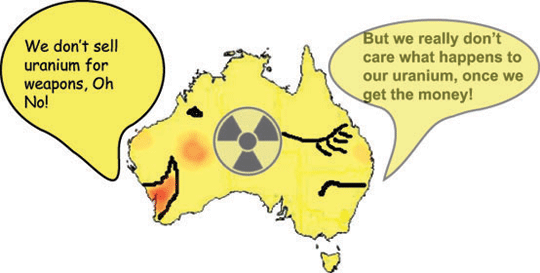
states – the U.S., U.K., China, France, Russia – although not one of them takes seriously its obligation under the Non-Proliferation Treaty (NPT) to pursue disarmament in good faith.
policy and binding Labor platform policy. That’s pretty low. Continue reading
Tiny Pacific island Tokelau to go %100 renewable energy – Durban report
 Tokelau to be first renewable energy nation Tokelau plans to use only renewable energy from next year. [ABC], Australia Network News, 9 Dec 2011 The tiny Pacific nation of Tokelau has told a UN conference it plans to use only renewable energy within a year. It would be the first country in the world to do so.
The head of the Tokelau Government, Foua Toloa, toldPacific Beat although his country is small, it has a powerful message.
“By September, 2012 – Tokelau will be the first nation 100 per cent renewable energy efficient, fulfilling our global obligation,” he said.
“We are making sure our voice is being heard here – especially the smallest of the small here in Durban”. Attending the UN conference in South Africa the Tokelau representatives have called for a legally-binding agreement of emission pledges from all countries. http://australianetworknews.com/stories/201112/3387536.htm?desktop
Nuclear radiation treated lightly in new Japanese schoolbooks
 “They highlighted coexistence with radiation. They treated radiation risks lightly.” On the subcontractor, he said, “I don’t think it reasonable for an organization that promotes nuclear power generation to be entrusted with the project. Soul-searching on the nuclear accident is lacking.”
TEPCO boss part of utility group in shady deal on publication of radiation books Mainichi Daily News, 8 Dec 11The education ministry commissioned a group managed by top executives of utility firms to produce supplementary books on radiation for elementary, junior and senior high school students even after the outbreak of the crisis at the Fukushima No. 1 Nuclear Power Plant, it has been learned.
The Japan Atomic Energy Relations Organization (JAERO) won a contract from the Ministry of Education, Culture, Sports, Science and Technology to produce supplementary books on radiation for school children before the outbreak of the crisis at the Fukushima nuclear complex on March 11. But the ministry did not change its decision to ask JAERO to produce the educational materials even after the nuclear disaster.
Toshio Nishizawa, president of Tokyo Electric Power Co. (TEPCO), and other top executives of utility firms are JAERO’s board members. Critics say the selection of the group as a subcontractor for the contract is not appropriate in light of the situation gripped by the ongoing nuclear crisis in Fukushima……. Continue reading
Secrecy over poor conditions and pay for Fukushima cleanup workers

 While the radiation at Fukushima continues to leak out, the same can’t be said about information regarding working conditions at the plant.
Fukushima secrecy over workers and conditions ABC Radio A.M.  Mark Willacy reported this story on Wednesday, December 7, 2011 TONY EASTLEY: Still in Japan and the ABC has obtained documents revealing the lengths being taken to keep work at the crippled Fukushima nuclear plant secret and to stop workers there from actually talking to the media. Continue reading
Some women may get increased radiation during mammography
 Breast-Mammogram Detector Mismatch Results in Excess Radiation By: PATRICE WENDLING, Family Practice News Digital Network 8 Dec 11, CHICAGO – A mismatch between breast size and detector size during mammography resulted in significantly higher doses of radiation for women with large breasts in a study of 886 patients.
On average, women with large breasts screened on a small detector received almost 5 milligray (mGy) of radiation, which exceeds the American College of Radiology guidelines of 3-4 mGy or less for a standard two-view mammogram. When a mismatch occurs, women with large breasts receive significantly higher doses of radiation than women with small breasts or their counterparts with large breasts correctly matched to a large detector, Dr. Cathy Wells said when presenting the award-winning study at the annual meeting of the Radiological Society of North America.
“Women with large breasts should be imaged with a large detector to avoid an unnecessary increase in radiation dose,” she urged….. http://www.familypracticenews.com/news/more-top-news/single-view/breast-mammogram-detector-mismatch-results-in-excess-radiation/1080647c40.html
Long range threat of Fukushima radiation accumulating on ocean floor
 the releases have not ended, so that is of concern. If the contaminants end up in the marine sediments/muds, then they will remain there for decades to come,
Fukushima ocean radiation could pose sleeper threat, Smart Planet, By David Worthington | December 7, 2011 Scientists have determined that the unprecedented release of radioactivity into the Pacific Ocean from the Fukushima nuclear disaster poses no direct exposure threat to people, but caution that the accumulated fallout lying in sediment is a potential danger for decades to come.
The findings were published in a report, Impacts of the Fukushima Nuclear Power Plants on Marine Radioactivity, on Wednesday. Levels of cesium and iodine peaked in April, a month after the core meltdowns when seawater used to cool the reactors and spent fuel rods was pumped out of the facility into the nearby ocean.
Levels of radioactive cesium peaked at 50 million times normal levels, becoming the largest accidental release of radiation into the ocean in history, Continue reading
France needs to boost nuclear security, following Greenpeace’s infiltration of nuke plant

 EDF to boost security at nuclear power plants-CEO Dec 8, 2011 Dec 8 (Reuters) – EDF will reinforce security at its nuclear power plants, its chief executive said on Thursday, after Greenpeace activists succeeded in entering two of them this week to alert the public on their lack of security.
Greenpeace activists entered the Nogent plant near Paris early on Monday and climbed onto one of the domes that houses a reactor, while others went into the Cruas nuclear power site in southeastern France.
“Measures have already been decided which will make this kind of intrusion even more difficult and probably more painful,” Proglio said on the margins of a partnership announcement with GE Energy. He declined to give details on those measures….
France’s dependence on nuclear energy, more than any other country, has been much debated ahead of the presidential election in April. The Socialist Party and the Greens struck a deal last month to shut France’s 24 oldest reactors by 2025 and not to build any more reactors if they come to power, marking a U-turn by the Socialists who had supported nuclear power in the 1980s and the 1990s.
After Japan’s Fukushima disaster in March 2011, France decided to carry out safety tests on its 58 nuclear reactors to check their capacity to resist flooding, earthquakes, power outages and failure of the cooling systems as well as operational management of accidents.
The tests did not include terrorist attacks or the possibility of a plane crash. (Reporting By Muriel Boselli, editing by Jane Baird)
Medical radiation listed as a top cause of breast cancer
Medical radiation, alcohol, obesity top IOM’s breast cancer risk report. December 08, 2011 by Brendon Nafziger , DOTmed News Associate Editor Medical radiation from CT scans, being overweight, using combination estrogen and progestin hormone therapy and drinking alcohol were among the usual suspects deemed to have the most convincing evidence showing a link with breast cancer risk, according to a new report by the Institute of Medicine examining environmental factors that contribute to the disease.
In a supplement, the group noted that avoiding “inappropriate medical radiation exposure” was a workable risk reduction goal, even though it also said that it should be balanced against the offsetting risk: missing crucial medical information by skipping a scan. …
Cruel, intolerant, culturally backward, violent Saudi Arabia to get nuclear weapons?

 Religious pilgrimage turns into nightmare The Age Maris Beck and Daniel Flitton December 8, 2011 ” ….. Mansor Almaribe, a father of five, who was last month charged with blasphemy while on a pilgrimage to Saudi Arabia, has been sentenced to a year in prison and 500 lashes. The Shepparton family said it was a death sentence. Mr Almaribe has diabetes, heart disease and was almost crippled in a 2004 car accident that broke his back in five places. “He won’t make 50 lashes,” son Mohammad, 16, told The Age….
..Mr Almaribe, a Shiite Muslim who was travelling in the majority Sunni kingdom, was found guilty of cursing two companions of the prophet Mohammed aloud in a public place…. a radical had reported Mr Almaribe to police after recognising him as Shiite from the green turban he wore. “He was just praying and reading the Koran to himself in an area known to be frequented by Shiites.”… http://www.theage.com.au/victoria/religious-pilgrimage-turns-into-nightmare-20111207-1ojbc.html#ixzz1g0DiYVsM
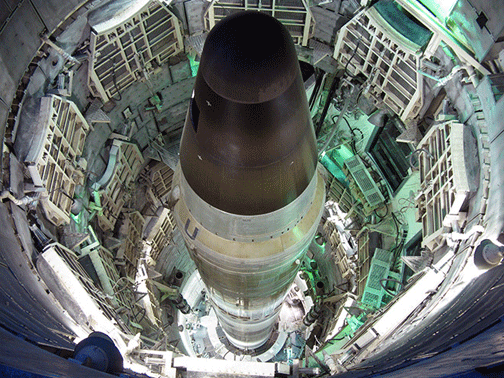 Prince Hints Saudi Arabia May Join Nuclear Arms Race, NYT, December 6, 2011 DUBAI, United Arab Emirates (AP) — A Saudi prince, in a remark designed to send chills through the Obama administration and its allies, suggested that the kingdom might consider producing nuclear weapons if it found itself between atomic arsenals in Iran and Israel. The prince, Turki al-Faisal, who has served as the Saudi intelligence chief and as ambassador to the United States, made the comment on Monday at a Persian Gulf security forum in Riyadh, Saudi Arabia. The remark confirmed Western fears about the potential for an arms race in the Middle East if Iran moves to produce a nuclear weapon…..
Prince Turki said at the forum on Monday that an Iranian quest for nuclear weapons and Israel’s presumed nuclear arsenal might force Saudi Arabia to follow suit. Most defense analysts believe that Israel has nuclear weapons, but it has refused to confirm or deny their existence.
“It is our duty toward our nation and people to consider all possible options, including the possession of these weapons,” Prince Turki was quoted as saying…http://www.nytimes.com/2011/12/07/world/middleeast/saudi-arabia-may-seek-nuclear-weapons-prince-says.html
Bill Gates touting “incredibly safe” nuclear reactor to China

Christina Macpherson's websites & blogs
The word “incredible” has really lost its currency. Derived from Latin – “Credo – I believe”, the real meaning of this adjective is “unable to be believed”. Sadly, everyone now uses “incredible” to mean “very”.
We don’t seem to have a word for “simply not able to be believed”.
However – in the case of Bill Gates’ statement about his gee whiz new nuclear reactors, I think that the word really does revert to its true meaning! Incredibly safe – indeed ! – Christina Macpherson
Bill Gates glowing with optimism about nuclear power for China Seattle Times, by Jon Talton, 7 Dec 11 Here’s the “hmmm” story of the day: Microsoft co-founder Bill Gates is in China discussing jointly developing with Beijing a “new and safer” nuclear reactor. “All these new designs are going to be incredibly safe,” Gates told the audience in China, according to the Associated Press. “They require no human action to remain safe at all times.” Continue reading
Call to stop Californian company’s radiation testing on monkeys
 Activists Protest Company’s Plan To Test Monkeys For Radiation, care 2 by Sharon Seltzer, December 6, 2011 A research company in Pasadena, CA is feeling the wrath of an animal rights group for a series of radiation tests it’s conducting on 32 monkeys. The company wants to determine the effects of potentially lethal doses of radiation on humans after a nuclear disaster.
ChromoLogic, a private diagnostic technology research company is developing a machine to test humans for levels of radiation poisoning after being exposed to a nuclear event such as Japan’s Fukushima nuclear disaster that occurred in March 2011. On Monday the company began testing 32 Rhesus monkeys for the project.
Animal activists from Stop Animal Exploitation Now! (SAEN) staged a protest outside ChromoLogic’s Pasadena office to halt the tests after a whistleblower leaked they would begin this week. “My goal is to get as many people to know what’s going on and to stop this,” said Josh Gutier, who attended the protest. Julia MacKenzie, SAEN’s L.A. representative said, “I object to them using animals in research and wasting taxpayers’ money.”…: http://www.care2.com/causes/activists-protest-companys-plan-to-test-monkeys-for-radiation.html#ixzz1fz5I0DHs
Nuclear energy production and consumption grinding down worldwide
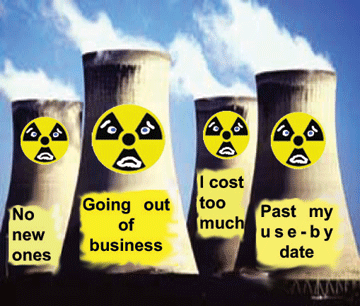 Much of the decline in installed capacity is the result of halted reactor construction around the world. ….. these numbers can hardly encourage the industry,” said Worldwatch President Robert Engelman.”The high cost of nuclear electricity generation and the widespread public perceptions that it poses unacceptable safety risks make it unlikely this form of power will help slow human-caused climate change or offer an attractive alternative to rising fossil-fuel prices any
time soon.”….
Global Nuclear Generation Capacity Falls E News Park Forest 06 DECEMBER 2011 New analysis indicates countries are turning to other energy sources as a result of high costs, low demand, and recent disasters. WASHINGTON–. Due to increasing costs of production, a slowed demand for electricity, and fresh memories of disaster in Japan, production of nuclear power fell in 2011, according to the latest Vital Signs Online (VSO) report from the Worldwatch Institute (www.Worldwatch.org).
…… global installed nuclear capacity—-the potential power generation from all existing plants—-declined to 366.5 gigawatts (GW) in 2011, from 375.5 GW at the end of 2010.
Not surprisingly, this drop in installed capacity corresponds with a decline in global consumption of nuclear energy. Continue reading
Japan’s problem of radioactivity in food – cesium 137 found in baby milk powder
 Cesium in Baby Milk Powder Shows Nuclear Risk for Japan Food December 07, 2011 By Kanoko Matsuyama and Yuriy Humber Dec. 7 (Bloomberg) — Radioactive cesium was found in milk powder in Japan made by a Meiji Holdings Co. unit, raising concern that nuclear radiation is contaminating baby food.
Meiji the past week found traces of cesium-137 and cesium- 134 in batches of “Meiji Step” made in March, the Tokyo-based company said yesterday. The probe was triggered by a customer complaint last month. ….
The finding highlights the radiation threat to food in Japan nine months after the Fukushima nuclear plant was wrecked by an earthquake and tsunami. ….
In a nuclear accident, radioactive isotopes including iodine-131 and cesium-137, which are normally contained inside the fuel rods, may be released into the atmosphere as gases or particulates if the rods are damaged. These can be inhaled or ingested through contaminated food or water. Children are especially susceptible to radiation poisoning from iodine, which can accumulate in the thyroid gland, according to the World Health Organization.
Cesium-137 that enters the body is distributed throughout the soft tissues, especially in muscle….
Radiation is more dangerous for infants because their cells are dividing more rapidly and radiation-damaged RNA may be carried in more generations of cells, according to Lincoln. The risk for children depends on the quantity of radioactive cesium they consume or are exposed to,…
Warning about computer viruses attacking nuclear plants
CIA suspected for ‘super weapon’ attack on Iranian nuclear plant Herald Sun, December 08, 2011 Computer virus attacked Iranian nuclear plant in 2010 THE CIA is the chief suspect behind a computer virus dubbed the world’s first cyber “super weapon” that attacked an Iranian nuclear plant. Continue reading
1 This Month

of the week – Shut Down Drone Warfare!


Tell the Ukrainian Government to Drop Prosecution of Peace Activist Yurii Sheliazhenko

Petition to revoke the licensing of the Near Surface Nuclear Disposal Facility (NSDF) at Chalk River. https://www.ourcommons.ca/petitions/en/Petition/Details?Petition=e-7247
To see nuclear-related stories in greater depth and intensity – go to https://nuclearinformation.wordpress.com
-
Archives
- March 2026 (237)
- February 2026 (268)
- January 2026 (308)
- December 2025 (358)
- November 2025 (359)
- October 2025 (376)
- September 2025 (257)
- August 2025 (319)
- July 2025 (230)
- June 2025 (348)
- May 2025 (261)
- April 2025 (305)
-
Categories
- 1
- 1 NUCLEAR ISSUES
- business and costs
- climate change
- culture and arts
- ENERGY
- environment
- health
- history
- indigenous issues
- Legal
- marketing of nuclear
- media
- opposition to nuclear
- PERSONAL STORIES
- politics
- politics international
- Religion and ethics
- safety
- secrets,lies and civil liberties
- spinbuster
- technology
- Uranium
- wastes
- weapons and war
- Women
- 2 WORLD
- ACTION
- AFRICA
- Atrocities
- AUSTRALIA
- Christina's notes
- Christina's themes
- culture and arts
- Events
- Fuk 2022
- Fuk 2023
- Fukushima 2017
- Fukushima 2018
- fukushima 2019
- Fukushima 2020
- Fukushima 2021
- general
- global warming
- Humour (God we need it)
- Nuclear
- RARE EARTHS
- Reference
- resources – print
- Resources -audiovicual
- Weekly Newsletter
- World
- World Nuclear
- YouTube
-
RSS
Entries RSS
Comments RSS
 nuclear-news