Oh dear, Fukushima nuclear cleanup not really going so well
 The new information about water levels in Unit 1, obtained after workers were able to enter the Unit 1 reactor building and adjust water gauges, now has officials worried that water level readings at Units 2 and 3 may also be wrong. It also throws a wrench in TEPCO’s sunny plan of having the crisis at the plant sewn up before the end of the year. And once the utility does achieve cold shutdown in all six reactors, it will face the problem of what to do with the damaged and unstable fuel rods.
Fukushima: Er, Sorry…Worse Than We Thought.TIME by Krista Mahr , May 13, 2011 n the two months since Japan’s Fukushima Daiichi nuclear power plant was pummeled by a quake and tsunami, no news has generally been good news.
Unfortunately, today, there’s some news.
Tokyo Electric Power Company (TEPCO) announced on Thursday that the damage to fuel rods inside Unit 1’s reactor core is worse than the utility previously thought. Continue reading
Fukushima reactor No 3 building – highly dangerous radiation level
Robot finds high radiation at No. 3 reactor bldg, The Yomiuri Shimbun, 14 May 11, A robot has detected highly dangerous levels of radiation in the Fukushima No. 1 nuclear power plant’s No. 3 reactor building, it has been learned, indicating further safety measures will be needed before workers can enter the structure.
According to plant operator Tokyo Electric Power Co., the remote-controlled PackBot robot on Tuesday found radiation levels in the northwestern section of the building of 49 to 120 millisieverts per hour, which would pose a threat to human workers.Time must be spent, therefore, removing or sealing up the radiation-contaminated debris in the building, before TEPCO starts work to stabilize the damaged reactors……http://www.yomiuri.co.jp/dy/national/T110513005828.htm
USA planning a short term action for securing nuclear waste
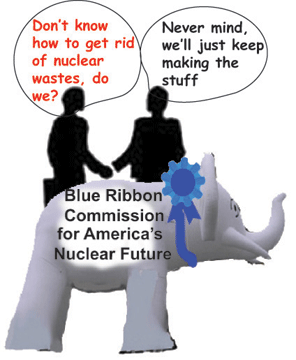 Report: Commission will outline above-ground nuclear waste strategy, THE HILL, By Andrew Restuccia – 05/13/11 A commission established by the Energy Department to find a path forward for dealing with the country’s nuclear waste will recommend storing it in above-ground containers, The New York Times reports.
The commission will outline a draft recommendation at a meeting Friday calling for “establishing one or more sites where used reactor fuel could be stored in steel and concrete structures on the earth’s surface for decades,” theTimes says. The Times says the commission will also outline steps toward determining a more permanent waste storage solution in the aftermath of the Obama administration’s decision to abandon a proposed permanent waste repository at Yucca Mountain in Nevada.
More from the Times:
“The commission will also recommend opening a new effort to find a burial site, members said, and suggest that it be led by an organization that is independent of the Department of Energy, which has been working on the waste disposal effort for decades…..http://thehill.com/blogs/e2-wire/677-e2-wire/161075-report-commission-will-outline-above-ground-nuclear-waste-strategy
Like Ukraine’s Pripyat Iitate becomes Japan’s nuclear ghost town
Fukushima village on way to becoming ghost town. By DAVID MCNEILL. The Japan Times, 14 May 11, IITATE, Fukushima Pref. — Sleepy, idyllic and dangerously irradiated, the village of Iitate is preparing to evacuate. The junior high school is closed, its children bused every day to nearby towns. Tractors sit idle, and weeds poke through rice and cabbage in the fields. Half-empty shelves greet customers at the A-Coop supermarket.
By the end of the month, this mountainous farming village of 7,000 people in Fukushima Prefecture, recently voted one of Japan’s most beautiful places, will join the Ukrainian ghost town of Pripyat on the planet’s short list of nuclear casualties….. Continue reading
Japan could, and should, move from nuclear power to renewables
Iida and ISEP researchers estimate that Chubu Electric can provide 30.59 million kilowatts without nuclear power, enough to cover this summer’s projected demand of 26.37 million kilowatts.
This can be done by operating all of its thermal power plants and buying surplus electricity from large manufacturers in the Chubu region, who run their own power stations, they say.
Namibia: government and unions waking up to exploitation by foreign miners
“A lot of mining companies are at it to exploit people together with the minerals. They either employ people on fixed term contracts or outsource certain functions of their business simply to reduce labour costs,” he said.
“This practice results in poverty jobs where employees of these contractors sometimes earn as little as 20% of the basic salary offered by the Eastern Platinum (EPL) holder for the same job.
| Second mining expo to be held amid fears of ‘nationalisation’ |  |
 |
 |
| Namibia Economist, by Nyasha Francis Nyaungwa | ||||||
| 13 MAY 2011 | ||||||
| The 2011 Mining Expo which kicks off next week in the capital is being held at a time when the mining sector faces uncertainty after government recently declared uranium, copper, coal, diamonds and rare earth metals as strategic minerals. Last month, government through cabinet endorsed a decision that the right to own licenses for strategic minerals will only be issued to a state company. The dramatic shift in policy has caught many investors and would-be investors unaware …..“….the mining sector’s contribution to government revenue is not commensurate with its share to the gross domestic product. Such contribution is mainly through royalties levied on the market value of the minerals. This means that Namibia benefits from its natural endowment mainly through rent-seeking. This situation is untenable” the minister said……http://www.economist.com.na/index.php?option=com_content&view=article&id=23739:second-mining-expo-to-be-held-amid-fears-of-nationalisation&catid=588:special-focus&Itemid=70
President of the Mineworkers Union of Namibia (MUN), John Ndeutepo, says that in order to create a conducive labour environment for workers in the mining sector, there is a need for a paradigm shift…. companies try by all means to prevent its employees from being organised. Some even deny them their rights to freedom of association. It is a proven fact that one cannot make people work any longer; you will need to motivate workers in order for them to perform,” Ndeutepo added. He said that the mining labour sector is faced with great challenges that calls for urgent change. One such challenge is the ability of unions to address labour issues involving contract and agency labour cases. |
Some multi national companies do not even bother to monitor adherence especially when it comes to contractors and they even end up corrupting compliance officials,” he said.
Ndeutepo also called for the recognition of unions in the sector. He said that a lot of companies cannot yet get any returns from this relationship as they view the union as an enemy.—http://www.economist.com.na/index.php?option=com_content&view=article&id=23738%3Aunion-calls-for-a-paradigm-shift-within-the-mining-industry&catid=588%3Aspecial-focus&Itemid=70
USA secret nuclear tests and coverups

 America’s Secret Nuclear Test Revealed in Area 51, The Daily Beast, by Annie Jacobsen 13 May 11In her explosive new book, Area 51, investigative journalist Annie Jacobsen reveals for the first time secret nuclear tests and a nuclear space rocket meltdown. Plus, she explains how she uncovered the real story. Continue reading
Time to depart from the unethical nuclear power industry
The 22-strong ethics commission set up by chancellor Angela Merkel to debate pros and cons of nuclear energy is set to recommend that all nuclear plants be taken out from the grid within the next decade, on May 28. The draft report says, “Ditching nuclear power is necessary to rule out risks it entails. The departure from nuclear energy does not, however, mean abandoning carbon-dioxide reduction goals or suffering ‘energy poverty’.” Continue reading
Australian uranium companies take heavy losses
Risk fallout hasn’t left uranium stock, May 13, 2011, SYDNEY (MarketWatch) — Australian-listed uranium firms are sporting heavy year-to-date losses after the recent disaster in Japan, and while investors appear to be slowly returning to some shares, analysts say the risks haven’t gone away.
Further afield, Canada’s Cameco Corp. has seen its stock fall 37.1% year-to-date, while Uranium One Inc. shares are down 19.8% in Toronto. Continue reading
Yes, Fukushima nuclear plant DID have a full nuclear meltdown
It’s Official: Fukushima Hit With Full-Blown Nuclear Meltdown Gizmodo Australia, By Sam Biddle on May 13, 2011 The flow of bad news (and radiation) out of Fukushima’s reactors has diminished to a trickle over the past several weeks, as rescue work has proceeded. Not today. TEPCO’s admitted for the first time that Fukushima experienced a full meltdown.
The possibility of a meltdown has been floating in the air since the earthquake and subsequent explosions first rocked the roof off of Fukushima, spreading radiation, confusion and displacement across the local populace (and beyond). Since then, TEPCO workers and the Japanese government have desperately struggled to keep the nuclear fuel rods inside the reactors cool – if they don’t, the scorching material will melt into a pool of radioactive lava. That’s the scenario everyone’s been aiming to avoid – and that’s the scenario we now know had actually occurred all along. Underneath all that dumped seawater has been lying a blob of melted fuel. And it could be melting its way out.
This admittance goes against every assurance TEPCO has handed the world in the midst of Japan’s nuclear crisis – that the situation was bad, but that with emergency work, the plant would be mostly stable, and could be safely shutdown within the year. The worry now, beyond the fact that the damage to the reactor is far worse than imagined, is that a hole in the facility will lead incredibly contaminated water leak out like a faucet. A scalding, radioactive faucet.
So now what? “We will have to revise our plans,” Junichi Matsumoto, a TEPCO rep, told The Guardian. To say the least. [The Guardian and Kyodo News]
It’s Official: Fukushima Hit With Full-Blown Nuclear Meltdown | Gizmodo Australia
Nuclear lobbies fight to weaken Europe’s planned nuclear safety rules

 EU nuclear safety testing row in meltdown, Google News, By Roddy Thomson (AFP) – 13 may 11, BRUSSELS — Fractious talks on testing the safety of European nuclear reactors broke down Thursday as calls to include terror attacks and other man-made disasters in the tests faced resistance from powerful nuclear lobbies in London and Paris. Continue reading
Navajo’s battle against uranium mining is to go to UN
 The groups contend the mines, first permitted by NRC in 1999, could contaminate drinking water for 15,000 Navajo residents in and around the two communities, which lie just outside the Navajo Nation. In 2005, the Navajo’s tribal government passed a law prohibiting uranium mining within its borders….The United Nations also recognizes clean water as a human right
Navajo Group to Take Uranium Mine Challenge to Human Rights Commission, NYTimes.com, By APRIL REESE of GreenwirePublished: May 12, 2011 In a last attempt to deep-six a controversial project to mine uranium near two Navajo communities in northwestern New Mexico, a Navajo environmental group is taking its fight to the global stage.
Tomorrow, Eastern Navajo Diné Against Uranium Mining, with the help of the New Mexico Environmental Law Center, will submit a petition to the Inter-American Commission on Human Rights arguing that the Nuclear Regulatory Commission’s decision to grant Hydro Resources Inc., a license to mine uranium ore near Churchrock and Crown Point, N.M., is a violation of international laws.
The groups contend the mines, first permitted by NRC in 1999, could contaminate drinking water for 15,000 Navajo residents in and around the two communities, which lie just outside the Navajo Nation. In 2005, the Navajo’s tribal government passed a law prohibiting uranium mining within its borders.
“By its acts and omissions that have contaminated and will continue to contaminate natural resources in the Dine communities of Crownpoint and Church Rock, the State has violated Petitioners’ human rights and breached its obligations under the American Declaration of the Rights and Duties of Man,” the petition reads.
“We’re very hopeful,” said Eric Jantz, an attorney with the New Mexico Environmental Law Center who is filing the petition on behalf of ENDAUM. “I think we have very solid claims. It’s always been our client’s position that clean water is a human right.”
The United Nations also recognizes clean water as a human right, he added.
The groups cannot take their case to the Inter-American Court of Human Rights, which is separate from the commission, because the United States does not recognize the international court’s jurisdiction, Jantz said…….
Most of the uranium mining projects in New Mexico are being financed by Japanese and other Asian investors, as well as some in Russia, he said.
Navajo Group to Take Uranium Mine Challenge to Human Rights Commission – NYTimes.com
Doctors, Public Health Agency, oppose Australian government nuclear waste dump plan
 Leading health organisations including MAPW and the Public Health Association have signed a statement calling for a comprehensive inquiry into the production of radioisotopes (including non-nuclear-reactor sources) and the disposal of nuclear medicine, before any action is taken to advance any national radioactive waste dump.
The Medical Association for Prevention of War (Australia) has called on the government to withdraw the National Radioactive Waste Management Bill , 13 May 11, Continue reading
Japan’s nuclear disaster a lesson in how to use less energy
How nuclear disaster forced Japan to be frugal with energy, Jonathan Watts guardian.co.uk, 12 may 11, The Fukushima nuclear disaster forces a re-think not just of the kind of energy we use, but how much
Japan‘s decision not to build more nuclear reactors is understandable given the explosions and leaks at the Fukushima power plant. But how will the country make up the massive energy shortfall? Prime minister Naoto Kan says supply can be sustained by investing more in renewables like wind, solar and geothermal. But there is a far simpler, cheaper and cleaner solution: use less power.
As I learned on a trip to Tokyo and Tohoku last week, this is already happening. In the wake of a disaster that knocked out six reactors, Japan‘s businesses and people have been forced to scale back their electricity consumption.
To conserve power, the utilities scheduled rolling power cuts, but many have not been necessary because considerable energy has been saved simply by promoting frugality. In shopping malls and stations, many automatic doors and escalators have been switched off, which means – shock, horror – that people are forced to push open doors and walk up stairs (there are still elevators for wheelchairs)…….
I think Japan’s disaster should also prompt us to look more closely at how much energy we use.
In a previous blogpost, I have speculated that we are in or approaching the era of “Peak Human”, with regards to the size of our population and consumption of resources, after which both will fall back to sustainable levels. That could still lead to qualitative improvements in our lives, but most of us are reluctant to accept quantative limits. Disasters, such as the one at Fukushima, remind us we may not have a choice..How nuclear disaster forced Japan to be frugal with energy | Jonathan Watts | Environment | guardian.co.uk
Thousands of animals to be culled in Fukushima area
Japan to cull nuclear-affected livestock, ABC News (Australian Broadcasting Corporation)By North Asia correspondent Mark Willacy, wires 13 May 11 Japan will start culling thousands of livestock abandoned inside the 20-kilometre evacuation zone around the earthquake and tsunami-damaged Fukushima nuclear plant.Farmers living inside the evacuation zone had no choice but to abandon their pigs, chickens, beef cattle and dairy cows when they were ordered out by the government…..
The news comes after the Tokyo Electric Power Company (TEPCO) yesterday reported a leak from the reactor vessel and another spill of contaminated water into the ocean.
TEPCO says rods inside one of the reactors have most likely melted after being fully exposed. The company says the water level inside reactor No. 1 was much lower than it thought, exposing about 1.5 metres of the fuel rods. It says the rods have likely melted and workers are still trying to cool them in water at the bottom of the pressure vessel.
According to TEPCO, seawater samples taken near the plant contained 18,000 times the permitted level of caesium-134….Japan to cull nuclear-affected livestock – ABC News (Australian Broadcasting Corporation)
1 This Month

of the week – Shut Down Drone Warfare!


Tell the Ukrainian Government to Drop Prosecution of Peace Activist Yurii Sheliazhenko

Petition to revoke the licensing of the Near Surface Nuclear Disposal Facility (NSDF) at Chalk River. https://www.ourcommons.ca/petitions/en/Petition/Details?Petition=e-7247
To see nuclear-related stories in greater depth and intensity – go to https://nuclearinformation.wordpress.com
-
Archives
- April 2026 (103)
- March 2026 (251)
- February 2026 (268)
- January 2026 (308)
- December 2025 (358)
- November 2025 (359)
- October 2025 (376)
- September 2025 (257)
- August 2025 (319)
- July 2025 (230)
- June 2025 (348)
- May 2025 (261)
-
Categories
- 1
- 1 NUCLEAR ISSUES
- business and costs
- climate change
- culture and arts
- ENERGY
- environment
- health
- history
- indigenous issues
- Legal
- marketing of nuclear
- media
- opposition to nuclear
- PERSONAL STORIES
- politics
- politics international
- Religion and ethics
- safety
- secrets,lies and civil liberties
- spinbuster
- technology
- Uranium
- wastes
- weapons and war
- Women
- 2 WORLD
- ACTION
- AFRICA
- Atrocities
- AUSTRALIA
- Christina's notes
- Christina's themes
- culture and arts
- Events
- Fuk 2022
- Fuk 2023
- Fukushima 2017
- Fukushima 2018
- fukushima 2019
- Fukushima 2020
- Fukushima 2021
- general
- global warming
- Humour (God we need it)
- Nuclear
- RARE EARTHS
- Reference
- resources – print
- Resources -audiovicual
- Weekly Newsletter
- World
- World Nuclear
- YouTube
-
RSS
Entries RSS
Comments RSS
 nuclear-news