Ashok Parthasarathi on the myth of cheap, ‘clean’, nuclear energy
such waste disposal applies not only to nuclear electrocuting reactors but also the “tailings” from uranium mines and mills which produce the basic material for making the fresh uranium fuel rods that feed the reactors but also in the process of reprocessing the used or ‘spent’ fuel coming out of the reactors and containing the deadliest and most dangerous plutonium. Human ingestion of even one billionth of a gram of plutonium leads to death.

 Renewable energy is the future, not nuclear, Business Standard, Ashok Parthasarathi / June 19, 2011 There are recurring slippages in the timescales of setting up nuclear power plants, particularly imported ones. Inevitably, there are cost over-runs too.
Nuclear power is often referred to as a ‘clean’, safe, economically cost-effective and environmentally benign source of electric power. This is incorrect. It is not ‘clean’ because it generates large quantities of highly radioactive solid and liquid wastes. The liquid wastes can be treated to bring them to set levels and then discharged into the environment. However, even after extensive multi-level treatment, the solid wastes leave a considerable amount of residues of long-life nuclear isotopes.
These have first to be loaded into thick walled lead containers, the containers hermetically sealed by a special technique, ‘vitrified’ and then buried deep in hard rock cavities in shafts of disused metaliferous or coal mines, making sure that the shafts are free of water ingress. Such storage has to be for several decades. This whole process is technically demanding and expensive but has to be done to ensure human and ecological safety. Popular accounts of nuclear reactors seldom bring out these issues.
But such waste disposal applies not only to nuclear electrocuting reactors but also the “tailings” from uranium mines and mills which produce the basic material for making the fresh uranium fuel rods that feed the reactors but also in the process of reprocessing the used or ‘spent’ fuel coming out of the reactors and containing the deadliest and most dangerous plutonium. Human ingestion of even one billionth of a gram of plutonium leads to death. So, all reprocessing plants are almost totally robotised.
Then there is the elaborate process and equipment involved in continuously cooling the ‘core’ of the reactor while the reactor is in operation. When an accident occurs, affecting the cooling system, as happened in two reactors of the Fukushima nuclear power in Japan in March, the core becomes so hot (2,000 degrees C) that the highly radioactive core melts and the molten core falls to the bottom of the reactor, punctures the heavy steel containment vessel and seeps into the reactor’s foundation and then into the ground beneath, contaminating any ground water present. All this is not a gory hypothetical scenario. It actually happened at Fukushima.
To steeply reduce the probability of such events, modern nuclear reactors have ‘traps’ at the base of the containment vessel, to prevent the kind of puncturing described above. Whether such ‘traps’ will be near-100 per cent effective, only time will tell.
It is well-known that because of the technology involved, nuclear power reactors are intrinsically highly capital-intensive. When one adds the protective technology and equipment, as well as the waste treatment technology and equipment described above, the capital costs go through the roof. Thus the capital cost of the ‘latest’ European Power Reactor (EPR) which the French firm Areva is to set up at Jaitapur in Maharashtra is around Rs 20 crore per Mw, compared to Rs 15 crore for solar power and Rs 6-7 crore per Mw for wind power. Such capital cost levels, in turn, take the cost of nuclear power to Rs 7-8 per KWh (or unit of power generated), making the reactors totally uneconomic.
Then there is the problem of recurring slippages in the time scales of setting up nuclear power plants, particularly imported ones. For example, the two 1,000 Mw Russian reactors coming up at Kudankulam in Tamil Nadu are already four years behind schedule, provided they are actually commissioned in 2011 and 2012, as the Nuclear Power Corporation claims they will be. The four Areva 1,650 Mw EPRs — one each in France and Finland, and two in China — are also four years behind schedule, with no firm commissioning dates indicated by Areva as of now.
As a result, the plant in Finland came close to being cancelled by the Finnish government about two years ago. This is despite all four, like the Kudankulam plant, being set up on a turnkey basis by the foreign suppliers involved. These time over-runs, which have for example taken the Kudankulam plants to a total construction time of 11 and 12 years, inevitably lead to huge cost over-runs as well.
Areva is now promising that the first two EPRs at Jaitapur will be commissioned in 2017-18. But what credence can we put on such promises, given Areva’s past record? This in turn makes NPCIL’s claim that it will have 20,000 Mw of nuclear power — 14,000 Mw indigenous and 6,000 Mw imported — by 2020, look like a pipe dream. As for its repeatedly announced plan of achieving 63,000 Mw by 2030, it is a laugh! To put these numbers in perspective, the current installed nuclear power generating capacity is around 5,000 Mw.
Contrast this state of affairs with that in renewable energy. In wind power we have an operating capacity of 16,000 Mw, the fourth largest in the world. Suzlon, our largest wind turbine manufacturer and project developer, added 4000 Mw last year. It is a Rs 22,000 crore company with subsidiaries in Europe and a production plant in China. As for solar energy, the 20,000 Mw by 2022 Nehru Solar Energy Plan is progressing well, with many foreign and local companies having committed to establish large grid-connected solar power plants of 100 Mw to 500 Mw capacity…http://www.business-standard.com/india/news/ashok-parthasarathi-renewable-energy-isfuture-not-nuclear/439598/
—
No progress in USA’s dilemma about nuclear wastes
U.S. making little progress on nuclear waste issue, Battle Creek Enquirer 17 June 11 When Congress passed the Nuclear Waste Policy Act of 1982, most Americans thought the nation was on its way toward dealing with the spent radioactive fuel from nuclear power plants.
But nearly 30 years and about $15 billion later, little progress has been made.
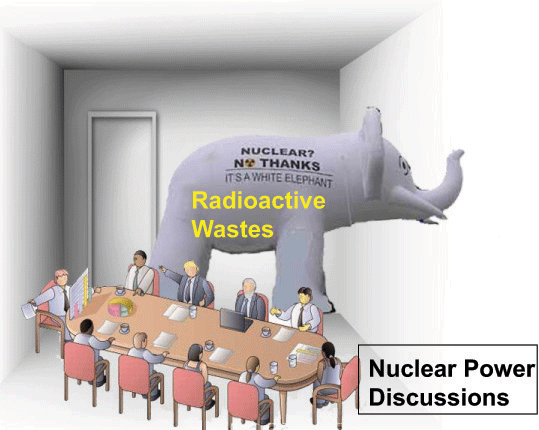
Michigan Public Service Commissioner Greg White, speaking on behalf of the National Association of Regulatory Utility Comm-issioners, told a U.S. House subcommittee earlier this month that the nation is no closer to creating a central repository for nuclear waste than it was in the early 1980s……. Continue reading
Japan’s govt changes evacuation system, as “radiation hot spots” are found
places that are outside the evacuation zones but are feared to have concentrations of radiation due to geographical or weather conditions will be designated as “specific evacuation recommendation spots.”…….
Govt refines evacuation system, The Yomiuri Shimbun, 18 June 11 The government has decided to adopt a new system that would recommend evacuation from areas affected by radiation from the crisis-hit Fukushima No. 1 nuclear power plant not by municipality but on a house-by-house basis. Continue reading
U.S. House Appropriations panel cuts funding for new nuclear weapons facility
The House Appropriations subcommittee that approves funding of the weapons complex, run by the National Nuclear Security Agency (NNSA), just whacked almost $500 million from the weapons program.
House panel whacks funding for nuclear complex, Washington Post, 18 June 11 By Walter Pincus Remember the ones demanded by Republican senators as the price for passage of the new Strategic Arms Reduction Treaty (START) last December? Back then, senators succeeded in getting the Obama administration to pledge to spend billions more to upgrade the U.S. nuclear weapons complex and modernize the country’s stockpile of deployed weapons.
Problem is, members of the House weren’t involved in the discussions.
Now, led by Republicans, lawmakers are cutting into the funds that the Obama administration had pledged for upgrades and modernization.
The House Appropriations subcommittee that approves funding of the weapons complex, run by the National Nuclear Security Agency (NNSA), just whacked almost $500 million from the weapons program. A slice of $100 million came out of a $200 million pot that is supposed to finance early steps in the coming year to build a new facility at Los Alamos National Laboratory….. http://www.washingtonpost.com/blogs/checkpoint-washington/post/house-panel-whacks-funding-for-nuclear-complex/2011/06/15/AGPrLAXH_blog.html
US General’s advice on how to reduce spending on nuclear weapons
 Brent Scowcroft’s Suggestion on the Nuclear Arsenal, HUFFINGTON POST, Rizwan Ladha, 17 June 11 For over sixty years, the United States has maintained a large and costly nuclear arsenal, composed of heavy bombers, submarine-launched missiles, and intercontinental missiles. But Lt. Gen. Brent Scowcroft thinks it’s time for a change.
In a talk Thursday at National Defense University, Gen. Scowcroft suggested that the U.S. nuclear force should be restructured, eliminating the air- and sea-based legs of the triad and only maintaining 1,000 to 1,500 single-warhead ICBMs. He argues this would provide a credible deterrent to adversaries, while guaranteeing security to U.S. allies……..http://www.huffingtonpost.com/rizwan-ladha/brent-scowcrofts-suggesti_b_879507.html
Exposure of 4 workers to high radiation
4 Workers Exposed to Strong Gamma Radiation in Southern Bulgaria Novinite.com, June 17, 2011,Four workers of the Gitava company, based near the Southern Bulgarian town of Stambolyiski, have been exposed to strong gamma radiation.
The accident happened on June 14 and a committee was subsequently assigned to investigate the matter, the Bulgarian Nuclear Regulation Agency announced.Gitava specializes in supplying and recharging gamma-ray therapeutic equipment for the treatment of cancer patients….. http://www.novinite.com/view_news.php?id=129388
USA Senate hearing finds nuclear safety unsatisfactory
Fukushima-Daiichi showed us that we have to consider the possibility of multiple units at a single site, perhaps multiple spent fuel pools being affected at the same time.”
Commissioners also had no answers about how to fix backup power systems that continue to cool nuclear material in the event of a major power outage…….Amidst these less-than-inspiring answers, the NRC commissioners tried to downplay the possibility of similar events happening here anyhow…..
Cold Comfort at Senate Nuclear Safety Hearing, The Nation 17 june 11 George Zornick In the two months since the Fukushima Daiichi Nuclear Power Plant suffered a catastrophic breakdown during an earthquake and tsunami in Japan, what has the United States learned about nuclear safety? How are regulators working to prevent a similar disaster at one of America’s 104 nuclear power plants, about a quarter of which share the same design as Fukushima Daiichi? Continue reading
Indonesia turning away from nuclear power plans
Indonesian President Susilo Bambang Yudhoyono said, “What happened in Japan last March can happen in Indonesia because (the two countries’) geography is very much similar.”
He suggested that in pursuing its best energy mix, the world’s most populous Muslim country is willing to consider alternative sources of energy, such as geothermal, solar and hydroelectric power, while moving to limit the use of oil and coal as energy sources in the long run….
Indonesia cautious about nuclear option after Fukushima crisis Mainichi Daily News 18 June 11 TOKYO (Kyodo) –– Visiting Indonesian President Susilo Bambang Yudhoyono expressed strong reservations on Friday about proceeding with plans to build nuclear power plants in his earthquake- and tsunami-prone country, following Japan’s nuclear disaster triggered by a magnitude 9.0 quake and tsunami. Continue reading
AREVA struggles to cope with freeze on nuclear investment
Investors demand clear Areva strategy from new CEO– By Marie Maitre The replacement of Areva’s charismatic head by a top executive little known outside the company ends a drawn-out battle for the group’s top job but offers no clues on how Areva plans to overcome project delays after the Fukushima disaster. PARIS, June 17 (Reuters) – Investors called for clarity on Areva’s strategy for dealing with a global nuclear investment freeze on Friday after a power struggle at the French nuclear power plant maker led to the dismissal of its long-serving boss.
Areva’s thinly traded shares were down 2.2 percent at 25.81 euros by 0950 GMT, lagging France’s CAC-40 .FCHI blue chip index, which was up 0.1 percent….http://www.reuters.com/article/2011/06/17/areva-ceo-idUSLDE75G0K820110617
How humans are geo-engineering the planet
“…….Aren’t we too puny rival the great forces of nature that shape our planet? . But the facts show that we are fundamentally impacting planet Earth in unprecedented ways, and we’ve known about it for a century…..
 we are well on the way to doubling CO2. In the past 100 years we have added almost 40 per cent, and warming that can only plausibly be attributed to a greenhouse effect is not only heating the atmosphere, but is also pumping heat into the oceans and the crust at a phenomenal rate.
How we’re geo-engineering the planet, Climate Spectator Mike Sandiford 16 June 11 Continue reading
The devil, as usual, is in the details. For instance, the cost of a nuclear reactor per unit of electrical generating capacity declines with increasing size……There are economies of scale associated with security, too ….Nuclear power advocates have long promised far more than they can deliver, ignoring essential hurdles such as cost, safety, and performance. Decades of experience, however, have proven those promises to be hollow and hazardous. The notion that “small is beautiful” for nuclear reactors is not just fanciful; it is whistling past the graveyard of the “nuclear renaissance” that never was
The problems with small nuclear reactors, THE HILL, By Dr. Arjun Makhijani – 06/15/11 “…… the enthusiasts of small reactors are back, promoting “small modular reactors” (SMRs) which, they say, can solve the central economic problem of large reactors that each cost so much and take so long to build that it becomes a “bet the farm” risk. But this is hype and hope more than substance. Unfortunately, Congress and the administration are buying into it. Continue reading
75% of Japanese want a nuclear free future – poll results
Japan poll finds most back a nuclear-free future,THE AUSTRALIA N AFP , June 14, 2011 ALMOST three-quarters of Japanese respondents to a newspaper poll favour a gradual phase-out of nuclear energy in the wake of the Fukushima atomic accident.
The Asahi Shimbun daily said in its weekend opinion poll that only 14 per cent were against such a gradual reduction.
The poll also showed 64 per cent of respondents believed “natural energy” such as wind and solar power would replace nuclear power in the future, while 24 per cent said they did not think so……..http://www.theaustralian.com.au/news/world/japan-poll-finds-most-back-a-nuclear-free-future/story-e6frg6so-1226075144056
Japan’s’:Nuclear Power Village a cosy closed community of industrialists and govt officials
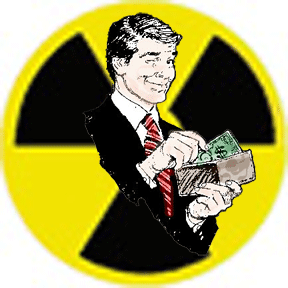 The nuclear power village is the nickname for a tight circle of government entities, utilities, manufacturers and others involved in the promotion of nuclear power who believe nuclear plants are safe and reject out of hand any opposing views….
But destroying the nuclear village is no easy task. The community involves heavy back-scratching and complex personnel relationships.
NUCLEAR CRISIS: HOW IT HAPPENED / ‘Nuclear power village’ a cozy, closed community, The Yomiuri Shimbun, 16 June 11 Three months have passed since the Great East Japan Earthquake triggered a nuclear crisis that shows little sign of ending anytime soon. Continue reading
Nuclear expert ‘s recommendations on risk management
 “Why not consider Three Mile Island, Chernobyl and Fukushima as warnings of greater catastrophes to come and avoid the inevitable by shutting them down, much like changing your diet and/or lifestyle after finding out that your cholesterol or blood pressure is elevated, rather than continuing down the same path until a heart attack or stroke strikes?”
Only lawyers see growth, as nuclear industry faces wind-down in Europe
Nuclear Twilight in Europe |
 |
 |
 |
| OilPrice.com by John Daly , 15 June 2011 |
| It is becoming evident to many that the March nuclear catastrophe at Japan’s six reactor Daichi Fukushima complex has dealt a huge, possibly fatal, blow to the nuclear industry’s hopes of a revival. |
1 This Month

of the week – Shut Down Drone Warfare!


Tell the Ukrainian Government to Drop Prosecution of Peace Activist Yurii Sheliazhenko

Petition to revoke the licensing of the Near Surface Nuclear Disposal Facility (NSDF) at Chalk River. https://www.ourcommons.ca/petitions/en/Petition/Details?Petition=e-7247
To see nuclear-related stories in greater depth and intensity – go to https://nuclearinformation.wordpress.com
-
Archives
- April 2026 (44)
- March 2026 (251)
- February 2026 (268)
- January 2026 (308)
- December 2025 (358)
- November 2025 (359)
- October 2025 (376)
- September 2025 (257)
- August 2025 (319)
- July 2025 (230)
- June 2025 (348)
- May 2025 (261)
-
Categories
- 1
- 1 NUCLEAR ISSUES
- business and costs
- climate change
- culture and arts
- ENERGY
- environment
- health
- history
- indigenous issues
- Legal
- marketing of nuclear
- media
- opposition to nuclear
- PERSONAL STORIES
- politics
- politics international
- Religion and ethics
- safety
- secrets,lies and civil liberties
- spinbuster
- technology
- Uranium
- wastes
- weapons and war
- Women
- 2 WORLD
- ACTION
- AFRICA
- Atrocities
- AUSTRALIA
- Christina's notes
- Christina's themes
- culture and arts
- Events
- Fuk 2022
- Fuk 2023
- Fukushima 2017
- Fukushima 2018
- fukushima 2019
- Fukushima 2020
- Fukushima 2021
- general
- global warming
- Humour (God we need it)
- Nuclear
- RARE EARTHS
- Reference
- resources – print
- Resources -audiovicual
- Weekly Newsletter
- World
- World Nuclear
- YouTube
-
RSS
Entries RSS
Comments RSS
 nuclear-news