Off-grid small scale solar energy in huts in Africa
There is no reliable data on the spread of off-grid renewable energy on a small scale, in part because the projects are often installed by individuals or tiny nongovernmental organizations…Part of the problem is that the new systems buck the traditional mold, in which power is generated by a very small number of huge government-owned companies that gradually extend the grid into rural areas. Investors are reluctant to pour money into products that serve a dispersed market of poor rural consumers
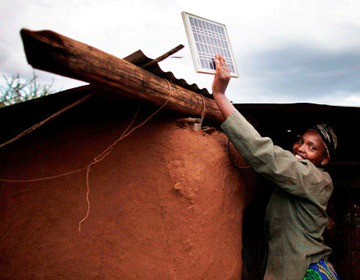
 Beyond Fossil Fuels African Huts Far From the Grid Glow With Renewable Power – NYTimes.com, by Elisabeth Rosenthal 27 Dec 10, “………As small-scale renewable energy becomes cheaper, more reliable and more efficient, it is providing the first drops of modern power to people who live far from slow-growing electricity grids and fuel pipelines in developing countries. Although dwarfed by the big renewable energy projects that many industrialized countries are embracing to rein in greenhouse gas emissions, these tiny systems are playing an epic, transformative role.
Since Ms. Ruto hooked up the system, her teenagers’ grades have improved because they have light for studying. The toddlers no longer risk burns from the smoky kerosene lamp. And each month, she saves $15 in kerosene and battery costs — and the $20 she used to spend on travel.
In fact, neighbors now pay her 20 cents to charge their phones, although that business may soon evaporate: 63 families in Kiptusuri have recently installed their own solar power systems……….
There is no reliable data on the spread of off-grid renewable energy on a small scale, in part because the projects are often installed by individuals or tiny nongovernmental organizations.
But Dana Younger, senior renewable energy adviser at the International Finance Corporation, the World Bank Group’s private lending arm, said there was no question that the trend was accelerating. “It’s a phenomenon that’s sweeping the world; a huge number of these systems are being installed,” Mr. Younger said.
With the advent of cheap solar panels and high-efficiency LED lights, which can light a room with just 4 watts of power instead of 60, these small solar systems now deliver useful electricity at a price that even the poor can afford, he noted. “You’re seeing herders in Inner Mongolia with solar cells on top of their yurts,” Mr. Younger said.
In Africa, nascent markets for the systems have sprung up in Ethiopia, Uganda, Malawi and Ghana as well as in Kenya, said Francis Hillman, an energy entrepreneur who recently shifted his Eritrea-based business, Phaesun Asmara, from large solar projects financed by nongovernmental organizations to a greater emphasis on tiny rooftop systems.
In addition to these small solar projects, renewable energy technologies designed for the poor include simple subterranean biogas chambers that make fuel and electricity from the manure of a few cows, and “mini” hydroelectric dams that can harness the power of a local river for an entire village.
Yet while these off-grid systems have proved their worth, the lack of an effective distribution network or a reliable way of financing the start-up costs has prevented them from becoming more widespread.
Just a few years ago, Mr. Maina said, “solar lights” were merely basic lanterns, dim and unreliable.
“Finally, these products exist, people are asking for them and are willing to pay,” he said. “But we can’t get supply.” He said small African organizations like his do not have the purchasing power or connections to place bulk orders themselves from distant manufacturers, forcing them to scramble for items each time a shipment happens to come into the country.
Part of the problem is that the new systems buck the traditional mold, in which power is generated by a very small number of huge government-owned companies that gradually extend the grid into rural areas. Investors are reluctant to pour money into products that serve a dispersed market of poor rural consumers because they see the risk as too high.
“There are many small islands of success, but they need to go to scale,” said Minoru Takada, chief of the United Nations Development Program’s sustainable energy program. “Off-grid is the answer for the poor. But people who control funding need to see this as a viable option.”
Even United Nations programs and United States government funds that promote climate-friendly energy in developing countries hew to large projects like giant wind farms or industrial-scale solar plants that feed into the grid. A $300 million solar project is much easier to finance and monitor than 10 million home-scale solar systems in mud huts spread across a continent.
As a result, money does not flow to the poorest areas. Of the $162 billion invested in renewable energy last year, according to the United Nations, experts estimate that $44 billion was spent in China, India and Brazil collectively, and $7.5 billion in the many poorer countries.
Only 6 to 7 percent of solar panels are manufactured to produce electricity that does not feed into the grid; that includes systems like Ms. Ruto’s and solar panels that light American parking lots and football stadiums.
Still, some new models are emerging. Husk Power Systems, a young company supported by a mix of private investment and nonprofit funds, has built 60 village power plants in rural India that make electricity from rice husks for 250 hamlets since 2007.
In Nepal and Indonesia, the United Nations Development Program has helped finance the construction of very small hydroelectric plants that have brought electricity to remote mountain communities. Morocco provides subsidized solar home systems at a cost of $100 each to remote rural areas where expanding the national grid is not cost-effective.
What has most surprised some experts in the field is the recent emergence of a true market in Africa for home-scale renewable energy and for appliances that consume less energy. As the cost of reliable equipment decreases, families have proved ever more willing to buy it by selling a goat or borrowing money from a relative overseas, for example.
In Kenya, Huts Far Off the Grid Harness the Sun – NYTimes.com
1 Comment »
Leave a comment
1 This Month

of the week – Shut Down Drone Warfare!


Tell the Ukrainian Government to Drop Prosecution of Peace Activist Yurii Sheliazhenko

Petition to revoke the licensing of the Near Surface Nuclear Disposal Facility (NSDF) at Chalk River. https://www.ourcommons.ca/petitions/en/Petition/Details?Petition=e-7247
To see nuclear-related stories in greater depth and intensity – go to https://nuclearinformation.wordpress.com
-
Archives
- March 2026 (237)
- February 2026 (268)
- January 2026 (308)
- December 2025 (358)
- November 2025 (359)
- October 2025 (376)
- September 2025 (257)
- August 2025 (319)
- July 2025 (230)
- June 2025 (348)
- May 2025 (261)
- April 2025 (305)
-
Categories
- 1
- 1 NUCLEAR ISSUES
- business and costs
- climate change
- culture and arts
- ENERGY
- environment
- health
- history
- indigenous issues
- Legal
- marketing of nuclear
- media
- opposition to nuclear
- PERSONAL STORIES
- politics
- politics international
- Religion and ethics
- safety
- secrets,lies and civil liberties
- spinbuster
- technology
- Uranium
- wastes
- weapons and war
- Women
- 2 WORLD
- ACTION
- AFRICA
- Atrocities
- AUSTRALIA
- Christina's notes
- Christina's themes
- culture and arts
- Events
- Fuk 2022
- Fuk 2023
- Fukushima 2017
- Fukushima 2018
- fukushima 2019
- Fukushima 2020
- Fukushima 2021
- general
- global warming
- Humour (God we need it)
- Nuclear
- RARE EARTHS
- Reference
- resources – print
- Resources -audiovicual
- Weekly Newsletter
- World
- World Nuclear
- YouTube
-
RSS
Entries RSS
Comments RSS
 nuclear-news
Decentralizing the power grid through sustainable technology is essential to long term resource security for all nations. If we could simply turn the vast oil machine into a machine driving sustainable technologies then a vast tide of resource abundance and opportunity would wash over the face of the earth instead of the scarcity and fear that we rise in now.
MacKenzie Stout
CEO
http://www.GridWideNews.com