Desert solar farms could use self-cleaning solar panels
The researchers found that 90 percent of deposited dust can be removed by the transparent screen in fewer than 60 seconds.
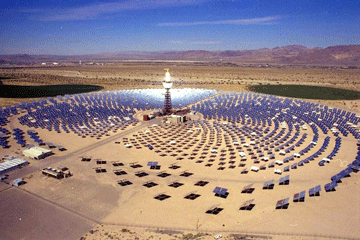
Self-cleaning solar panels could find use in the dusty environs of Arizona, the Middle East or Mars, Scientific American, By Larry Greenemeier, Aug 22, 2010, The best places to collect solar energy are also some of the dustiest on Earth and beyond, a quandary that leads to inefficiencies in how well the cells are able to convert strong sunlight into renewable electricity. The solution, according to new research, is to coat solar cells with material that enables them to chase away dirt particles on their own with the help of dust-repelling electrical charges.
A dust layer of 4 grams per square meter can decrease solar power conversion by 40 percent, says Malay Mazumder, a research professor in Boston University’s Department of Electrical and Computer Engineering. To put this in perspective, dust deposition in Arizona is about 17 grams per square meter per month, and the situation is worse in many other solar-friendly sites, including the Middle East, Australia and India. Mazumder, who led the study, presented the results Sunday at the 240th National Meeting of the American Chemical Society (ACS).
The electrodynamic transparent screen developed by Mazumder and his colleagues is made by depositing a transparent, electrically sensitive material—indium tin oxide (ITO)—on glass or a clear plastic sheet covering the solar panels. When energized, the electrodes produce a traveling wave of electrostatic and dielectrophoretic forces that lift dust particles from the surface and transport them to the screen’s edges. The researchers found that 90 percent of deposited dust can be removed by the transparent screen in fewer than 60 seconds.This works in part because many solar panels are positioned at an angle—the raised dust would simply fall off. Whereas solar panels are generally placed in dry, open spaces, the researchers are hoping to make their technique and technology also work to keep raindrops and mud from adhering to solar panel surfaces as well…………
Future generations of dust-proof solar panels are likely to have electrodes embedded in their glass surfaces. These electrodes, like the original filters, would be powered by the solar cell itself, so they would have to operate using very little energy. Sensors would monitor dust levels on the surface of the panel and energize the surface when dust concentration reached a critical level.
1 Comment »
Leave a comment
1 This Month

of the week – Shut Down Drone Warfare!


Tell the Ukrainian Government to Drop Prosecution of Peace Activist Yurii Sheliazhenko

Petition to revoke the licensing of the Near Surface Nuclear Disposal Facility (NSDF) at Chalk River. https://www.ourcommons.ca/petitions/en/Petition/Details?Petition=e-7247
To see nuclear-related stories in greater depth and intensity – go to https://nuclearinformation.wordpress.com
-
Archives
- March 2026 (244)
- February 2026 (268)
- January 2026 (308)
- December 2025 (358)
- November 2025 (359)
- October 2025 (376)
- September 2025 (257)
- August 2025 (319)
- July 2025 (230)
- June 2025 (348)
- May 2025 (261)
- April 2025 (305)
-
Categories
- 1
- 1 NUCLEAR ISSUES
- business and costs
- climate change
- culture and arts
- ENERGY
- environment
- health
- history
- indigenous issues
- Legal
- marketing of nuclear
- media
- opposition to nuclear
- PERSONAL STORIES
- politics
- politics international
- Religion and ethics
- safety
- secrets,lies and civil liberties
- spinbuster
- technology
- Uranium
- wastes
- weapons and war
- Women
- 2 WORLD
- ACTION
- AFRICA
- Atrocities
- AUSTRALIA
- Christina's notes
- Christina's themes
- culture and arts
- Events
- Fuk 2022
- Fuk 2023
- Fukushima 2017
- Fukushima 2018
- fukushima 2019
- Fukushima 2020
- Fukushima 2021
- general
- global warming
- Humour (God we need it)
- Nuclear
- RARE EARTHS
- Reference
- resources – print
- Resources -audiovicual
- Weekly Newsletter
- World
- World Nuclear
- YouTube
-
RSS
Entries RSS
Comments RSS
 nuclear-news
Recent years have seen tremendous focus on renewable energy in the US. Emphasis has been on wind and solar energy and a lot of attention seems to have been concentrated on the desert areas of Southern California. With millions of acres of sandy area, the Mojave and Colorado deserts offer an ideal opportunity for huge wind and solar farms. Interestingly, the US government too has put its final stamp on a number of projects, many of them are being fast tracked, and California is now poised to become the solar energy capital of the world. But while a lot of attention is being laid on generating energy from renewable sources and much revenue is being funneled towards it, is putting up solar and wind farms all it takes to reduce our dependence on fossil fuel, many would think not.