Decentralised Solar Energy – 10 Million Solar Roofs
Here’s how the Ten Million Solar Roofs Act works: take the example of a homeowner who decides to install a 5-kilowatt solar system which, depending on location, would produce enough electricity to cover most, if not all, of an average electric bill (the solar panels would produce excess power during the day that can be sold back to the utility, covering some or all of the cost of electricity when the sun is not shining).
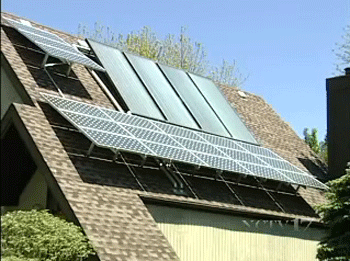
Here Comes the Sun: Ten Million Solar Rooftops, Renewable Energy World, by Greg Chafee : July 21, 2010 “……Today 92% of Americans want our country to develop solar energy resources, and 77% believe the federal government should make solar power development a national priority.
Despite the recession, new U.S. solar installations are rising, as are new jobs and new economic growth. Data from the Solar Energy Industries Association show that total U.S. solar electric capacity from photovoltaic and concentrating solar power technologies climbed past 2,000 megawatts (MW) in 2009. Solar industry revenues also surged despite the economy, climbing 36%. Another sign of optimism is that venture capitalists invested more in solar than any other clean technology in 2009 – over $1.4 billion. For an industry with a total U.S. volume of $4 billion, that signals huge optimism about near-term growth.
The solar industry accounts for about 46,000 jobs in the U.S., and is expected to rise to 60,000 by the end of 2010. North Carolina, a state that has embraced renewable energy development, projects that as many as 28,000 new jobs and a 10 million ton reduction in greenhouse gas emissions will be achieved by 2030 if the state can draw 14% of its electricity from solar sources……
Here’s how the Ten Million Solar Roofs Act works: take the example of a homeowner who decides to install a 5-kilowatt solar system which, depending on location, would produce enough electricity to cover most, if not all, of an average electric bill (the solar panels would produce excess power during the day that can be sold back to the utility, covering some or all of the cost of electricity when the sun is not shining). That system today costs roughly $35,000 to purchase and install. The federal tax credit of 30% reduces the system cost to $24,500. Most states offer additional tax incentives. For example, if a homeowner could get an additional rebate of $1.75 per watt, the system cost is now reduced to $15,750.
The Ten Million Solar Roofs Act would provide an additional rebate of as much as $1.75 per watt, covering up to 50% of the remaining cost. The result: the consumer now pays $7,875 for the solar system. That’s pretty attractive for a family that plans to stay in its home or wants to increase its home value or a small business looking to stabilize its energy costs. Plus, our nation would benefit by reducing expensive construction of new power plants and lowering health care and other costs associated with air and water pollution from fossil fuels.
Here Comes the Sun: Ten Million Solar Rooftops | Renewable Energy World
No comments yet.
1 This Month
Chernobyl: The Lost Tapes – A good documentary on Chernobyl on SBS available On Demand for the next 3 weeks– https://www.sbs.com.au/ondemand/tv-program/chernobyl-the-lost-tapes/2352741955560

of the week–London Campaign for Nuclear Disarmament

Tell the Ukrainian Government to Drop Prosecution of Peace Activist Yurii Sheliazhenko
To see nuclear-related stories in greater depth and intensity – go to https://nuclearinformation.wordpress.com
-
Archives
- April 2026 (126)
- March 2026 (251)
- February 2026 (268)
- January 2026 (308)
- December 2025 (358)
- November 2025 (359)
- October 2025 (376)
- September 2025 (257)
- August 2025 (319)
- July 2025 (230)
- June 2025 (348)
- May 2025 (261)
-
Categories
- 1
- 1 NUCLEAR ISSUES
- business and costs
- climate change
- culture and arts
- ENERGY
- environment
- health
- history
- indigenous issues
- Legal
- marketing of nuclear
- media
- opposition to nuclear
- PERSONAL STORIES
- politics
- politics international
- Religion and ethics
- safety
- secrets,lies and civil liberties
- spinbuster
- technology
- Uranium
- wastes
- weapons and war
- Women
- 2 WORLD
- ACTION
- AFRICA
- Atrocities
- AUSTRALIA
- Christina's notes
- Christina's themes
- culture and arts
- Events
- Fuk 2022
- Fuk 2023
- Fukushima 2017
- Fukushima 2018
- fukushima 2019
- Fukushima 2020
- Fukushima 2021
- general
- global warming
- Humour (God we need it)
- Nuclear
- RARE EARTHS
- Reference
- resources – print
- Resources -audiovicual
- Weekly Newsletter
- World
- World Nuclear
- YouTube
-
RSS
Entries RSS
Comments RSS
 nuclear-news
Leave a comment