Short term approach to nuclear wastes masks reality of the problem
as the world’s nuclear military powers are discovering the costs continue after the submarines and power stations have been decommissioned from active service. The equipment and reactors cannot easily or cheaply be dismantled and will remain radioactive for hundreds of years
Nuclear and radioactive waste disposal – by Patrick Boniface – Helium, 30 May 2010, Nuclear waste is dangerously toxic, its environmental impact if released would be devastating, as was witnessed during both the Chernobyl explosion, the American Three Mile Island scare and the Windscale fire of 1957.In these cases radioactive material was released into the atmosphere. With the Windscale fire some 15,000 terabequerels (TBq) of radioactive material (notably Iodine-131) were released (3).
A report compiled by Crick & Linsley in 1983 estimated that 260 people would eventually die from dieases, such as thyroid cancers, related to the release of the material during the fire, (4).
Other aspects that environmentalist’s voice concerns over include the storage of spent nuclear fuels, from commercial nuclear reactors and increasingly from redundant nuclear warships such as submarines.
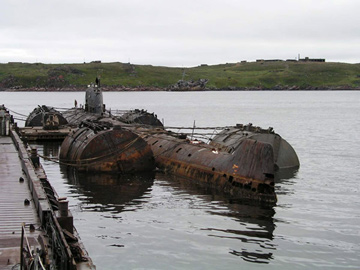
In particular in the former Soviet Union around the submarine base of Arkangel in Northern Russia there are around sixty nuclear submarines that are rotting away but still with large amounts of nuclear material contained within their hulls.
The Russian economy is unable to afford the costs of de-commissioning these submarines. The cost of decommissioning is between $100-300 million per submarine (5).
The cost of decontaminating the area after a nuclear explosion would in comparison be astronomical. Similar numbers of submarines exist within the American, French fleets whilst in the UK, the Royal Navy is trying to dispose of eleven redundant nuclear submarines (5).
Spent nuclear fuel is also causing concerns for residents that border the Irish Sea. The fuel is reprocessed at Sellafield in Cumbria and, although, flatly denied by the press department, the Irish Sea is one of the most radioactive in the world from discharges into the sea from the site in Cumbria…….
The problem, however, is that all the processes and ideas to curb the impact of radioactivity have a short term approach which is the complete opposite to the problem. With long half life’s radioactive materials will remain hazardous for up to thousands of years, much longer than is currently planned for…….
Nuclear power stations cost billions of pounds to design, plan, construct and operate. Furthermore, as the world’s nuclear military powers are discovering the costs continue after the submarines and power stations have been decommissioned from active service. The equipment and reactors cannot easily or cheaply be dismantled and will remain radioactive for hundreds of years. Nuclear and radioactive waste disposal – by Patrick Boniface – Helium
No comments yet.
1 This Month


Tell the Ukrainian Government to Drop Prosecution of Peace Activist Yurii Sheliazhenko

Petition to revoke the licensing of the Near Surface Nuclear Disposal Facility (NSDF) at Chalk River. https://www.ourcommons.ca/petitions/en/Petition/Details?Petition=e-7247


of the week – STOP SMALL MODULAR REACTORS IN CANADA
To see nuclear-related stories in greater depth and intensity – go to https://nuclearinformation.wordpress.com
-
Archives
- March 2026 (183)
- February 2026 (268)
- January 2026 (308)
- December 2025 (358)
- November 2025 (359)
- October 2025 (376)
- September 2025 (258)
- August 2025 (319)
- July 2025 (230)
- June 2025 (348)
- May 2025 (261)
- April 2025 (305)
-
Categories
- 1
- 1 NUCLEAR ISSUES
- business and costs
- climate change
- culture and arts
- ENERGY
- environment
- health
- history
- indigenous issues
- Legal
- marketing of nuclear
- media
- opposition to nuclear
- PERSONAL STORIES
- politics
- politics international
- Religion and ethics
- safety
- secrets,lies and civil liberties
- spinbuster
- technology
- Uranium
- wastes
- weapons and war
- Women
- 2 WORLD
- ACTION
- AFRICA
- Atrocities
- AUSTRALIA
- Christina's notes
- Christina's themes
- culture and arts
- Events
- Fuk 2022
- Fuk 2023
- Fukushima 2017
- Fukushima 2018
- fukushima 2019
- Fukushima 2020
- Fukushima 2021
- general
- global warming
- Humour (God we need it)
- Nuclear
- RARE EARTHS
- Reference
- resources – print
- Resources -audiovicual
- Weekly Newsletter
- World
- World Nuclear
- YouTube
-
RSS
Entries RSS
Comments RSS
 nuclear-news
Leave a comment