Future for U.S. Nuclear power industry really is doubtful
 Problematically, the Nuclear Regulatory Commission has a policy that does not require newer designs to be substantially safer than old designs,
Where Is Nuclear Power Really Heading?A Look at Obama’s Call for New Nuclear and the Reactors that Might Be Built by solveclimate Dave Levitan – Feb 5th, 2010 “…..Energy Secretary Steven Chu and the president are making it clear that they intend to move forward. Thus, the question arises: After more than a decade without any new nuclear plants being built in the U.S., what exactly would new nuclear power look like?
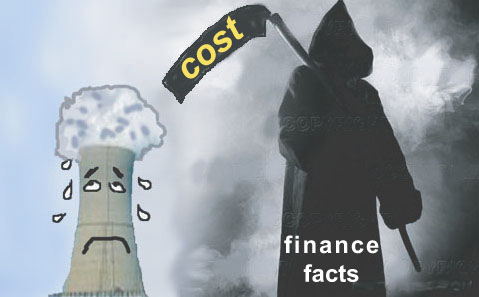
Slowed Momentum, Escalating Costs….
attempts to build new nuclear reactors have been stymied by skyrocketing cost estimates. In the most visible of those disputes, CPS Energy is suing NRG Energy and Toshiba for misleading officials on the cost of a reactor to be built near San Antonio, Texas. The cost estimates rose by about $4 billion from an initial estimate of $5.4 billion.
Such issues certainly call into question whether or not the $54.5 billion in loan guarantees that the Obama budget requests could really support the construction of 7 to 10 new reactors, as Chu asserted in budget discussions this week…
n order to maintain the current share of electricity generation into the future, many more than just those 7 to 10 reactors would need to be built, he said.
Are New Plants Really That New?
Mixed in with all the recent discussion of “restarting” the U.S. nuclear program is the assumption — as stated directly in Obama’s speech — that all these new reactors will be a next-generation fleet.
According to Lyman, the reactors currently proposed and those with even mild potential to be built within a decade involve only a few designs that are “just evolutionary variants of the current generation.”
All of the reactor designs still involve pressurized water or boiling water cooling mechanisms, and there have been no major breakthroughs in methods to reduce waste or improve energy output, Lyman said. He said the one major difference from currently active plants is that the proposed reactors will likely be bigger,…………Lyman says that the only major area for improvements in soon-to-be-built reactors is in their degree of safety. Problematically, the Nuclear Regulatory Commission has a policy that does not require newer designs to be substantially safer than old designs, Lyman says. This can put reactors that incorporate extra safety features at a competitive disadvantage: They just cost more…………
No comments yet.
1 This Month

of the week – Shut Down Drone Warfare!


Tell the Ukrainian Government to Drop Prosecution of Peace Activist Yurii Sheliazhenko

Petition to revoke the licensing of the Near Surface Nuclear Disposal Facility (NSDF) at Chalk River. https://www.ourcommons.ca/petitions/en/Petition/Details?Petition=e-7247
To see nuclear-related stories in greater depth and intensity – go to https://nuclearinformation.wordpress.com
-
Archives
- March 2026 (244)
- February 2026 (268)
- January 2026 (308)
- December 2025 (358)
- November 2025 (359)
- October 2025 (376)
- September 2025 (257)
- August 2025 (319)
- July 2025 (230)
- June 2025 (348)
- May 2025 (261)
- April 2025 (305)
-
Categories
- 1
- 1 NUCLEAR ISSUES
- business and costs
- climate change
- culture and arts
- ENERGY
- environment
- health
- history
- indigenous issues
- Legal
- marketing of nuclear
- media
- opposition to nuclear
- PERSONAL STORIES
- politics
- politics international
- Religion and ethics
- safety
- secrets,lies and civil liberties
- spinbuster
- technology
- Uranium
- wastes
- weapons and war
- Women
- 2 WORLD
- ACTION
- AFRICA
- Atrocities
- AUSTRALIA
- Christina's notes
- Christina's themes
- culture and arts
- Events
- Fuk 2022
- Fuk 2023
- Fukushima 2017
- Fukushima 2018
- fukushima 2019
- Fukushima 2020
- Fukushima 2021
- general
- global warming
- Humour (God we need it)
- Nuclear
- RARE EARTHS
- Reference
- resources – print
- Resources -audiovicual
- Weekly Newsletter
- World
- World Nuclear
- YouTube
-
RSS
Entries RSS
Comments RSS
 nuclear-news
Leave a comment