Financial connections between U.S. politicians and the nuclear lobby
Lobbying, global warming portend nuclear comeback
McClatchy By Judy Pasternak | Investigative Reporting Workshop January 24, 2010
“………….BRIDGES TO CONGRESS, WHITE HOUSEThese constituencies are important to the party that’s in power. Disclosure records show that the industry deftly kept its traditional base among Senate Republicans — who want 100 new nuclear units even if the climate bill fails — while building bridges to Democrats in both houses.
Clyburn is one example, receiving about $195,600 from nuclear energy companies and affiliated unions since 2000, $187,000 of that in the last two election cycles. The Nuclear Energy Institute contributed at least $10,000 to Clyburn’s scholarship foundation, and nuclear interests spent more than $30,000 for two six-day trips for Clyburn and his wife. One was to inspect nuclear facilities in France, and the other in the United Kingdom. He also owns stock valued at $15,000 to $50,000 in SCANA Corp., a South Carolina company that’s applied to build two reactors.
Clyburn has become a key ambassador for the industry, making ample use of its surrogate network. He quoted CASEnergy’s Moore approvingly in an opinion column he wrote and in a keynote speech to a convention of Ayers’ building trades group.
He arranged a session on nuclear power for the Congressional Black Caucus. Nuclear energy is so high on Clyburn’s agenda that he made a point of attending Senate confirmation hearings for Steven Chu, Obama’s energy secretary. When Chu spoke favorably about nuclear fission as a source of electricity, Clyburn concluded that “Obama is not anti-nuclear or he would not have nominated Chu.”
In an interview, Clyburn said he could report progress. Four congressional Democrats from New York, he said, are moving in his direction on nuclear power. Carol Browner, the Obama administration’s energy czar and a former head of the EPA, told him that it would be inconsistent to worry about global warming and dismiss nuclear power. He raised the issue at a congressional lunch with Obama and said he left feeling reassured.
The industry is plugged in on its own at the White House through labor groups and Exelon. Exelon CEO John W. Rowe is the Nuclear Energy Institute’s past chairman and a current director.
The company, based in the president’s home state of Illinois, has funded Obama’s campaigns since his Senate run, when employees contributed more than $48,000, according to CQ Moneyline, and Exelon’s political action committee gave the maximum of $10,000. Exelon employees gave Obama nearly $210,000 for his presidential campaign, according to CQ Moneyline.
Exelon’s management includes two Obama bundlers who are friends of the president. One, director John W. Rogers, helped direct Obama’s Illinois fundraising during his presidential race and helped plan the inauguration. The other, Frank M. Clark, has lobbied on nuclear issues for the company.
White House Chief of Staff Rahm Emanuel is close to Exelon, too. The merger that created the utility was the biggest deal of Emanuel’s brief but lucrative investment-banking career. Another White House connection is strategist David Axelrod, whom Exelon subsidiary ComEd once hired to create a fake grass-roots organization supporting higher electricity rates.
Exelon lobbyist David Brown said that the company had applied for the federal loan guarantees, but it didn’t make the cut for the first round. Exelon hasn’t contacted its high-level White House friends, he added.
HELP WANTED FROM WASHINGTON
The nuclear wish list is controversial. Electric utilities want more than $100 billion in guarantees for construction that’s expected to cost $200 billion. The Nuclear Energy Institute contends that the guarantees wouldn’t cost taxpayers a dime because the recipients would pay fees that should cover the cost of defaults, much the way that auto insurers cover the cost of accidents with premiums paid by safe drivers. However, the Congressional Budget Office concluded in 2003 that the risk of default on a nuclear loan would be “very high — well above 50 percent.”
Critics of nuclear power say these sums would divert resources from other low-carbon sources of electricity that don’t have nuclear’s safety or waste issues. These include wind, solar, biomass and geothermal generators. The clean energy bank as proposed would “be a big nuclear-coal slush fund,” charged Michele Boyd, who lobbies for Physicians for Social Responsibility. Carbon capture for coal and nuclear construction are so expensive that there would be little left over for renewables, she thinks.
Even some advocates of new reactors say that utilities should find private financing without involving taxpayers.
“It’s a proven technology. Kick back the government and let industry get about the business of building reactors,” said Jack Spencer, an analyst for the conservative Heritage Foundation, a research center in Washington.
There are other options, too, for generating more nuclear electricity. By upgrading its existing reactors, Exelon expects to gain an additional 1,300 to 1,500 megawatts of capacity. That’s about what a new reactor could produce for significantly less money — a total of $3.5 billion. No loan guarantees are needed for these projects, said Marshall Murphy, a spokesman for Exelon’s nuclear division.
Clyburn, however, said the nuclear industry deserved help. A former employment counselor, he finds the jobs argument convincing, and he’s unimpressed by local opponents who argue that the seven plants in his home state are unsafe: “Every time I talk to somebody about the dangers, they go back to Three Mile Island,” he said. “In fact, Three Mile Island did not fail. . . . That process worked. So what’s the deal?”
Most of all, Clyburn said, he wonders how the U.S. will generate electricity in the future. “I just woke up one day and said, ‘Where are you gonna get it?’ ” he recalled.
There’s no telling whether the industry’s expensive effort will succeed. Witness the fate of the full-court press a week after Obama’s inauguration.
Sen. Robert Bennett, R-Utah, who received $56,000 in nuclear-interest donations from 1999 to 2008, pitched the addition of $50 billion in loan guarantees for the nuclear power industry to the economic stimulus bill. Sen. Byron Dorgan, D-N.D., allowed it; he chairs the energy appropriations subcommittee and has received $190,000 in industry contributions since 1999, nearly half of that in 2007-2008. Although nuclear power plants starting a multi-year licensing process are hardly “shovel-ready,” “You take the vehicles you can get,” Bennett said in an interview.
The full Senate included the money, but critics protested and the House insisted on removing the loan guarantees from the final version of the bill.
Obama stayed out of the fight. “The president is a very smart guy,” Clyburn said. “The Energy Department hadn’t given out the (Bush-era loan guarantees of) $18.5 billion. Why tie up $50 billion?”
Since then, Chu has announced talks with four finalists for those guarantees. “That $18.5 billion can only cover three or four, but no more,” he told the House energy appropriations subcommittee in June.
He’d be back to ask for more, he added.
Lobbying, global warming portend nuclear comeback | McClatchy
No comments yet.
1 This Month
To see nuclear-related stories in greater depth and intensity – go to https://nuclearinformation.wordpress.com/
12 February – Webinar The Big Push: New Nuclear Projects in Canada
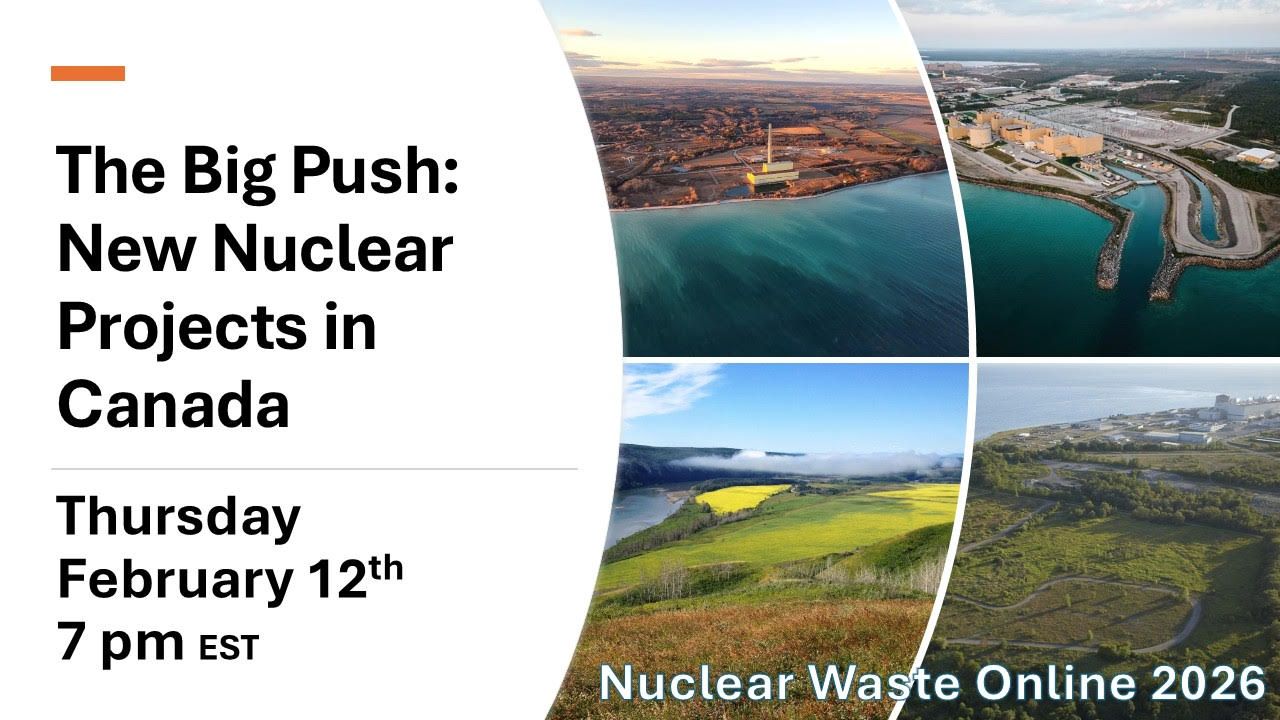
Thursday, February 12, 7 pm Eastern | 2nd of 4 sessions in the 2026 Nuclear Waste Online webinar series
Join a webinar on the push for new nuclear generation in Canada. Go to Northwatch.org to register or use the registration link https://us02web.zoom.us/webinar/register/WN_ZfWOf1GITqSRIZX8CB-A9w
-
Archives
- February 2026 (127)
- January 2026 (308)
- December 2025 (358)
- November 2025 (359)
- October 2025 (376)
- September 2025 (258)
- August 2025 (319)
- July 2025 (230)
- June 2025 (348)
- May 2025 (261)
- April 2025 (305)
- March 2025 (319)
-
Categories
- 1
- 1 NUCLEAR ISSUES
- business and costs
- climate change
- culture and arts
- ENERGY
- environment
- health
- history
- indigenous issues
- Legal
- marketing of nuclear
- media
- opposition to nuclear
- PERSONAL STORIES
- politics
- politics international
- Religion and ethics
- safety
- secrets,lies and civil liberties
- spinbuster
- technology
- Uranium
- wastes
- weapons and war
- Women
- 2 WORLD
- ACTION
- AFRICA
- Atrocities
- AUSTRALIA
- Christina's notes
- Christina's themes
- culture and arts
- Events
- Fuk 2022
- Fuk 2023
- Fukushima 2017
- Fukushima 2018
- fukushima 2019
- Fukushima 2020
- Fukushima 2021
- general
- global warming
- Humour (God we need it)
- Nuclear
- RARE EARTHS
- Reference
- resources – print
- Resources -audiovicual
- Weekly Newsletter
- World
- World Nuclear
- YouTube
-
RSS
Entries RSS
Comments RSS
 nuclear-news
Leave a comment