AREVA and the nuclear illusion
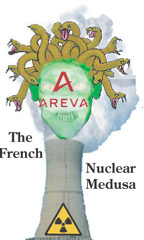 Areva’s difficulties and the nuclear illusion
The View From Brittany June 3 2009Areva is no ordinary company. It is the nuclear arm of the French state, in charge with the building and the supplying of French nuclear plants. Even though it is technically a corporation, it is owned by the Commissariat à l’Énergie Atomique, a public agency whose director is appointed by the French President who has occasionally sold nuclear plants on its behalf.
Areva, supposedly the “jewel” of the French industry is in real troubles. Even though it sells more than ever, its benefits have plummeted and it has been forced to cancel a mining project in Canada. According to the “Réseau Sortir du Nucléaire”, Areva needs 3 billions euros, mostly because of the costly failure the Olkiluoto EPR has proven to be. The Finnish third generation nuclear plant, which should have been put online this year has been delayed due to technical difficulties and costs are sky-rocketing – 5.4 billions instead of the original 3 billions. Moreover, South Africa has recently cancelled the building of 12 nuclear plants while the “sells” announced by the French presidency (4 plants in Italy and 2 in India) remain virtual – nobody know how they are going to be funded.
Areva is presently clamouring for public funds. It will probably get them, no matter how loud we, and others, protest. France, trapped as it is by its own nuclear strategy, simply cannot afford to lose the control of its uranium supply.
That is hardly the whole story, however. What this affair highlight is how problematic is nuclear power at the eve of catabolic collapse. A nuclear plant is very costly and takes a long time to build. Besides, it is of absolutely no use as long as it is not completed. The end result is that to launch a nuclear program you have to immobilize a lot of capital – human, natural and financial – without any hope of anything looking like a return of investment for quite a long time……………………Areva’s difficulties pose, however, another, often overlooked question : what will nuclear plants will become after the nuclear industry fails. In a number of countries, it may happen sooner than one thinks……………….And then what ?
Dismantling a nuclear plant and disposing of the wastes are very costly operation. Will the impoverished societies of forty years from now be able to afford them ? One can seriously doubt it. In fact, in a situation of worsening energy and capital shortage, one can expect them to operate their ageing nuclear plants to very end – the way the Ukrainian government did with Chernobyl – then let them decay away.
The result, needless to say, won’t be good for the neighbourhood,……………. This, by the way, can have interesting geopolitical consequences in countries such as France which are littered with nuclear plants.
The activists who, in the late seventies, have made sure no nuclear plant would ever be built in Brittany may have won their far descendants more than what they thought.
http://theviewfrombrittany.blogspot.com/2009/06/arevas-difficulties-and-nuclear.html
No comments yet.
1 This Month

of the week – Shut Down Drone Warfare!


Tell the Ukrainian Government to Drop Prosecution of Peace Activist Yurii Sheliazhenko

Petition to revoke the licensing of the Near Surface Nuclear Disposal Facility (NSDF) at Chalk River. https://www.ourcommons.ca/petitions/en/Petition/Details?Petition=e-7247
To see nuclear-related stories in greater depth and intensity – go to https://nuclearinformation.wordpress.com
-
Archives
- March 2026 (244)
- February 2026 (268)
- January 2026 (308)
- December 2025 (358)
- November 2025 (359)
- October 2025 (376)
- September 2025 (257)
- August 2025 (319)
- July 2025 (230)
- June 2025 (348)
- May 2025 (261)
- April 2025 (305)
-
Categories
- 1
- 1 NUCLEAR ISSUES
- business and costs
- climate change
- culture and arts
- ENERGY
- environment
- health
- history
- indigenous issues
- Legal
- marketing of nuclear
- media
- opposition to nuclear
- PERSONAL STORIES
- politics
- politics international
- Religion and ethics
- safety
- secrets,lies and civil liberties
- spinbuster
- technology
- Uranium
- wastes
- weapons and war
- Women
- 2 WORLD
- ACTION
- AFRICA
- Atrocities
- AUSTRALIA
- Christina's notes
- Christina's themes
- culture and arts
- Events
- Fuk 2022
- Fuk 2023
- Fukushima 2017
- Fukushima 2018
- fukushima 2019
- Fukushima 2020
- Fukushima 2021
- general
- global warming
- Humour (God we need it)
- Nuclear
- RARE EARTHS
- Reference
- resources – print
- Resources -audiovicual
- Weekly Newsletter
- World
- World Nuclear
- YouTube
-
RSS
Entries RSS
Comments RSS
 nuclear-news
Leave a comment