Uranium: Wealth or Woe?
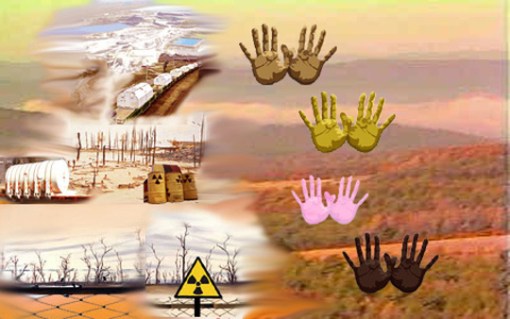
Uranium: Wealth or Woe World Sihk News Gunter Wippel and Norbert Suchanek 26 March 09 Whilst tragic results of the atomic bombs dropped on Hiroshima and Nagasaki are well documented, the environmental and health problems that are a consequence of uranium exploration are less well known by the general global public.
During the development of the atomic bomb, thousands of mines were built in the Southwest of the United States and Northern Canada. The radioactive waste, known as tailings, that builds up in huge piles of rocks and slush outside the mines continues to threaten the wellbeing of local populations and contaminates the environment.
The sad truth is that Governments are fully aware of the dangers but still refuse to implement adequate protection measures.
Uranium is not only radioactive but chemically toxic too. 80% of the radioactivity of the original uranium ore is left behind in highly acidic ‘tailings’. It remains radioactive for hundreds-of-thousands of years and should be kept safely isolated from the environment.
Uranium can cause a wide variety of health problems. Miners and local communities drink contaminated water, eat contaminated food and breathe in radon gas and dust from the tailings. In addition to this, the extraction and processing of uranium ore uses huge amounts of highly sought-after water that cannot be recycled.
It has been argued by mining companies that uranium extraction brings jobs to local populations, thus creating better living conditions, and for a few this was true. However the companies also quietly ignore the health and environmental effects of the process. ……………….After 30 years living alongside uranium mines, the Tuareg of Niger refer to uranium as a ‘curse’ rather than a blessing. They say the North of Niger “suffer[s] from its wealth’, rather than reap supposed rich rewards. ………………………t appears that financial institutions within the country, such as the Bank of Namibia, have found the potential income that mining may bring too attractive to reject. This is despite studies in other African countries that demonstrates only a small percentage of the worth of the resources extracted actually stay in the country.
No comments yet.
1 This Month

of the week – Shut Down Drone Warfare!


Tell the Ukrainian Government to Drop Prosecution of Peace Activist Yurii Sheliazhenko

Petition to revoke the licensing of the Near Surface Nuclear Disposal Facility (NSDF) at Chalk River. https://www.ourcommons.ca/petitions/en/Petition/Details?Petition=e-7247
To see nuclear-related stories in greater depth and intensity – go to https://nuclearinformation.wordpress.com
-
Archives
- March 2026 (237)
- February 2026 (268)
- January 2026 (308)
- December 2025 (358)
- November 2025 (359)
- October 2025 (376)
- September 2025 (257)
- August 2025 (319)
- July 2025 (230)
- June 2025 (348)
- May 2025 (261)
- April 2025 (305)
-
Categories
- 1
- 1 NUCLEAR ISSUES
- business and costs
- climate change
- culture and arts
- ENERGY
- environment
- health
- history
- indigenous issues
- Legal
- marketing of nuclear
- media
- opposition to nuclear
- PERSONAL STORIES
- politics
- politics international
- Religion and ethics
- safety
- secrets,lies and civil liberties
- spinbuster
- technology
- Uranium
- wastes
- weapons and war
- Women
- 2 WORLD
- ACTION
- AFRICA
- Atrocities
- AUSTRALIA
- Christina's notes
- Christina's themes
- culture and arts
- Events
- Fuk 2022
- Fuk 2023
- Fukushima 2017
- Fukushima 2018
- fukushima 2019
- Fukushima 2020
- Fukushima 2021
- general
- global warming
- Humour (God we need it)
- Nuclear
- RARE EARTHS
- Reference
- resources – print
- Resources -audiovicual
- Weekly Newsletter
- World
- World Nuclear
- YouTube
-
RSS
Entries RSS
Comments RSS
 nuclear-news
Leave a comment