A resounding rejection of ‘nuclearism’
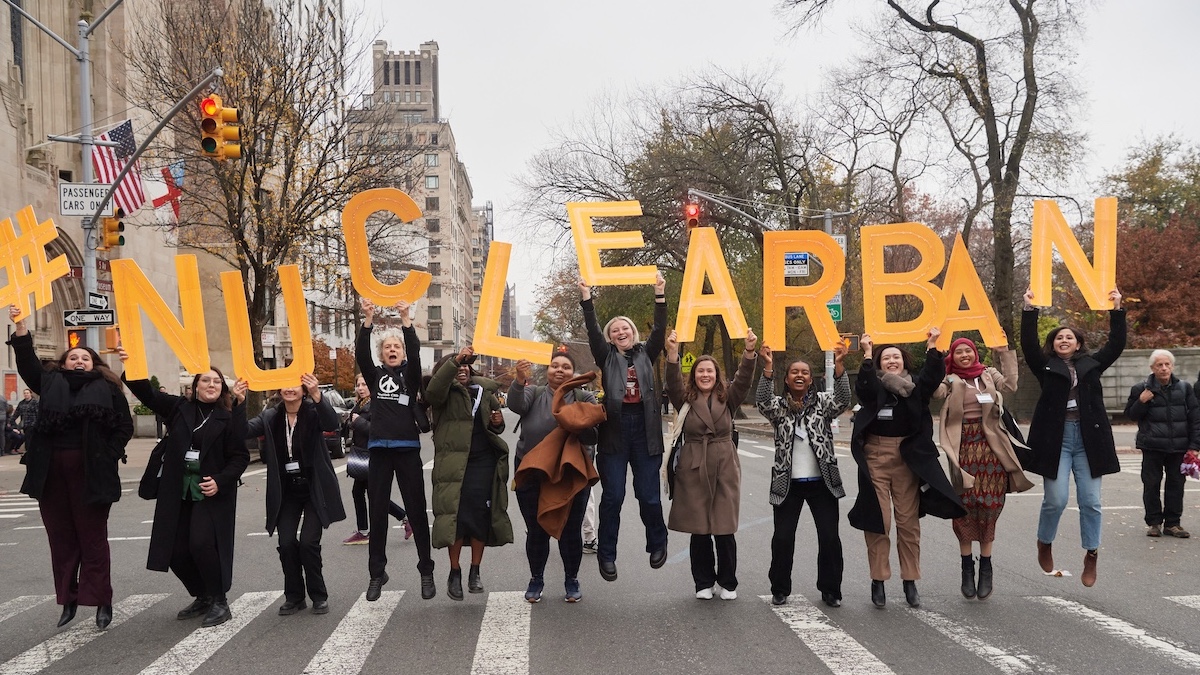
Non-nuclear states gathered in New York are decidedly anti-nuclear in outlook and approach
By Tom Unterrainer, chair, Campaign for Nuclear Disarmament
The non-nuclear majority met in New York between 27 November and 1 December for the Second Meeting of States Parties (2MSP) to the Treaty on the Prohibition of Nuclear Weapons (TPNW). This coming together was not simply ‘non-nuclear’ but decidedly anti-nuclear in outlook and approach.
The TPNW represents many things: a ‘work in progress’, a part of international law, a mechanism for the eventual abolition of nuclear weapons and similar. What it represents politically, at the time of coming into force and since, is a full-frontal rejection of ‘nuclearism’ and a challenge to the nuclear-armed world. 2MSP saw discussion and decision making on how to embed this aspect of the Treaty.
Between 15 and 27 October 1953, the British government carried out ‘Operation Totem’ over an area in Southern Australia. Totem I and Totem II were atmospheric nuclear tests and together with five additional ‘non-critical’ tests, Britain delivered death and catastrophe on the First Nations people inhabiting the area.
These people “felt the ground shaking and the black mist rolling”, as Karina Lester put it on the floor of 2MSP. “We know our lands are poisoned”, she went on, clearly stating that “we want governments to recognise what they have done.”
What the British government did in 1953 was to consign a people and their land to death, destruction and continuing – intergenerational – harm.
The British government has refused to recognise or make recompense for what it did over seventy years ago and recently affirmed that it would not do so now. This roadblock to justice must be challenged, as should the other roadblocks to peace and justice that are erected by nuclear-armed states.
The Campaign for Nuclear Disarmament has been engaged on the question of Britain’s legacy of nuclear colonialism and recently agreed a resolution at our 2023 Policy Conference to enhance this work. The message coming loud and clear from 2MSP is that this aspect of our work is urgently necessary and incredibly important. Even in states like the UK which possess nuclear weapons and which take a hostile approach to the TPNW, the overall message and intent of the Treaty has universal applicability.
The theme of ‘universalisation’ was prominent at 2MSP, with a series a working papers, proposals and speeches made to address the concept. In an early ‘thematic debate’, a representative of the International Committee of the Red Cross outlined some of what this could mean. For example, highlighting and embedding the anti-nuclear consensus that any nuclear use would have an enormous humanitarian impact; being clear that nuclear possession is “not exceptional” and does not stand above and beyond international law…………………………………………………………………………………………….
What is clear is that the Campaign for Nuclear Disarmament can and will play an important role in pressing forward with ‘universalising’ anti-nuclear ideas, including those embodied in the TPNW.
It is also clear – and this is one of the more positive aspects of such international meetings – that CND and our supporters are the representatives of majority non-nuclear and anti-nuclear thinking in the UK. Given Britain’s nuclear-armed status and nuclear alliances, our work – and the work of the TPNW community globally – is as important as ever. https://beyondnuclearinternational.org/2023/12/10/a-resounding-rejection-of-nuclearism/
No comments yet.
1 This Month


Tell the Ukrainian Government to Drop Prosecution of Peace Activist Yurii Sheliazhenko

Petition to revoke the licensing of the Near Surface Nuclear Disposal Facility (NSDF) at Chalk River. https://www.ourcommons.ca/petitions/en/Petition/Details?Petition=e-7247


of the week – STOP SMALL MODULAR REACTORS IN CANADA
To see nuclear-related stories in greater depth and intensity – go to https://nuclearinformation.wordpress.com
-
Archives
- March 2026 (204)
- February 2026 (268)
- January 2026 (308)
- December 2025 (358)
- November 2025 (359)
- October 2025 (376)
- September 2025 (258)
- August 2025 (319)
- July 2025 (230)
- June 2025 (348)
- May 2025 (261)
- April 2025 (305)
-
Categories
- 1
- 1 NUCLEAR ISSUES
- business and costs
- climate change
- culture and arts
- ENERGY
- environment
- health
- history
- indigenous issues
- Legal
- marketing of nuclear
- media
- opposition to nuclear
- PERSONAL STORIES
- politics
- politics international
- Religion and ethics
- safety
- secrets,lies and civil liberties
- spinbuster
- technology
- Uranium
- wastes
- weapons and war
- Women
- 2 WORLD
- ACTION
- AFRICA
- Atrocities
- AUSTRALIA
- Christina's notes
- Christina's themes
- culture and arts
- Events
- Fuk 2022
- Fuk 2023
- Fukushima 2017
- Fukushima 2018
- fukushima 2019
- Fukushima 2020
- Fukushima 2021
- general
- global warming
- Humour (God we need it)
- Nuclear
- RARE EARTHS
- Reference
- resources – print
- Resources -audiovicual
- Weekly Newsletter
- World
- World Nuclear
- YouTube
-
RSS
Entries RSS
Comments RSS
 nuclear-news
Leave a comment